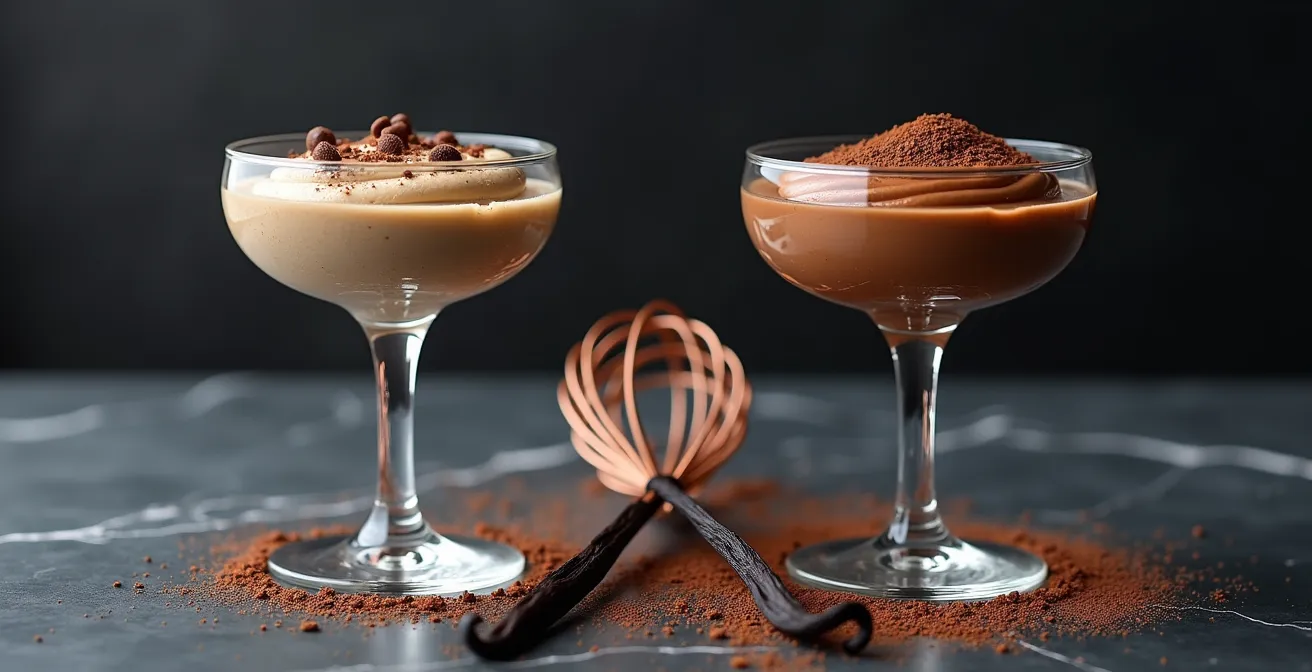
Mastering single-origin chocolate isn’t about the country on the label; it’s about architecting flavour by controlling its specific aromatic and chemical properties.
- The unique notes of a single-origin chocolate are fragile and can be destroyed by minor temperature errors or masked by improper pairing.
- A true “signature” dessert comes from either embracing the purity of one origin or strategically blending several to build calculated complexity.
Recommendation: Stop treating single-origin chocolate as a simple ingredient and start using it as a technical tool to manipulate acidity, texture, and aroma in your desserts.
As a chef, you’ve faced the paradox. You select a “Madagascar Origin” couverture, expecting its celebrated bright, red-fruit acidity to slice through a rich mousse. Yet, the final dessert is flat, muddy, or disappointingly one-dimensional. The promised sensory journey ends before it begins. The common advice—”choose good quality chocolate”—is true, but utterly insufficient. Many believe the magic is simply in the terroir, a romantic notion of soil and climate whispered into the cacao bean. They focus on the origin story, a narrative that sells well but doesn’t always translate to the plate.
This approach overlooks a critical truth: a single-origin chocolate is not a fixed flavour. It is a complex aromatic architecture, a delicate structure of volatile compounds, acids, and fats. Its potential can be unlocked or obliterated by your technique. The real challenge isn’t finding a great origin; it’s understanding its unique chemical blueprint and how to protect, amplify, or balance it within the context of a composed dessert. The difference between a generic chocolate dessert and a signature creation lies not in the bean’s passport, but in the chef’s ability to act as a flavour architect.
But what if the key wasn’t just in the origin, but in understanding the hidden forces that shape its final expression? This guide moves beyond the marketing narrative. We will deconstruct the elements that define a chocolate’s personality—from the smoky notes of volcanic soil to the floral fragility of an Arriba Nacional. We’ll explore how to manipulate acidity, build complexity through blending, and verify the promises of traceability. This is about transforming a premium ingredient from a liability into your most powerful tool for culinary expression.
To navigate this complex world of flavour, this article breaks down the essential strategies and considerations for any chef looking to master single-origin chocolate. We will explore the nuances of terroir, the art of pairing, the science of temperature, and the crucial importance of traceability.
Summary: Why a “Madagascar Origin” Couverture Radically Transforms Your Chocolate Mousse
- Why does the volcanic soil give smoky notes to cacao from Papua New Guinea?
- How to marry the acidity of a Peruvian cacao with exotic fruits without a clash?
- Chocolat d’origine ou Blend maison : lequel privilégier pour une ganache signature ?
- The temperature mistake that destroys the floral notes of an Arriba Nacional
- Problème de traçabilité : comment savoir si votre “Origine Ghana” est vraiment single-origin ?
- When to organize a tasting to perceive the nuances of terroir?
- Why is the term “Trinitario” a guarantee of aromatic balance?
- How can the natural acidity of cocoa balance an overly rich dessert?
Why does the volcanic soil give smoky notes to cacao from Papua New Guinea?
The evocative “smoky” note attributed to cacao from Papua New Guinea is often a case of mistaken identity. While the island’s volcanic soil does impart a distinct mineral and earthy complexity, the prominent smoke flavour is frequently an artefact of the post-harvest process, not a direct expression of the terroir. In many remote regions, growers use wood-fired driers to speed up the drying process during the rainy season. This method can imbue the beans with acrid, phenolic notes of smoke, which are entirely different from the subtle, savory minerality of the soil itself.
Discerning the two is a mark of a true connoisseur. True volcanic terroir contributes notes of iron or a gentle earthiness, a savoury depth that enhances complexity. Smoke from improper drying, conversely, can be harsh and overpowering, tasting “hammy” or like burnt wood. The fermentation process is another critical factor. As research published in Scientific Reports shows, fermentation temperatures reach 45-50°C, a range where crucial flavour precursors are developed. If this process is rushed or poorly managed, it can fail to develop the bean’s inherent character, making the flavour profile more susceptible to being dominated by external factors like smoke from drying.
For a chef, this distinction is paramount. Are you building a dessert around a complex, earthy foundation or are you simply working with a flaw? Understanding this difference allows you to source more effectively and to know whether you are highlighting a genuine signature of the terroir or merely compensating for a processing defect. The goal is to find a cacao where the process has been clean enough to let the unique voice of the soil speak clearly.
How to marry the acidity of a Peruvian cacao with exotic fruits without a clash?
Peruvian cacao, particularly from the Piura region, is prized for its bright, fruity acidity and notes of strawberry or citrus. However, this same characteristic can become a liability when paired incorrectly, creating an aggressive, acidic clash on the palate. The secret to a harmonious pairing lies not in avoiding acidity, but in understanding and managing pH balance. Marrying high-acid chocolate with equally tart fruits like starfruit or under-ripe pineapple is a recipe for disaster, as the combined acidity becomes shrill and unpleasant.
The solution is to think like a flavour architect, using buffers and complementary profiles. Pairing a fruity Peruvian chocolate with a sweet, lower-acid fruit like ripe mango creates a beautiful harmony. The mango’s sweetness mellows the chocolate’s sharpest edges while its tropical notes complement the cacao’s inherent fruitiness. Another advanced technique is to use a fat-based buffer. When pairing with a high-acid fruit like passion fruit, incorporating an element like cream, crème fraîche, or mascarpone into the dessert is key. The fat coats the palate, softening the perception of acidity from both the fruit and the chocolate, and allowing their aromatic qualities to shine through in a smooth, integrated sequence.
This is where visual and textural harmony also plays a role. The vibrant colours of tropical fruits against the deep brown of the chocolate create an irresistible appeal, hinting at the flavour explosion to come.
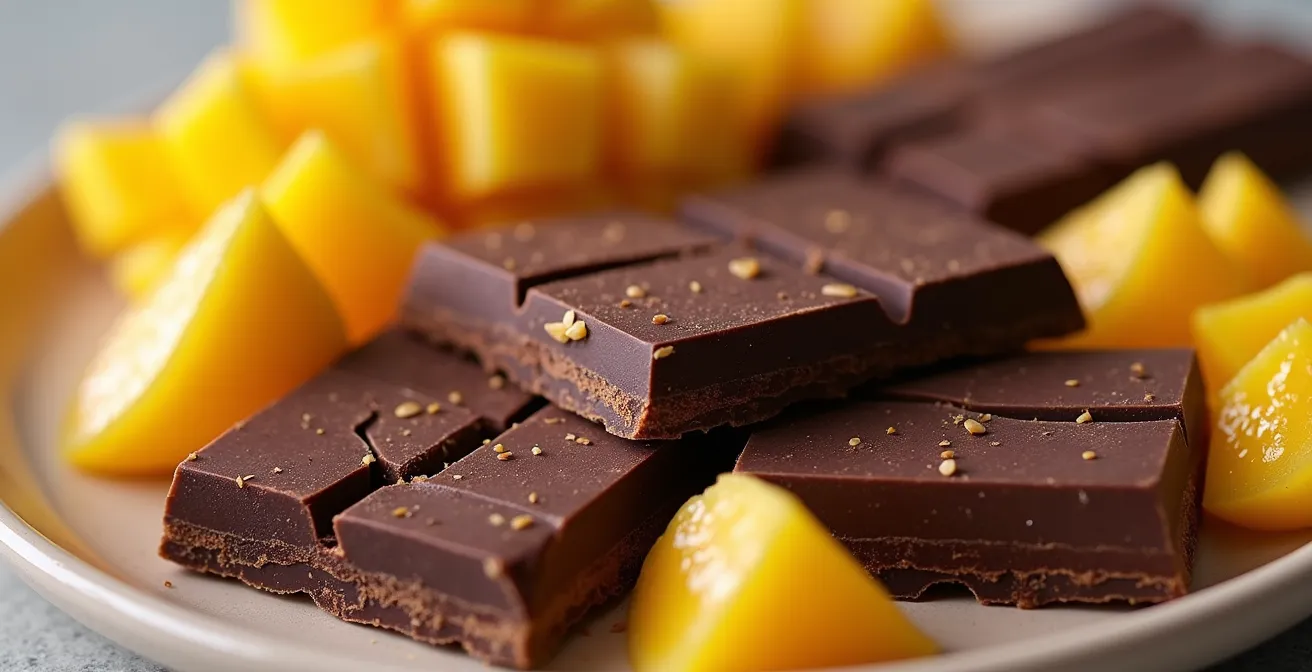
The goal is to create a multi-layered experience where the acidity acts as a point of brightness and lift, not a source of conflict. As this analysis of successful pairings shows, a thoughtful approach to balancing pH and using buffers is what separates a masterful dessert from a jarring failure.
This comparative table, based on common professional pairings, illustrates the critical role of pH balance in creating successful flavour combinations.
| Pairing Type | Chocolate Notes | Fruit Choice | Result | pH Balance |
|---|---|---|---|---|
| Success | Peruvian Piura (strawberry notes) | Sweet mango | Harmonious blend | Balanced 4.5-5.0 |
| Failure | Peruvian high-acid | Tart starfruit | Acidic clash | Too low 3.0-3.5 |
| Success | Peruvian fruity | Passion fruit with cream buffer | Smooth transition | Buffered to 4.0 |
Chocolat d’origine ou Blend maison : lequel privilégier pour une ganache signature ?
The choice between a single-origin chocolate and a house blend for a signature ganache is a fundamental strategic decision. It’s a choice between purity of expression and controlled complexity. Using a single-origin, such as a Madagascar or a Venezuelan Chuao, allows you to showcase a pure, unadulterated flavour profile. The ganache becomes a pedestal for that specific terroir. This approach is powerful when you want to tell a clear, focused story and highlight a very specific set of aromatic notes—the bright red fruits, the nutty undertones, or the delicate florals. However, it also comes with risks: vintage-to-vintage variability can alter your signature flavour, and the very purity of the origin can sometimes feel one-dimensional in a complex application.
Creating a house blend, on the other hand, puts the chef in complete control. You become the architect of the flavour profile, building it from the ground up to achieve a specific, consistent, and often more complex result. This technique allows for a level of artistry and consistency that a single origin cannot always guarantee.
Case Study: The Three-Part Signature Blend
Many professional chocolatiers adopt a three-part structure for their house blends to achieve balance and depth. A typical construction might use a robust Forastero base from Ghana for deep, classic chocolate notes and viscosity. To this, they might add a fruity Trinitario from Madagascar to introduce bright, acidic high notes that lift the profile. Finally, an earthy origin like Papua New Guinea could be added in a smaller quantity to contribute a savoury, complex base note and a long finish. This method allows the chef to create a truly unique flavour that is greater than the sum of its parts and, crucially, to maintain that exact flavour profile year after year by adjusting the ratios of the components.
Ultimately, the decision depends on your objective. If your goal is to educate the palate on the specific character of a single place, the single-origin is your tool. If your goal is to create a unique, inimitable, and perfectly consistent sensory experience that is yours and yours alone, the house blend is your canvas.
The temperature mistake that destroys the floral notes of an Arriba Nacional
Ecuador’s Arriba Nacional cacao is legendary for its delicate, haunting floral notes—a complex bouquet of jasmine, orange blossom, and rose. These aromas are produced by highly volatile organic compounds like linalool and geraniol. Their defining characteristic is also their greatest weakness: fragility. The single most common mistake that erases this signature is improper temperature management during the preparation of a ganache or mousse. Even brief exposure to excessive heat can cause these volatile compounds to evaporate permanently, leaving you with a good, but generic, chocolate flavour, stripped of its extraordinary character.
The critical danger zone for these delicate aromas is surprisingly low. While tempering requires higher temperatures, the infusion process for creams or liquids is where the damage is often done. As scientific research confirms, temperatures between 40-50°C can already begin to degrade these delicate compounds. Bringing a cream to a boil and pouring it over Arriba Nacional chocolate is a guaranteed way to destroy its most precious notes. A far superior method is to gently heat the cream to around 45°C (113°F) before incorporating the chocolate, or even to use a cold infusion method. This involves steeping cacao nibs directly in cold cream for 24-48 hours, then straining. This technique extracts the aromatic compounds without any heat exposure, preserving their integrity completely.
Another related error is thermal shock. Introducing very warm melted chocolate to frozen or very cold elements can cause the aromatic compounds to “lock up,” becoming imperceptible to the palate. The transition in temperature must be gradual. Protecting the floral notes of an Arriba Nacional requires a mindset of preservation. It’s less about cooking and more about gently coaxing the flavour, treating its volatile compounds with the respect they demand. The reward is a dessert that offers a truly transcendent aromatic experience.
Problème de traçabilité : comment savoir si votre “Origine Ghana” est vraiment single-origin ?
The term “Single Origin” on a package of chocolate is a promise of a distinct flavour profile tied to a specific place. However, especially with major cacao-producing nations like Ghana, this promise can be misleading. For decades, the national system involved collecting beans from countless small farms across different regions and mixing them at central collection points. This means a bag labelled “Ghana Origin” is often a blend of terroirs, climates, and farming practices—the very opposite of a true single origin.
As one industry analysis bluntly states, this has been the standard practice for bulk cacao. According to a USDA overview of Ghana’s cocoa sector, beans from disparate regions are often mixed, creating a standardized but generic “Ghana” flavour profile. While the Ghanaian government is making strides with traceability—their new system now covers over 60% of internal purchases—the burden of verification still falls on the discerning chef. A true single origin should, at a minimum, be traceable to a specific region or, ideally, a single cooperative or estate. This is the difference between “single origin” and the more precise “single estate”.
To cut through the ambiguity, you must learn to ask the right questions of your supplier. Don’t settle for “Ghana”; demand specifics. The landscape of Ghanaian cocoa is vast and varied, and a true single-origin chocolate will reflect a specific pocket of that diversity.

Verifying the authenticity of a single-origin claim requires a proactive approach. The following checklist provides a framework for auditing your chocolate’s provenance and ensuring you’re getting the specific terroir you’re paying for.
Action Plan: 5 Key Questions for Verifying True Single-Origin
- What is the name of the specific cooperative or estate the beans are from?
- Which region within the country is it from (e.g., “Ashanti” in Ghana, not just “Ghana”)?
- Can you provide details on the specific harvest year and season for this batch?
- Can you describe the fermentation and drying protocols used by this specific cooperative?
- How does this cooperative’s process differ from the national standard (e.g., COCOBOD in Ghana)?
When to organize a tasting to perceive the nuances of terroir?
For a chef, tasting chocolate should be a structured, analytical exercise, not a casual indulgence. The goal is to deconstruct its flavour architecture to understand how it will perform in a dessert. Organizing specific, targeted tastings is the only way to truly train your palate to perceive the subtle nuances of terroir and process. According to professional cocoa experts like Darin Sukha, there are three essential formats for analytical tasting: vertical, horizontal, and process tastings.
A horizontal tasting is the most common, involving tasting chocolates of the same percentage from different origins side-by-side (e.g., a 70% Madagascar vs. a 70% Ecuador vs. a 70% Peru). This is excellent for understanding the fundamental differences in flavour profiles driven by genetics and terroir. A vertical tasting, on the other hand, involves tasting chocolate from the exact same origin or estate but from different harvest years. This reveals the impact of climate variation—the “vintage” effect—and helps you understand an origin’s consistency. Finally, a process tasting is perhaps the most enlightening for a chef: tasting the same origin at different stages, such as the raw bean, the untempered liquor, and the finished bar. This deconstructs the flavour journey and reveals how each step of the chocolate-making process adds or alters notes.
A tasting of a bar made last week will be sharp and disjointed compared to the same bar tasted 3 months later, when flavors have integrated.
– Victoria Cooksey, Chocolate Connoisseur Magazine
This expert insight highlights another critical factor: time. The flavour of a chocolate bar is not static. It needs time to age and integrate. A tasting organized immediately after receiving a new shipment might not reflect the chocolate’s true potential. Scheduling tastings systematically—when sourcing new origins, when a new harvest arrives, and after letting bars rest for a few months—transforms you from a passive user of chocolate into an active, knowledgeable expert who can predict and control its behaviour.
Why is the term “Trinitario” a guarantee of aromatic balance?
The Trinitario cacao variety is often described as the “best of both worlds,” and for good reason. As a hybrid of the robust, high-yield Forastero and the delicate, flavourful Criollo, Trinitario carries the genetic potential for both deep chocolatey notes and a complex array of fruit and floral aromas. This inherent genetic diversity makes it a natural candidate for aromatic balance. Unlike the often one-dimensional Forastero or the sometimes-fickle Criollo, a well-processed Trinitario can deliver a complete, harmonious flavour profile all on its own.
However, this genetic potential is just that—potential. It is unlocked or squandered during post-harvest processing, particularly fermentation. This stage is where Trinitario’s destiny is forged. Proper fermentation is a delicate dance of time and temperature. As research shows, Trinitario beans require an optimal fermentation period of around 96 hours to fully develop the flavour precursors that will later yield complex notes during roasting. During this time, Maillard reactions between proteins and sugars create the building blocks for a rich, balanced flavour.
Conversely, poor fermentation is disastrous for Trinitario. Under-fermentation fails to break down the polyphenols sufficiently, resulting in a chocolate that is overly bitter and astringent. These harsh notes completely mask the bean’s delicate fruit and floral potential. This explains why two Trinitario chocolates from the same region can taste vastly different; one can be a symphony of flavour, while the other is a cacophony of bitterness. Therefore, while “Trinitario” is a powerful indicator of potential aromatic balance, its guarantee is only fully realized when it is paired with masterful processing. For a chef, sourcing Trinitario from producers known for their meticulous fermentation protocols is non-negotiable.
Key Takeaways
- A chocolate’s flavour is an architecture of terroir, genetics, and processing—not just a single origin.
- Acidity is a tool: use it to cut richness and build complexity, but buffer it with fat or sweetness to avoid clashes.
- Verifying a true single origin requires asking specific questions about the cooperative, region, and processing methods beyond the country name.
How can the natural acidity of cocoa balance an overly rich dessert?
In pastry, richness is often the enemy of satisfaction. A dessert heavy with butter, cream, and sugar can quickly become cloying and one-dimensional. Here, the natural acidity of certain single-origin chocolates becomes a chef’s most powerful tool for creating balance and perceived lightness. A high-acid chocolate, such as one from Madagascar with its characteristic citrus and red berry notes, acts as a counterpoint to fat and sweetness. It effectively “cuts” through the richness, cleansing the palate and introducing a layer of complexity that keeps the dessert engaging from the first bite to the last.
Imagine two chocolate mousses with identical fat and sugar content. One is made with a low-acid, earthy Forastero from Ghana, and the other with a high-acid Trinitario from Madagascar. The Ghanaian mousse will likely be perceived as heavier, denser, and more stereotypically “chocolatey.” The Madagascan mousse, by contrast, will feel lighter and more vibrant. Its bright acidity provides a lift that balances the richness of the cream and egg yolks, making the entire experience feel more refreshing and sophisticated. This effect is not just subjective; it is a direct result of how our palates perceive the interplay of fat, sugar, and acid.
This principle of using acidity for balance is fundamental in cuisine—think of a squeeze of lemon on fried fish or a vinaigrette on a rich salad. Applying it within a dessert by choosing the right chocolate is a mark of advanced pastry technique. The following table demonstrates how changing only the chocolate origin can drastically alter the perception of richness in a dessert.
The following data, based on sensory panel analyses, highlights how chocolate choice directly impacts the final perception of a dessert.
| Dessert Type | Fat Content | Chocolate Origin | Acidity Level | Perceived Richness |
|---|---|---|---|---|
| Mousse A | 30% | Madagascar (high-acid) | High citrus notes | Light & Balanced |
| Mousse B | 25% | Ghana Forastero (low-acid) | Minimal | Heavy & Cloying |
| Ganache | 35% | Ecuador + raspberry | Layered acids | Complex & Fresh |
By leveraging the inherent properties of your chosen cacao, you move from simply making a dessert to consciously engineering a balanced and memorable sensory journey for your guests.
The next step is to stop thinking of single-origin chocolate as a simple flavour and start treating it as a technical component. Begin by consciously selecting a chocolate not for its name, but for a specific property—its acidity, its earthiness, its floral notes—and build your next dessert entirely around highlighting or balancing that single attribute.