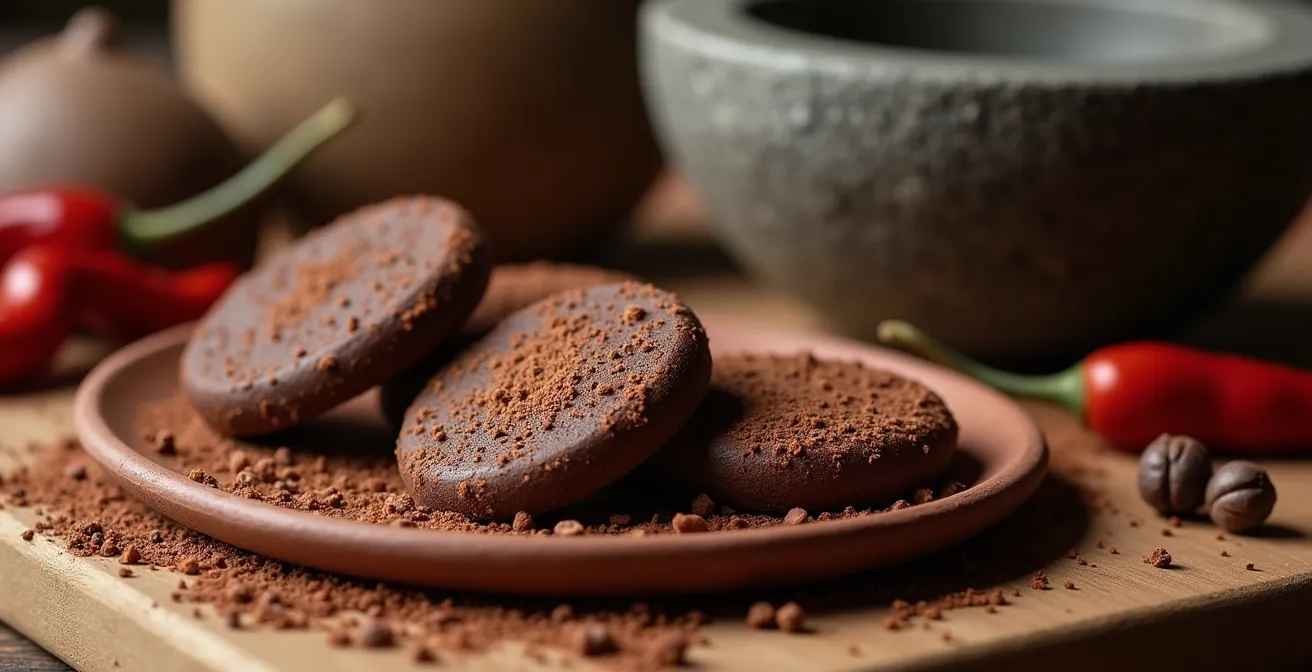
The authentic texture of a traditional mole comes not from a specific ingredient, but from the coarse, uneven particles of stone-ground chocolate that create its signature velvety body.
- Modern, smooth chocolate dissolves completely, failing to build the essential textural matrix of a true mole.
- The gentle charring of ingredients (the Maillard reaction) and the choice of thickener (bread or tortilla) are foundational steps that support the chocolate’s role.
Recommendation: To achieve an authentic mole, seek out Mexican-style stone-ground chocolate and embrace its rustic texture as the cornerstone of your sauce, not just a flavoring.
Come closer, mijo. You want to make a real mole, the kind that sings with the stories of our grandmothers? Many people think the secret is in a long, secret list of ingredients. They chase recipes with thirty or more items, believing that more is better. They talk of chiles, of nuts, of a dozen spices. And while these are the soul of the mole’s flavor, they are missing the heart of the matter. The true secret, the one that separates a simple brown sauce from a transcendent Mole Poblano, is not just in the taste, but in the feeling. It is in the texture.
The conversation often stops at “use Mexican chocolate.” But it fails to ask *why*. The answer lies in the ancient way it is made. Modern chocolate is prized for being silky and smooth, melting away to nothing on the tongue. But for mole, this is a flaw, not a virtue. We need structure. We need body. The key is the rustic, almost gritty character of true stone-ground chocolate. Its particles are not uniform; they are a family of different sizes that refuse to disappear completely. Instead, they join with the other ingredients to create a velvety, coating texture that is the hallmark of a mole made with patience and wisdom.
Forget the quick, simplified versions. Today, we will not just follow steps; we will understand the spirit behind them. We will learn why the slight bitterness of one chile balances another, why a scorched tortilla is a blessing, and how that imperfectly ground chocolate is, in fact, the perfect foundation for the most revered dish in Mexico. This is the path to the mole’s true soul.
This guide will walk you through the essential wisdom of mole-making, focusing on the techniques that create its legendary texture. We will explore the harmony of flavors and the science of texture that our ancestors understood by heart.
Summary: Unlocking the Authentic Texture of Traditional Mole
- Mulato, Ancho, Pasilla: a chili trio that balances the bitterness of cacao?
- Why does lightly charring onions and tortillas create such depth of flavor?
- Maillard or carbonization: what’s the line you should never cross?
- Stale bread or fried tortilla: which thickener for a traditional coating texture?
- The mistake of cooking the chocolate for too long and making the sauce acrid
- How to pair the acidity of Peruvian cacao with exotic fruits without a clash?
- How to get a velvety, thick hot chocolate without using of fécule?
- Red rice or warm tortillas: how to taste mole like you’re in Puebla?
Mulato, Ancho, Pasilla: a chili trio that balances the bitterness of cacao?
The foundation of any good mole begins with the chiles. You cannot choose them by chance. They must speak to each other. The holy trinity for Mole Poblano is the Ancho, Mulato, and Pasilla. Think of them as a family. The Ancho is the warm, fruity heart, bringing a gentle sweetness. The Pasilla is darker, more serious, with notes of dried fruit and a whisper of bitterness. And the Mulato, a cousin of the Ancho, is the bridge between them, offering hints of smoke, licorice, and, yes, chocolate.
This is where the wisdom begins. The slight bitterness of the Pasilla is not a flaw; it is an invitation. It prepares the palate for the complexity of the cacao. As chef Justin Mosel notes, “Chocolate is used in moles to add complexity, color and complementary sweet and bitter notes to ingredients such as nuts and seeds.” The chiles lay the groundwork, creating a deep, earthy base where the chocolate doesn’t just add sweetness, but a new layer of sophisticated bitterness. They work in harmony, so one flavor does not shout over the others. You are not making a chocolate sauce with chiles; you are making a chile sauce deepened by chocolate.
Before you even think of grinding, you must toast them on a hot comal. This awakens their oils and transforms their flavor from flat and dusty to vibrant and fragrant. But be patient. A scorched chile is a bitter chile, and that is a bitterness that no amount of sugar can hide. You want them pliable and aromatic, not brittle and black.
Why does lightly charring onions and tortillas create such depth of flavor?
After the chiles are awakened, we turn to the other aromatics. Onions, garlic, tomatoes. Here, we do not simply “cook” them. We char them. On a dry comal, we lay them down and let the heat work its magic, turning them slowly until they are blistered with black spots. This is not burning. This is a transformation. This process, known as the Maillard reaction, is a conversation between sugars and amino acids, creating hundreds of new aromatic compounds.
This is where the deep, savory, and roasted notes of the mole are born. It is what gives the sauce its incredible depth, a flavor you can never achieve by just boiling ingredients in a pot. The science tells us that the Maillard reaction that creates depth in charred ingredients occurs optimally between 284-330°F (140-165°C). Your comal is your instrument to conduct this symphony of flavor. The slightly sweet, caramelized notes from a properly charred onion are essential to balance the earthiness of the chiles and the bitterness of the chocolate.
This process requires your full attention. You are looking for a mosaic of colors: the pale white of the onion turning golden, then caramel, then finally flecked with a deep, dark char. Each color represents a different family of flavors.
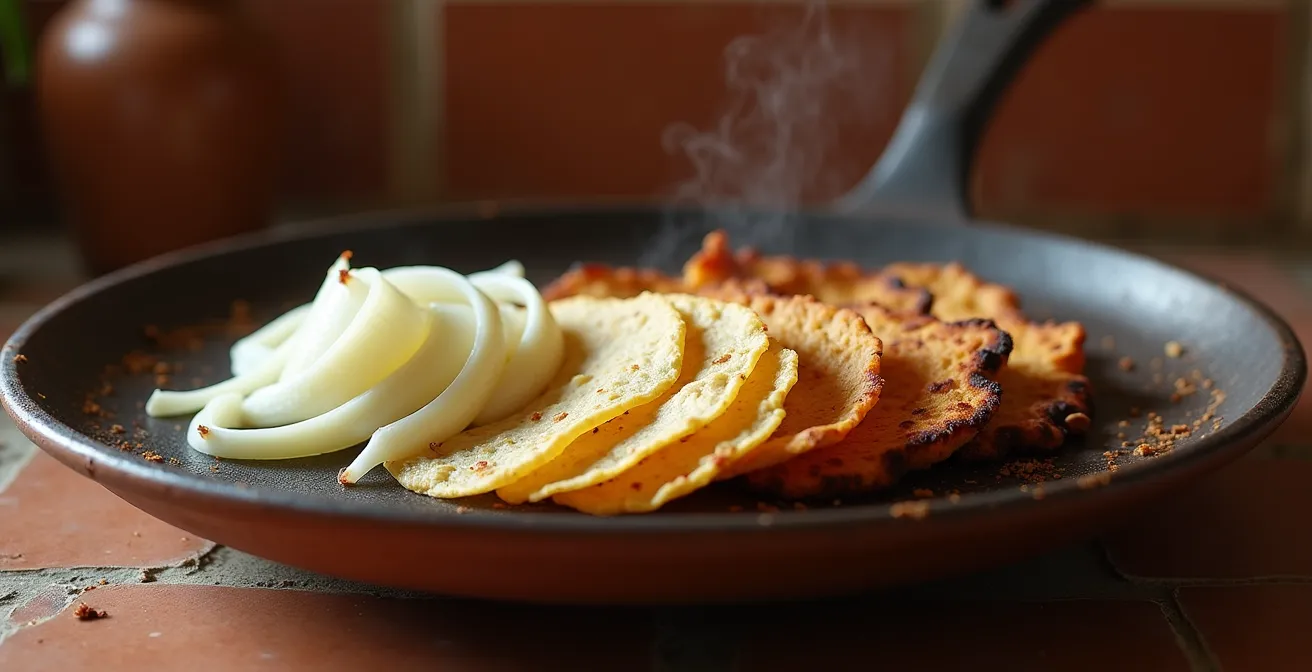
Look at the progression. From raw to toasted to deeply caramelized, each stage unlocks a new layer of complexity. The same principle applies to the tortillas or bread used to thicken the mole. A light charring not only adds nutty flavor but also dries them out, preparing them to absorb the liquids and form the body of the sauce.
Maillard or carbonization: what’s the line you should never cross?
There is a fine line, mijo, between creating depth and creating disaster. The Maillard reaction is our friend. It gives us beautiful brown colors and complex, roasted flavors. But if you are not watchful, if the heat becomes too aggressive, you cross a line into another territory: pyrolysis, or what you would call burning. This is where the magic dies and a harsh, acrid bitterness is born.
The aromas are your guide. The Maillard reaction smells nutty, toasty, and sweet. Carbonization smells sharp, smoky, and acrid. One scorched clove of garlic or a handful of blackened almonds can cast a bitter shadow over your entire pot of mole. This bitterness is aggressive and unpleasant, unlike the sophisticated bitterness of a Pasilla chile or dark chocolate. It is a flavor of failure, and it cannot be masked.
The science confirms what our senses tell us. At the higher temperatures of the Maillard range, the browning is beautiful. But at a certain point, the chemical pathways change. According to culinary research, when food reaches temperatures over 350°F (176°C), pyrolysis begins to dominate, leading to the final breakdown of the food’s structure and the development of these unwanted acrid flavors. Your goal is to keep the ingredients dancing in that sweet spot just below this threshold. This is why a traditional comal, which allows for precise heat control, is superior to a modern non-stick pan that can quickly overheat.
Stale bread or fried tortilla: which thickener for a traditional coating texture?
Now we build the body. A mole must have a texture that coats the back of a spoon, a luxurious, velvety consistency. This does not come from flour or cornstarch. That is the modern, lazy way. The traditional body comes from toasted nuts, seeds, and, crucially, a starchy element like stale bread or fried corn tortillas. Both work by releasing their starches to thicken the sauce, but they also contribute their own unique, toasty flavors from the Maillard reaction we just discussed.
But the true secret to the signature texture of mole is the chocolate itself. And not just any chocolate. You must use stone-ground Mexican chocolate. Why? Because of its texture. Modern industrial chocolate is ground until its particles are incredibly fine, so it feels silky in the mouth. For a smooth truffle, this is good. For a mole, it is not. The industry standard is that chocolate particles must be ground below 30 microns for the human tongue to perceive it as completely smooth.
Stone-ground chocolate, however, is beautifully imperfect. Its particles are much larger and unevenly sized, often ranging from 22 to 35 microns in the same batch. When you add this to your mole, it doesn’t completely disappear. These tiny, rustic particles remain suspended in the sauce, creating a textural matrix. They work with the ground nuts and thickeners to build a body that is not just thick, but has a subtle, pleasing graininess. This is the authentic mouthfeel of a Pueblan mole. It is not a flaw; it is the sign of a sauce made in the traditional way.
The mistake of cooking the chocolate for too long and making the sauce acrid
Here is where many well-intentioned cooks fail. They have spent hours toasting their chiles, grinding their nuts, and simmering their sauce. Then, at the very end, they add the chocolate and continue to cook it over high heat. This is a grave mistake. Stone-ground chocolate is more delicate than its industrial cousins. The volatile, aromatic compounds that give it its beautiful fragrance are not as tightly “locked in” by fat.
When you overheat it, two bad things happen. First, you burn away those delicate aromas of cinnamon and spice that are so characteristic of Mexican chocolate. Second, and much worse, you can push the chocolate past its breaking point, causing it to become bitter and acrid. This happens when temperatures exceeding 170°C (about 340°F) cause new, bitter compounds to form. The mole turns from complex and rich to harsh and unpleasant. It is a tragedy that happens in the final moments.
The correct way is to treat the chocolate with respect. It is the final grace note, not an ingredient to be boiled. Add the chopped chocolate to the mole sauce at the very end of the cooking process, *after* you have removed it from the direct heat. The residual heat of the sauce is more than enough to melt it. Stir it gently and patiently until it is fully incorporated. The chocolate should melt *into* the sauce, not cook *in* it. This preserves its delicate aromas and prevents any chance of it turning acrid, ensuring the final flavor is one of harmony, not of discord.
Your Action Plan: Preventing Chocolate Bitterness
- Final Ingredient Check: Ensure all other ingredients are fully cooked and the sauce has the right consistency before the chocolate is even unwrapped.
- Heat Off: Remove the pot of mole completely from the stove or turn the burner to the absolute lowest setting possible.
- Chop Finely: Never add a whole tablet. Chop the stone-ground chocolate into small, even pieces for quick and gentle melting.
- Stir, Don’t Boil: Add the chopped chocolate and stir continuously and patiently with a wooden spoon. Feel the sauce; it should be very warm, but not bubbling.
- Taste and Rest: Once the chocolate is melted, taste the mole. Let it rest for at least 10-15 minutes off the heat for the flavors to meld together before serving.
Why the origin of your cacao matters more than its exoticism
In modern kitchens, there is a fascination with exotic cacaos from Peru, from Ecuador, from Africa. These can be wonderful, with bright, acidic, and fruity notes. For a fancy dessert, they are a delight. For a traditional mole, they can be a problem. The entire flavor profile of a classic mole—the earthy chiles, the sweet nuts, the smoky aromatics—was developed over centuries in perfect balance with the cacao that grew in Mexico.
Traditional Mexican cacao is generally less acidic and has a more straightforward, earthy, and nutty flavor profile. Our ancestors did not need to balance the bright acidity of a Peruvian chocolate because it was not what they were using. As traditional cooking wisdom tells us, a mole recipe is balanced for a more neutral, earthy Mexican cacao. Introducing a highly acidic chocolate can clash with the other ingredients, creating a flavor that feels disjointed or sour rather than harmonious.
So, instead of looking for the most “exotic” chocolate, look for the most “appropriate.” This means seeking out Mexican-style stone-ground chocolate, which is made to honor this tradition. Brands like Taza are a good example, as they specifically create chocolate in this style, often using a high cacao percentage. For a truly deep mole, a chocolate with at least 70% cacao is recommended. This high percentage ensures you get the robust chocolate flavor and necessary bitterness to stand up to the chiles, without the distracting acidity of other origins.
How the right chocolate creates a velvety thickness without modern starches
People are often amazed at the thickness of a good mole and ask what the secret thickener is. They expect the answer to be flour or cornstarch. The real answer is: everything, working together. But the role of the chocolate in this final texture is something special. As we discussed, the larger particles of stone-ground chocolate provide a physical structure, a pleasing “body” to the sauce.
But there is more. Authentic Mexican chocolate tablets, the kind used for mole and for hot chocolate, are not just pure cacao. They typically contain sugar and cinnamon, and are made with a high percentage of cacao solids. A good quality, authentic stone-ground Mexican chocolate tablet will contain about 70% chocolate. This high concentration of cacao solids, which includes cocoa butter, is a powerful emulsifier. An emulsion is a blend of fat and water, and a good mole is a perfect emulsion.
The ground nuts provide fat and solids. The rehydrated chiles provide solids and water. And the chocolate, with its cocoa butter and solid particles, acts as the final binding agent. It helps to bring the fats from the nuts and the water from the stock and tomatoes together into a stable, creamy, and velvety sauce. It is this emulsifying power, combined with the textural contribution of its coarse grind, that allows a traditional mole to achieve its incredible thickness and richness without ever needing a pinch of modern, flavor-diluting starch.
Key takeaways
- The authenticity of mole lies in its texture, which is primarily created by the coarse, uneven particles of traditional stone-ground chocolate.
- Mastering the Maillard reaction (charring) without crossing into pyrolysis (burning) is essential for developing deep, complex flavors.
- The entire recipe—chiles, nuts, thickeners, and chocolate—is an integrated system designed to create a stable, velvety emulsion without modern starches.
Red rice or warm tortillas: how to taste mole like you’re in Puebla?
After all this work, all this patience, you have a pot of dark, fragrant, and complex mole. How you serve it is the final act of respect for the dish. In Puebla, the birthplace of this mole, it is most often served simply. The mole is generously ladled over pieces of tender, poached chicken or turkey. The meat is just a canvas for the art of the sauce.
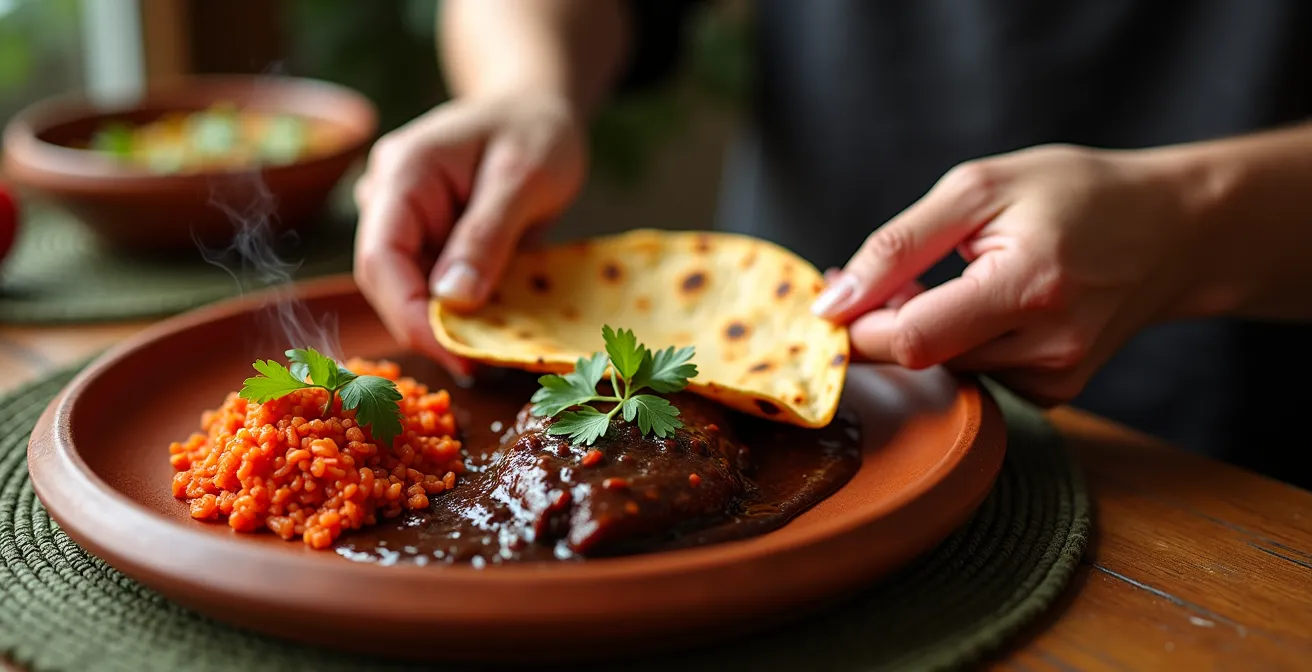
The presentation is finished with a sprinkle of toasted sesame seeds. This is not just for decoration. The nutty crunch provides a wonderful textural contrast to the smooth, velvety sauce. On the side, there is always simple red rice (arroz rojo) and, most importantly, a stack of warm, soft corn tortillas. The tortillas are not for making tacos. They are your spoon. You tear off a piece and use it to scoop up the mole, ensuring you get every last drop.
This traditional way of serving allows you to experience the full aromatic journey of the mole. You first get the bright, toasty notes from the sesame seeds, followed by the deep, multi-layered complexity of the sauce itself. The simple, neutral flavors of the chicken, rice, and tortillas do not compete. They are there to support the star of the show. Eating mole this way is not just a meal; it is an experience. It is a moment to slow down and appreciate the history, the labor, and the love that is in every single bite.
Now you understand that making mole is not a race. It is a meditation. By focusing on the texture, by respecting the traditions, and by choosing your chocolate with wisdom, you are not just cooking. You are connecting to generations of cooks who knew that the soul of food is found in patience and love. Embrace the process, and the mole will reward you.