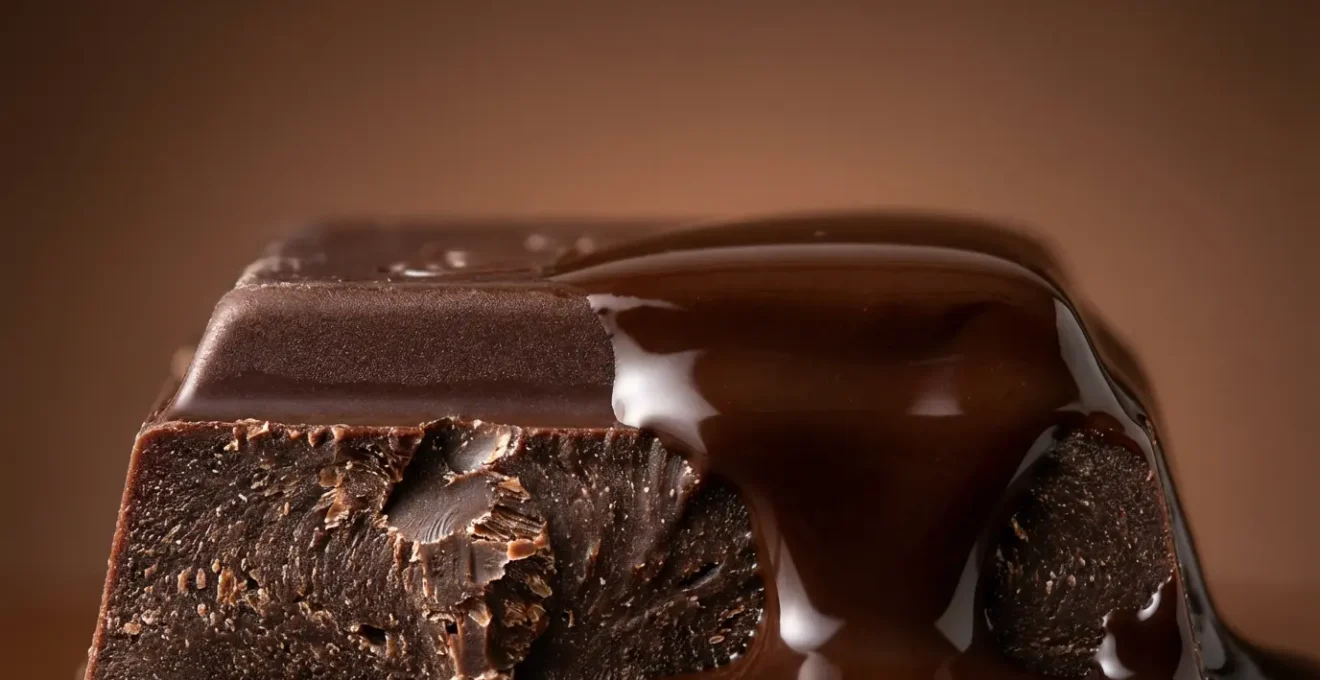
The true flavor profile of chocolate is not a fixed quality but a dynamic experience unlocked through patience. By allowing chocolate to melt instead of chewing it, you engage in a form of sensory recalibration. This process respects the physics of its crystalline structure, synchronizes with your body’s rhythms, and transforms a simple taste into a profound moment of mindfulness and well-being.
In our hurried lives, we often consume food without truly tasting it. A square of chocolate is quickly chewed and swallowed, a fleeting moment of sweetness. We might think we are “tasting” it, but we are merely scratching the surface of a deep and complex sensory world. The common advice is to taste chocolate like one tastes wine, but this comparison often remains abstract, failing to guide us toward a genuinely richer experience.
But what if the key to unlocking chocolate’s true potential was not in the intensity of our attention, but in the gentleness of our approach? The secret lies in a radical shift: from the aggressive act of chewing to the passive, mindful act of letting it melt. This article will not just tell you to slow down; it will guide you through the science and art of this practice. We will explore the physics of flavor release, the role of breath in sensory perception, and the environmental factors that can either mute or amplify the symphony of notes hidden within a single piece of chocolate.
This is an invitation to transform a simple treat into a meditative practice. By understanding the ‘why’ behind the ‘how’, you can turn each square of chocolate into an anchor for the present moment, a tool for calm, and a source of unparalleled gustatory pleasure. It is the art of slow chocolate, a journey into the heart of flavor and the quiet center of the self.
Summary: The Art of Slow Chocolate and Sensory Awakening
- Why not chewing releases the aromas encapsulated in the cocoa butter?
- How to sync your breath with the melting for an explosion of flavors?
- Bruit and light: how the context influences your perception of taste?
- The mistake of eating while driving that reduces pleasure by 80%
- Why absolute silence allows you to detect des notes florales subtiles?
- Why éteindre les écrans change-t-il la perception de satiété du chocolat?
- Why heating to 45°C then cooling to 27°C is mandatory for the shine?
- Why choosing un chocolat à 85% de cacao optimise votre apport en antioxydants?
Why not chewing releases the aromas encapsulated in the cocoa butter?
The impulse to chew chocolate is a difficult one to resist, yet it is the single greatest barrier to experiencing its true character. Chewing is an act of destruction; it shatters the intricate, crystalline structure that a chocolatier has painstakingly created. This structure, primarily composed of cocoa butter, is not just fat; it is a meticulously arranged matrix that encapsulates the volatile aromatic compounds responsible for flavor.
When you allow a piece of chocolate to rest on your tongue, you initiate a gentle and controlled deconstruction. The warmth of your mouth slowly melts the cocoa butter, layer by layer. This gradual phase transition from solid to liquid allows the aromatic molecules to be released sequentially, creating a narrative of flavor that unfolds over time. You might first perceive the brighter, fruitier top notes, followed by the deeper, roasted base notes. Chewing, in contrast, releases all these notes at once in a chaotic burst, overwhelming the palate and muddying the nuances.
The science of mouthfeel physics confirms this. The process is about lubrication and the changing surface of the chocolate as it melts. This slow release also impacts our perception of sweetness. In fact, a 2024 study in Scientific Reports demonstrated that controlled melting results in a 24% increase in sweetness perception compared to chewing. By allowing the chocolate to melt, you are not just tasting it differently; you are allowing it to present itself as it was designed, revealing the full tapestry of its composition.
How to sync your breath with the melting for an explosion of flavors?
Once you have committed to letting chocolate melt, the next layer of this practice is to synchronize the experience with your breath. Flavor is not just a matter of taste buds on the tongue; it is a profound partnership between taste and smell. A significant portion of what we perceive as flavor comes from retronasal olfaction—the process of smelling aromas that travel from the back of our mouth up into our nasal cavity.
By consciously controlling your breath, you can amplify this effect, turning a passive tasting into an active exploration. When you inhale and exhale through your nose while the chocolate is melting, you create a gentle current of air that carries the newly released volatile compounds directly to your olfactory receptors. This intentional act transforms your breath from an automatic function into a tool for discovery, revealing a spectrum of aromas—floral, nutty, earthy, spicy—that would otherwise remain unnoticed.

This practice is a form of sensory meditation. It quiets the mind’s chatter and focuses your full attention on the present moment, on the subtle shifts in texture and the evolving symphony of aromas. It is a dialogue between your body and the chocolate, a slow dance of melting and breathing that culminates in a heightened state of sensory awareness. The following ritual can serve as a guide to begin this practice.
Your Action Plan: The Chocolate Breathing Ritual
- Place the chocolate on your tongue without chewing and let it rest for 4 seconds, noticing the initial contact.
- Inhale slowly through your nose for 4 seconds as the chocolate begins to melt, drawing in the first wave of aromas.
- Hold your breath for 4 seconds, allowing the liquid chocolate to coat the entire surface of your tongue.
- Exhale gently through your nose for 4 seconds, activating retronasal olfaction to perceive the deeper notes.
- Pause for 4 seconds before swallowing, noticing the finish and the lingering base notes of the chocolate.
Noise and light: how the context influences your perception of taste?
The environment in which you taste chocolate is not a passive backdrop; it is an active participant in your sensory experience. Our brains are constantly processing information from all our senses, and this data converges to create our perception of reality, including taste. This phenomenon, known as cross-modal correspondence, means that what you hear and see can fundamentally alter what you taste.
Sound, in particular, has a powerful and often subconscious influence. Research into auditory-gustatory interaction has shown that different frequencies can prime our brains to expect and perceive certain tastes. High-pitched sounds, for example, can enhance the perception of sweetness, while low-frequency rumbles can accentuate bitterness. This is why a noisy environment, filled with a cacophony of competing frequencies, can muddle and diminish the delicate flavors of a fine chocolate.
Similarly, the color and intensity of light shape our expectations and, consequently, our perception. Warm, reddish lighting can prime us to detect richer, fruitier flavors, while cool, blue-toned light can have a dampening effect, suppressing flavor intensity. The context is not merely atmospheric; it is an integral component of the tasting process itself, capable of either elevating or sabotaging the experience.
The following table, based on scientific findings, illustrates how deeply these external factors can influence your palate. Understanding these interactions allows you to consciously curate your environment to create the optimal conditions for sensory exploration.
| Environmental Factor | Impact on Taste | Scientific Mechanism |
|---|---|---|
| High-pitched sounds | Enhances sweetness perception | Cross-modal correspondence activation |
| Low-frequency sounds | Accentuates bitterness | Auditory-gustatory interaction |
| Warm lighting (red tones) | Enhances fruity/rich flavors | Visual priming of taste expectation |
| Cool lighting (blue tones) | Suppresses flavor intensity | Cognitive dampening effect |
The mistake of eating while driving that reduces pleasure by 80%
Tasting chocolate while driving, or engaging in any distracting activity, is the antithesis of the mindful practice we are exploring. While the “80% reduction” is an illustrative figure, the underlying principle is scientifically sound: divided attention drastically diminishes sensory perception. This happens because of a concept known as cognitive load.
Your brain has a finite amount of processing power. Activities that require significant attention, such as navigating traffic, making decisions, and monitoring your surroundings, consume a large portion of these cognitive resources. When your mind is occupied with the demands of driving, it has very little capacity left to process the subtle and complex sensory information coming from your palate. The rich tapestry of flavors, aromas, and textures from the melting chocolate is reduced to a simple, one-dimensional signal: “sweet.”
The intricate sensation of mouthfeel, for example, is one of the first casualties of distraction. As research on chocolate lubrication highlights, the unique pleasure we derive comes from the way fat particles interact with our saliva from the very first moment of contact. This initial phase is critical for setting the stage for the entire flavor journey. When your cognitive resources are diverted to the task of driving, this crucial initial sensory processing is severely compromised, and the foundation for a rich experience is never laid.
Why absolute silence allows you to detect subtle floral notes?
If a noisy environment can mute flavor, then it stands to reason that absolute silence can amplify it. By creating a space free from auditory distraction, you are not just removing interference; you are allowing your brain to reallocate its processing power entirely to the senses of taste and smell. In this quiet, focused state, your sensory acuity sharpens, enabling you to perceive nuances that are typically lost in the background noise of daily life.
This is particularly true for the most delicate and volatile aromas in chocolate, such as subtle floral or citrus notes. These compounds are often the first to be released but are also the most easily overpowered by stronger base notes or external stimuli. In the stillness of a silent tasting, your retronasal olfaction can operate at its peak sensitivity. The gentle exhalation through your nose becomes a powerful tool, carrying these light, ethereal aromas to your olfactory receptors without competition.

Silence does more than just enhance perception; it fosters a meditative state. It encourages an inward focus, a deep listening to the body’s sensory feedback. In this space, you can notice the subtle shift in texture as the last crystal of cocoa butter melts, the lingering finish on the palate, and the gentle aftertaste that can evolve for minutes. Creating silence is an act of respect for the chocolate and for your own capacity for sensory experience. It is the ultimate expression of the “slow chocolate” philosophy, where less (stimulus) truly becomes more (sensation).
Why turning off screens changes the perception of satiety from chocolate?
Just as driving divides our attention, engaging with screens while eating imposes a significant cognitive load that dulls our sensory experience. The constant stream of information, notifications, and visual stimuli from a phone or television captures our focus, leaving little room for the brain to process the signals coming from our palate and stomach. This has a profound impact not only on flavor perception but also on our sense of satiety.
Satiety is a complex process, a dialogue between the gut and the brain. The physical sensations in the mouth—the texture, the melting rate, the richness—are critical inputs in this conversation. As physicist Jan Ilavsky of Argonne National Laboratory notes, our tongues are highly sensitive to the microstructure of food. “Based on how compact or how open the structure is, that can possibly have an impact on how fast or how slowly the chocolate melts,” he states in an article on chocolate’s melt-in-your-mouth properties. This structure is what scientists investigate using advanced techniques to understand mouthfeel.
Based on how compact or how open the structure is, that can possibly have an impact on how fast or how slowly the chocolate melts.
– Jan Ilavsky, Argonne National Laboratory physicist
When you eat while distracted by a screen, your brain fails to properly register these intricate textural cues. It receives a blunt signal of “sweet” and “calories” but misses the rich, detailed information that contributes to the feeling of being satisfied. As a result, you may feel the urge to eat more, not because you are physically hungry, but because your brain is seeking a sensory experience it never fully received. By turning off screens, you allow your mind to fully engage with the food, to register its complexity, and to receive the subtle signals that say, “this is enough.” It is a simple act that reconnects you to your body’s innate wisdom.
Why heating to 45°C then cooling to 27°C is mandatory for the shine?
The pleasure we derive from letting chocolate melt is not an accident; it is the direct result of a precise and scientific process known as tempering. This crucial step in chocolate making is entirely dedicated to controlling the crystalline structure of cocoa butter. Cocoa butter is polymorphic, meaning it can solidify into six different crystal forms, but only one—Form V—gives chocolate its desirable qualities: a glossy shine, a satisfying “snap” when broken, and, most importantly, a melting point that is just below human body temperature.
Tempering is the art of encouraging the formation of these stable Form V crystals. The process involves carefully heating the chocolate to around 45°C to melt all existing crystal forms. It is then cooled to about 27°C while being agitated, which encourages the formation of Form V crystal “seeds.” Finally, it is gently reheated to around 31°C to melt any unstable crystals that may have formed, leaving only the stable, desirable Form V structure.
This painstaking process is what makes the “slow chocolate” experience possible. As explained by chocolate experts, the critical temperature control ensures that these Beta-V crystals melt at 34-35°C. This specific melting point means the chocolate will remain solid at room temperature but will begin to melt almost instantly on your tongue, releasing its flavors in a smooth, luxurious wave. Untempered chocolate, with its unstable crystals, has a dull appearance, a crumbly texture, and an unpleasant, waxy mouthfeel because it melts at inconsistent temperatures. The shine, therefore, is not just cosmetic; it is the visual promise of a perfect melt.
Key Takeaways
- The slow melting of chocolate, rather than chewing, allows for a sequential release of aromatic compounds, enhancing flavor complexity and perceived sweetness.
- Synchronizing your breath with the melting process, using retronasal olfaction, is a powerful technique to amplify the detection of subtle aromas.
- Your tasting environment matters: sound and light can significantly alter your perception of taste, making silence and neutral lighting ideal for a focused experience.
Why choosing an 85% cacao chocolate optimizes your antioxidant intake?
The final element in cultivating a mindful chocolate practice is the selection of the chocolate itself. While personal preference plays a role, choosing a high-cacao chocolate, such as one with 85% cacao content, aligns perfectly with the goals of both sensory complexity and well-being. The percentage of cacao refers to the total amount of ingredients derived from the cacao bean (cacao solids and cocoa butter). A higher percentage means more of the bean and less of other ingredients, primarily sugar.
From a wellness perspective, this is significant. Cacao is one of the richest natural sources of flavanols, a class of powerful antioxidants that have been linked to various health benefits, including improved cardiovascular health and cognitive function. By choosing an 85% chocolate, you are maximizing your intake of these beneficial compounds while minimizing your sugar consumption.
From a sensory perspective, high-cacao chocolate offers a more complex and challenging flavor profile. The reduced sweetness allows the inherent characteristics of the cacao bean—its fruity, earthy, or floral notes—to come to the forefront. The bitterness, often feared, is not a flaw but an integral part of this complexity, providing a counterpoint that makes the other flavors more vibrant. As research on chocolate polymorphism shows, the composition affects melting properties; for instance, a 70% cocoa dark chocolate contains about 39% fat, which creates an optimal melting experience. At 85%, the balance shifts, offering a slower melt and a longer, more intense finish that is deeply satisfying.
Embracing the art of slow chocolate is an invitation to pause, to pay attention, and to find richness in simplicity. It is a small but profound act of self-care that can ripple through your day, reminding you of the beauty that unfolds when you simply allow things to be. Begin this practice today, and rediscover the world of flavor waiting just beneath the surface.
Frequently Asked Questions About the Art of Slow Chocolate Tasting
Why is my chocolate not shiny and what does it mean for tasting?
A lack of shine indicates the chocolate is not properly tempered. This means the cocoa butter has formed unstable crystals, which results in a crumbly texture and a waxy mouthfeel that melts poorly. A shiny surface is a visual cue that the chocolate has a stable Form V crystal structure, promising a clean snap and a smooth, luxurious melt on the tongue.
How do I start tasting for the different “notes” in chocolate?
Start by creating a quiet, distraction-free environment. Use the breathing technique outlined in this article: inhale and exhale through your nose as the chocolate melts. This activates retronasal olfaction, which is key to detecting aromas. Begin with a 70% cacao chocolate and try to identify one dominant flavor family: is it fruity, nutty, or earthy? As your palate develops, you will start to discern more specific and subtle notes like cherry, almond, or coffee.
Is there a “right” way to melt chocolate in your mouth?
The “right” way is simply to be patient and let your body’s warmth do the work. Place a small piece on the center of your tongue and resist the urge to chew or move it around too much. Let it rest and feel the transition from solid to liquid. Closing your eyes can help you focus on the changing textures and the unfolding layers of flavor. The key is passivity and mindful observation.