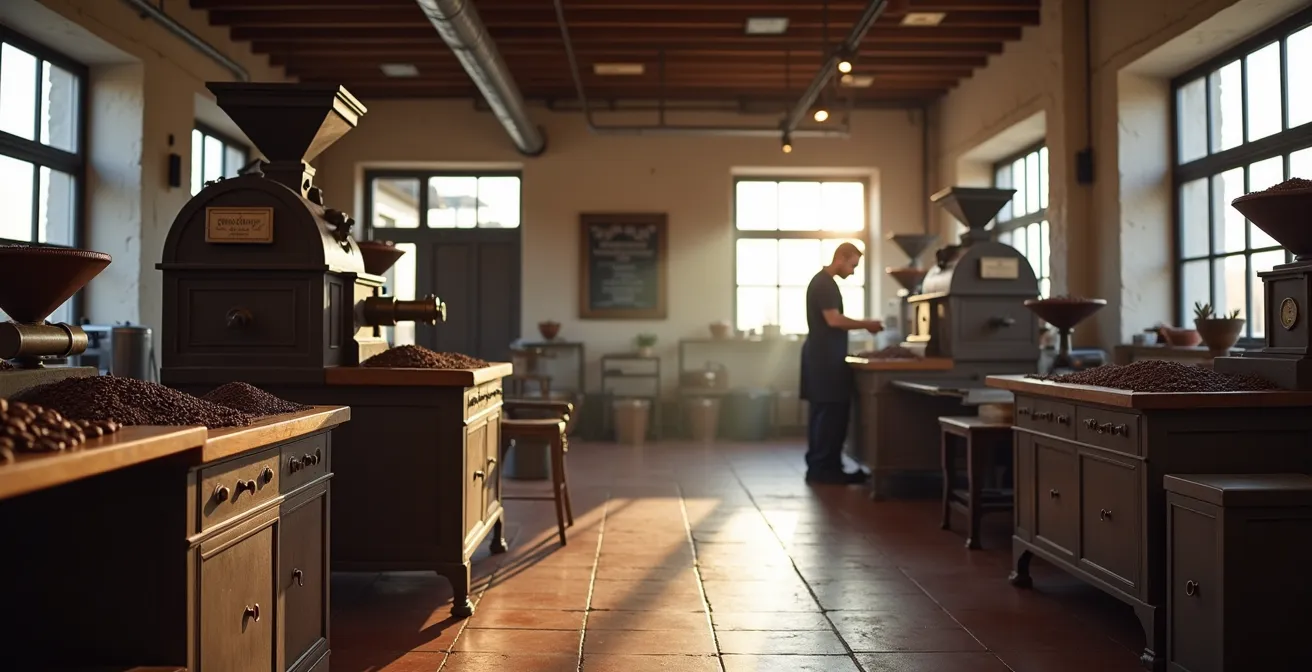
The premium price of a craft chocolate bar directly funds the restoration of flavor, ethics, and nutrition that industrial models systematically strip away.
- The industrial supply chain captures over 90% of the chocolate bar’s value, leaving cacao farmers with as little as 6%.
- Gentle craft processing preserves up to 90% more of the cacao’s natural, healthy polyphenols compared to harsh industrial methods.
Recommendation: To make an informed choice, look beyond the price tag and check the packaging for specific bean origin transparency and direct trade information.
Standing in the chocolate aisle, you’ve likely felt that moment of hesitation. In one hand, a familiar $2 chocolate bar; in the other, a beautifully packaged craft bar costing $10, $12, or even more. The immediate reaction is often sticker shock, followed by a simple question: “Why?”. The common answer is that craft chocolate uses “better beans” and is made in “small batches.” While true, these explanations barely scratch the surface. They fail to capture the profound, systemic difference you are paying for.
The reality is that the industrial chocolate model is built on a philosophy of extraction and subtraction. It’s a system designed to strip value—flavor, nutrition, and fair wages—at every step to deliver the lowest possible price. The high cost of a craft chocolate bar isn’t an arbitrary markup; it represents a conscious act of value re-integration. It’s the price of restoring what was lost: paying farmers a living wage, preserving the delicate and unique flavors of the cacao’s terroir, and protecting the powerful nutrients naturally present in the bean.
This article will deconstruct that $10 price difference. We will not just list the costs, but explore the fundamental philosophy that separates a mass-market candy from a true bean-to-bar creation. We’ll start by uncovering the economic injustice at the heart of the cocoa trade, then guide you on how to identify authentic makers, understand the nutritional science, and finally, appreciate the complex flavors that only craft methods can unlock. This is the story of why that extra cost is not an expense, but an investment in a better, more delicious, and more equitable world.
To help you navigate this complex world, this guide breaks down the key pillars that define craft chocolate and justify its price. The following sections will provide a clear, structured look into the economics, ethics, and science of fine chocolate.
Contents: The True Value of a Craft Chocolate Bar
- Why the industrial model deprives farmers of 94% of the added value?
- How to identify a true artisan chocolate maker in 3 simple steps?
- Industrial or artisanal chocolate: which best preserves the polyphenols?
- The hidden ecological mistake behind your $2 bar
- When to organize a tasting to perceive the nuances of terroir?
- How to explain to your customers that a tablet of Porcelana costs €25?
- What are the 5 absolute criteria to note to improve your analysis?
- How does anaerobic fermentation create unique fruity notes in the cacao?
Why the industrial model deprives farmers of 94% of the added value?
The most significant, yet often invisible, component of a cheap chocolate bar’s price is the systemic suppression of the farmer’s income. The global cocoa market operates as a commodity system, where prices are set on abstract trading floors like the ICE Futures market, thousands of miles from the farms. In this system, speculators who may never see a cocoa pod can influence prices more than the farmers who cultivate them. This disconnects the price of cocoa from the actual cost of sustainable production, trapping farmers in a cycle of poverty. The result is a gross imbalance in value distribution.
The numbers are staggering. According to data from the World Economic Forum, farmers receive an astonishingly low portion of the final price of a chocolate bar. Research confirms that farmers receive just 6.6% of the value of a tonne of cocoa once it’s processed into chocolate. The vast majority of the profit—over 90%—is captured by large manufacturers, brands, and retailers. This isn’t just an unfortunate byproduct of a global market; it’s the foundational principle that allows a chocolate bar to be sold for $2. It relies on paying the producer a price that is often below the cost of living.
Craft chocolate makers actively work to dismantle this model. By engaging in direct trade, they bypass the commodity market and negotiate prices directly with farmers or cooperatives. This allows them to pay a significant premium—often two to three times the market price—that reflects the quality of the beans and the cost of sustainable, ethical farming. This premium is the first and most critical component of that $10 price difference: it’s a direct payment for economic justice.
How to identify a true artisan chocolate maker in 3 simple steps?
In a market where “artisan” and “gourmet” are used as marketing buzzwords, distinguishing a genuine bean-to-bar maker from a company that simply remelts industrial chocolate can be challenging. A “chocolatier” often works with pre-made chocolate (called couverture), melting it down to create bonbons and confections. A true bean-to-bar maker, however, controls the entire process, from sourcing raw, fermented beans to roasting, grinding, and molding the final bar. This complete control is where the magic—and the cost—truly lies.
To ensure you’re investing in authentic craft chocolate, you need to become a label detective. True makers pride themselves on transparency because it’s the core of their philosophy. They want you to know the story behind the bar. Here are three key steps to identify them:
- Check the Origin Transparency: Look at the ingredient list. If it just says “cocoa mass” or “cacao,” be wary. An authentic bean-to-bar maker will list the specific country of origin, and often the region, cooperative, or even the specific farm where the beans were grown (e.g., “Kokoa Kamili, Tanzania” or “Maya Mountain, Belize”).
- Distinguish “Chocolatier” from “Maker”: The packaging and website should clarify their role. Makers will talk about roasting, grinding, and conching. They will discuss their machinery and their process. Chocolatiers will focus more on fillings, ganaches, and creative shapes, but rarely on the origin of the chocolate itself.
- Evaluate Transparency Beyond Marketing: The best makers go a step further. They often publish annual transparency reports detailing the prices they pay for their beans, far exceeding the commodity market or Fairtrade minimums. They share stories and photos of the specific farmers they partner with, making the supply chain personal and accountable.
This level of control allows the maker to bring out the best in each bean, as seen in the meticulous small-batch roasting process. Each origin has a unique flavor potential that must be unlocked with a specific roasting profile.
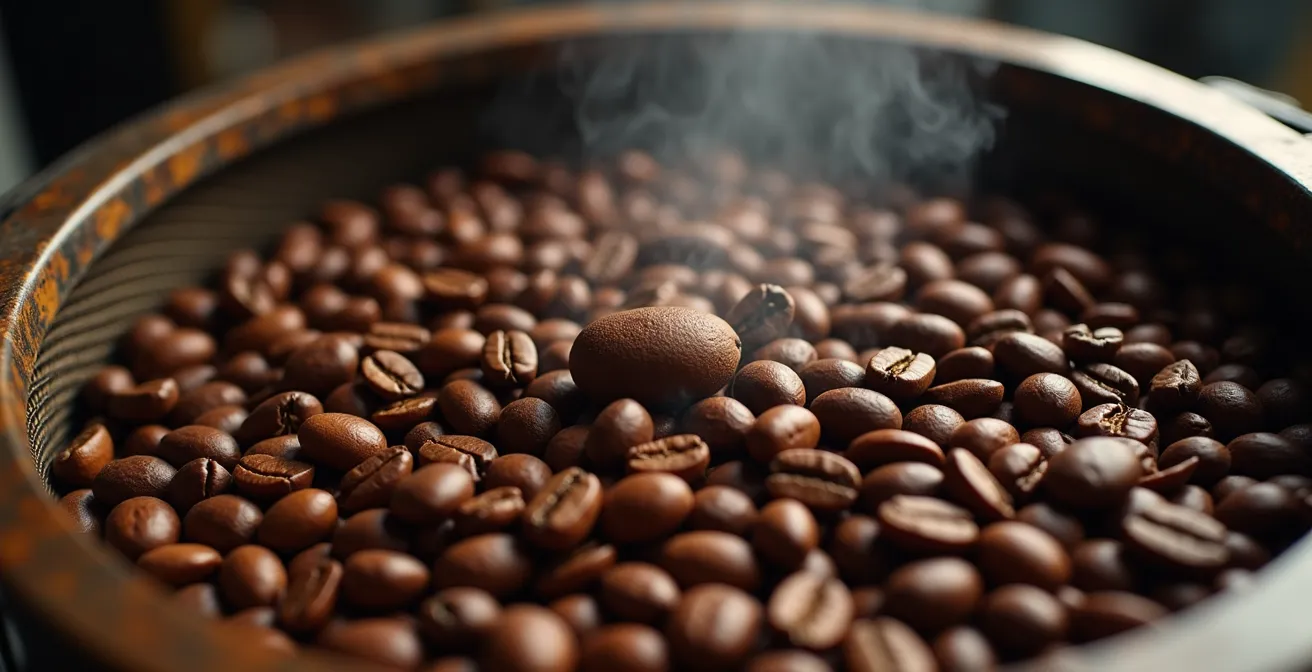
As the illustration shows, this is a hands-on, sensory-driven stage—a world away from automated, high-volume industrial roasters. This dedication to process is a hallmark of a true maker and a key reason for the superior quality of the final product.
Industrial or artisanal chocolate: which best preserves the polyphenols?
Beyond ethics and flavor, one of the most tangible differences between industrial and craft chocolate lies in its nutritional content. Cacao is naturally one of the richest sources of polyphenols, a class of powerful antioxidants linked to various health benefits, including improved cardiovascular health and cognitive function. However, these delicate compounds are extremely sensitive to heat and processing. The industrial chocolate-making process, optimized for speed and uniformity, systematically destroys them.
One of the main culprits is “Dutch processing” or alkalization. This is a chemical process where cocoa beans are washed with an alkaline solution to reduce their natural bitterness and darken their color. While it creates a milder, more uniform flavor, it’s devastating to the nutritional content. According to research, Dutch processing can eliminate up to 90% of the beneficial flavanols. Most craft chocolate makers never alkalize their beans, choosing instead to work with the bean’s natural acidity and flavor profile.
The destruction continues through other stages like high-temperature roasting and extended conching (a process of mixing and aerating). A recent analysis provides a stark comparison of how these methods impact polyphenol retention, with the source data available from a comparative analysis in wine and food culture publications.
| Processing Stage | Industrial Method | Craft Method | Polyphenol Retention |
|---|---|---|---|
| Alkalization | Dutch processing to reduce bitterness | No alkalization | Industrial: 10% retained Craft: 100% retained |
| Roasting | High temperature, rapid | Gentle, bean-specific profiles | Industrial: 40% retained Craft: 75% retained |
| Conching | High heat for extended periods | Lower temperatures, shorter duration | Industrial: 50% retained Craft: 85% retained |
This table clearly demonstrates that the craft approach isn’t just about taste; it’s a commitment to nutritional preservation. When you pay for a craft bar, you are not just buying a treat; you are buying a food that retains a significant portion of its natural, health-promoting properties. The industrial bar, by contrast, has had much of its nutritional value processed out in the name of efficiency and mass-market appeal.
The hidden ecological mistake behind your $2 bar
The low price of industrial chocolate also conceals a significant ecological cost. To meet the massive global demand for cheap cocoa, industrial agriculture has favored practices that prioritize high yields over biodiversity and long-term sustainability. This often leads to deforestation and the promotion of monoculture farming, which depletes soil health and makes crops more vulnerable to disease, requiring more pesticides.
A prime example of this is the reliance on specific high-yield, disease-resistant cacao clones like CCN-51. This variety was engineered for productivity, not flavor or environmental harmony. Its widespread adoption has led to vast monoculture plantations that decimate biodiversity, pushing out the countless heirloom cacao varietals that hold the key to complex and unique flavors. This focus on a single, robust clone is an agricultural shortcut that trades flavor integrity and ecological resilience for sheer volume. It’s the agricultural equivalent of the Dutch processing method—a way to strip out character for the sake of uniformity and scale.
In contrast, the craft chocolate movement is deeply intertwined with a commitment to biodiversity and sustainable farming practices like agroforestry. This method involves growing cacao trees within a diverse ecosystem of other trees and plants. This not only creates a healthier, more resilient environment but also contributes to reforestation and provides farmers with other sources of food and income. In fact, globally, an estimated 70% of cocoa is grown in agroforestry systems, a practice that craft makers actively support and promote by seeking out beans from these biodiverse farms. By paying a premium for beans from these systems, they create a financial incentive for farmers to preserve and expand these vital ecosystems.
The choice between a $2 bar and a $12 bar is, therefore, also an ecological one. One often supports a system of monoculture and environmental degradation, while the other invests in biodiversity, reforestation, and a more sustainable future for cacao farming.
When to organize a tasting to perceive the nuances of terroir?
Once you understand the economic, ethical, and ecological value packed into a craft chocolate bar, the final step is to experience the most delicious justification for its price: its flavor. Industrial chocolate is designed to taste the same every time—a consistent, one-note “chocolatey” flavor. Craft chocolate is the opposite; it’s an exploration of terroir, the unique set of environmental factors (soil, climate, altitude) of a specific location that gives its cacao a distinct flavor profile. Beans from Madagascar can have bright, red-fruit notes, while those from Vietnam might be earthy and spicy.
To truly appreciate these subtleties, you need to taste with intention. A structured tasting is the best way to train your palate to move beyond “sweet” and “bitter” and start identifying the complex tapestry of flavors. Organizing a tasting is simple and can be done at any time you have a quiet moment to focus. The key is comparison. Here are a few professional methods to guide your exploration:
- Horizontal Tasting: This is the best way to discover terroir. You compare several bars of the same percentage (e.g., all 70%) but from different origins. Tasting a 70% bar from Madagascar next to one from Ecuador and another from Vietnam will reveal startlingly different flavor notes, purely based on where the beans were grown.
- Vertical Tasting: This method helps you understand the maker’s craft. You taste bars from the same origin but made by different chocolate makers. This highlights how different roasting and conching profiles can transform the same raw material. You can also compare different harvest years from the same maker to see how climate variations affect flavor.
- Flavor Wheel Pairing: For a more structured approach, use a chocolate flavor wheel (easily found online) to guide your tasting. Before you even taste, try to identify aromas. Then, as you taste, try to pinpoint specific notes from the wheel, such as fruity, nutty, floral, or earthy.
Setting up for a tasting is part of the ritual. Arrange small pieces of each chocolate on a neutral surface, like a slate board or white plate, allowing you to observe their different colors and textures before you even begin.
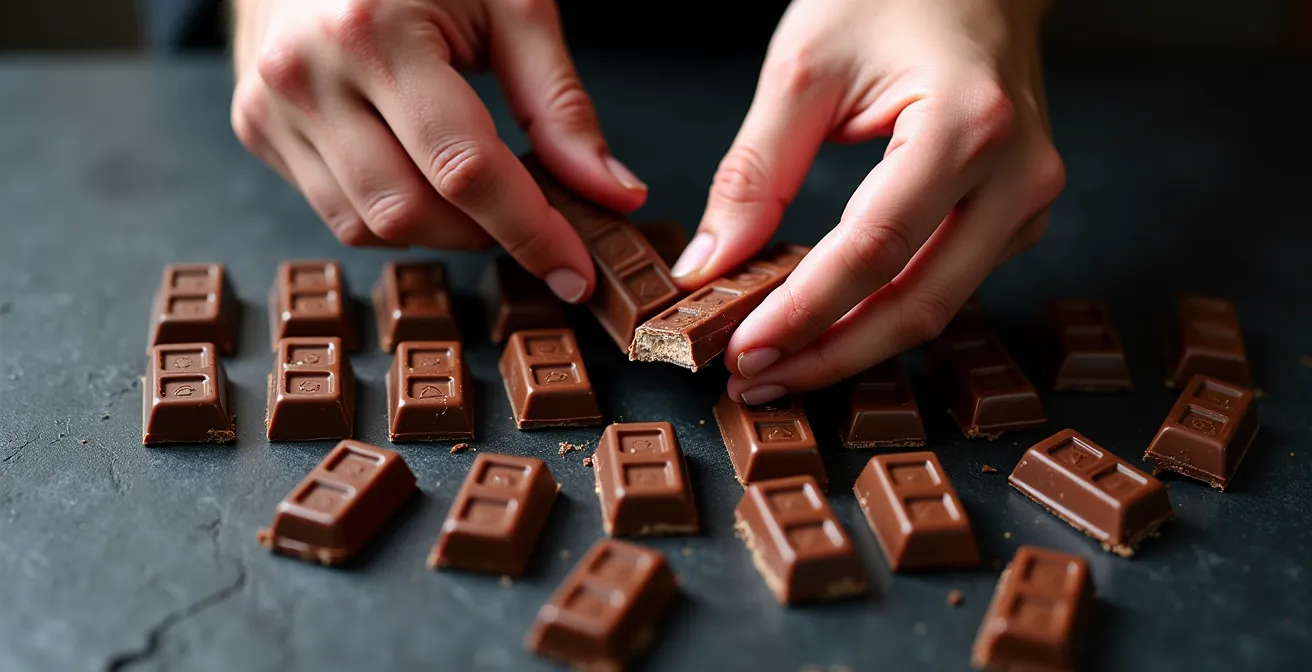
This deliberate, mindful approach transforms eating chocolate from a passive act of consumption into an active, engaging experience of discovery. It’s at this moment that the $10 price tag makes perfect sense—you are paying for a culinary journey, not just a candy bar.
How to explain to your customers that a tablet of Porcelana costs €25?
Even within the world of craft chocolate, some bars command exceptionally high prices. A bar made from Porcelana cacao, for instance, can easily cost $25 or more. Explaining this requires moving beyond the general principles of craft chocolate and into the specialized world of heirloom cacao genetics. Just as there are different grape varietals for wine, there are thousands of cacao varietals, each with its own unique flavor potential and rarity.
Porcelana is one of the rarest and most prized. It is a sub-type of Criollo, the most ancient and genetically pure cacao family. Its name comes from the porcelain-like white color of its beans. It’s notoriously difficult to grow, with low yields and high susceptibility to disease. As a result, it is incredibly scarce. Data from the International Cocoa Organization (ICCO) suggests that Porcelana Criollo represents less than 0.1% of the world’s total cacao production. This extreme rarity is the primary driver of its cost. When you buy a Porcelana bar, you are purchasing one of the world’s most exclusive agricultural products.
Furthermore, making chocolate is not a get-rich-quick scheme. It’s a passion project that requires immense investment in specialized equipment and sourcing, with very slim profit margins. As Shawn Askinosie, a pioneer of the American craft chocolate movement, bluntly puts it, it’s a labor of love. In a comment on the financial realities of the business, he states:
Most craft chocolate makers are not rich unless they were rich before they started, in which case they are now less rich.
– Shawn Askinosie, CEO of Askinosie Chocolate
This quote perfectly encapsulates the financial reality. The high price of a rare bar like Porcelana isn’t padding a maker’s pockets; it’s covering the exorbitant cost of the raw material and the immense effort required to transform it into chocolate. It’s the price of preserving and sharing a piece of living history.
What are the 5 absolute criteria to note to improve your analysis?
Progressing from a casual taster to a discerning analyst requires a structured approach. Simply liking or disliking a chocolate is subjective; identifying *why* you feel that way is the beginning of expertise. Professional chocolate sommeliers use a consistent methodology to evaluate quality, focusing on a few key sensory criteria that tell the story of the bean’s origin and the maker’s skill. By paying close attention to these elements, you can deconstruct the flavor experience and develop a much deeper appreciation for the craft.
The first step in any tasting is to engage your sense of smell. What should you look for before the chocolate even touches your tongue? The aroma is your first clue to the flavor profile. Before tasting, break off a piece and inhale deeply. A great chocolate will offer a complex bouquet of scents—perhaps notes of brownie, fresh raspberries, or even a hint of tobacco. This primes your palate for the flavors to come. Next is the physical experience. A sharp, clean snap when you break the chocolate indicates that it was well-tempered, a crucial sign of a skilled maker. As it melts in your mouth, pay close attention to the texture. Is it silky smooth, or does it feel waxy or grainy? This reveals the quality of the grinding and conching process.
Of course, the most important part is the flavor itself. Great chocolate is not static; it should tell a story. Note how the flavor evolves on your palate. There should be a primary flavor that hits you first, followed by a wave of secondary notes as it melts, and a final set of lingering notes in the finish. Finally, as you become more experienced, you’ll start to notice more technical aspects. Professional tasters assess the balance between acidity and astringency—is there a pleasant, bright fruitiness, or an unpleasant sourness? They also evaluate the finish: how long do the pleasant flavors linger after the chocolate is gone? A long, complex finish is a hallmark of exceptional quality.
Your 5-Point Tasting Analysis Checklist: From Novice to Analyst
- Assess the Aroma: Before tasting, break a piece and inhale. Note the primary scents (e.g., nutty, fruity, floral, earthy) to prime your palate.
- Evaluate the Snap and Texture: Listen for a sharp, clean snap (good tempering). As it melts, judge the mouthfeel—is it smooth and silky or grainy and waxy?
- Track the Flavor Evolution: Identify the three stages of flavor: the initial taste, the secondary notes that emerge as it melts, and the final notes that appear at the end.
- Balance Acidity and Astringency: Notice any bright, pleasant tartness (acidity) versus a mouth-drying, puckering sensation (astringency). A good balance is key.
- Measure the Finish: After swallowing, time how long the pleasant flavors linger. A long, clean, and complex finish is the sign of a truly superior chocolate.
Key takeaways
- The industrial model’s low price is built on paying farmers as little as 6% of the final product’s value; craft chocolate’s price reflects a direct investment in ethical, living wages.
- Craft chocolate makers avoid industrial shortcuts like alkalization, preserving up to 90% more of the cacao’s natural, healthy polyphenol antioxidants.
- True bean-to-bar makers are defined by transparency, detailing the specific origin of their beans and controlling the entire process from roasting to molding the bar.
How does anaerobic fermentation create unique fruity notes in the cacao?
Perhaps the most exciting frontier in craft chocolate is the exploration of advanced processing techniques at the farm level, particularly in fermentation. Fermentation is the critical first step after harvesting where the seeds and pulp are placed in boxes or piles to ferment. This process develops the foundational precursors to the chocolate flavor we know. Traditionally, this is an aerobic process, meaning it occurs with exposure to air. However, innovative farmers and makers are now experimenting with anaerobic fermentation, a method that radically alters the flavor profile of the final chocolate.
In anaerobic fermentation, the cacao pulp and beans are placed in a sealed, oxygen-free environment, often a tank or sealed bag. This forces a different set of microbes to take the lead. Instead of acetic acid bacteria (which produce vinegar-like notes) dominating as in aerobic fermentation, lactic acid bacteria (which produce yogurt-like tang) thrive. This shift in microbial activity leads to the creation of a higher concentration of esters—the chemical compounds responsible for fruity and floral aromas. The process is similar to the carbonic maceration technique used in winemaking to produce the fruity Beaujolais Nouveau wines. Even simplified versions of this method can produce chocolate with intensely complex and vibrant fruity flavors, mimicking those found in the highest-end bars or specialty coffees.
This process is high-risk and requires immense precision, as improper control can easily ruin a batch. However, when done correctly, it unlocks a spectrum of flavors simply unattainable through traditional methods. This comparison from chocolate-making experts highlights the key differences.
| Aspect | Traditional Aerobic | Anaerobic Fermentation |
|---|---|---|
| Dominant Bacteria | Acetic acid bacteria | Lactic acid bacteria |
| Primary Acid Produced | Acetic acid (vinegar-like) | Lactic acid (yogurt-like) |
| Flavor Compounds | Standard chocolate notes | Higher concentration of esters (fruity/floral) |
| Risk Level | Low – traditional method | High – requires precise control |
| Similar Process | Standard wine fermentation | Carbonic maceration (Beaujolais) |
As the table from a comprehensive chocolate-making guide shows, this method is a complete departure from the norm. The pursuit of such unique flavor profiles, driven by scientific experimentation at the farm level, represents the pinnacle of the craft chocolate philosophy. It’s a testament to the relentless quest for quality and a final, powerful justification for why a bar of chocolate can be—and should be—so much more than just a cheap candy.
Now that you understand the true value behind every dollar spent on a craft chocolate bar, the next logical step is to experience it for yourself. Seek out a local specialty shop or browse online stores for bean-to-bar makers who are transparent about their sourcing. Start your own tasting journey and discover the world of flavor you’ve been missing.