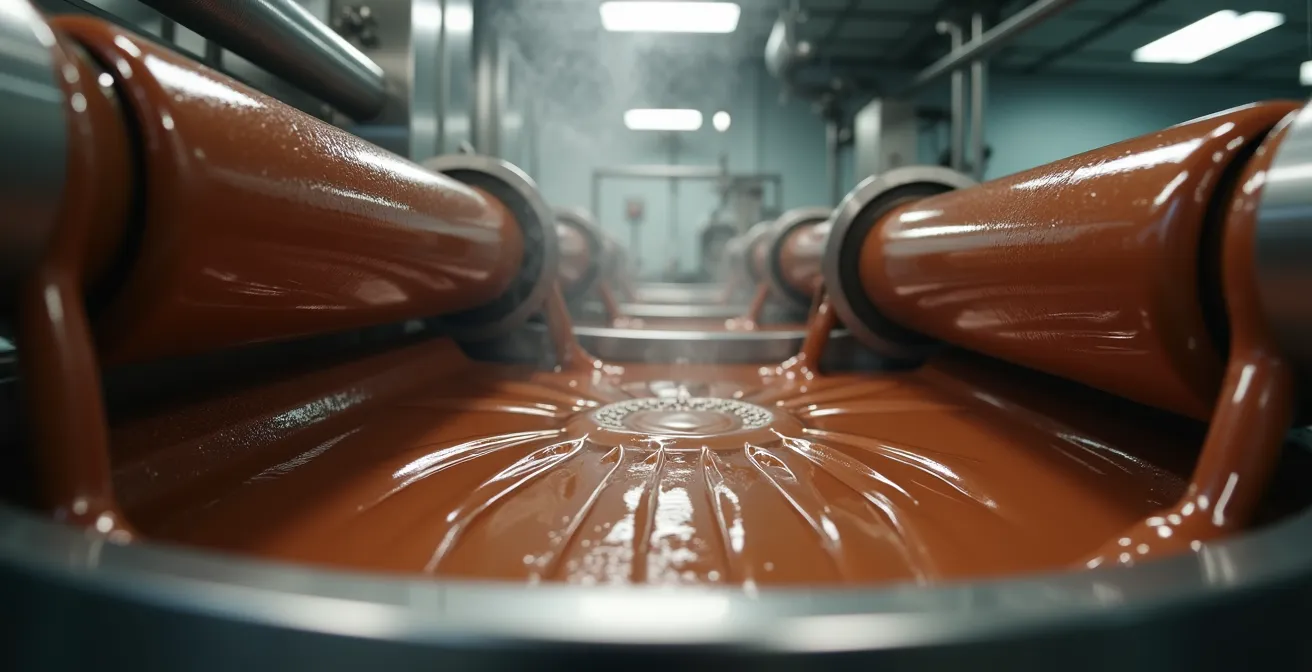
Achieving a silky, non-acidic chocolate is not a matter of time, but of mastering the rheological transitions during conching to precisely control texture and flavour.
- The dry conching phase is essential for targeting and evaporating harsh volatile acids like acetic acid.
- Over-aeration is a critical error that strips desirable fruity aromatic esters along with unwanted acids.
- Final mouthfeel is determined by particle coating and reduced interparticle friction, not just particle size.
Recommendation: Focus on shear rate, temperature, and airflow as precise controls over viscosity and volatile compound selectivity, rather than simply relying on conching duration.
For the dedicated bean-to-bar chocolatier, the pursuit of a perfectly silky, exquisitely flavoured chocolate is a journey of precision. You’ve sourced exceptional beans, roasted them to perfection, and ground them with care. Yet, a persistent, sharp acidity or a slightly grainy texture can stand between a good chocolate and an unforgettable one. The common advice is often an oversimplification: “just conche it longer.” This approach treats conching as a blunt instrument, a matter of endurance rather than finesse. It overlooks the complex interplay of physics and chemistry at work.
The truth is that conching is not merely a mixing step; it is a sophisticated rheological process. Rheology, the study of the flow of matter, is the key to unlocking its full potential. It’s about transforming a mass of solid particles suspended in fat into a fluid, harmonious medium. Understanding conching through this lens allows you to move beyond guesswork and start manipulating variables like shear stress, viscosity, and particle interaction with intention.
This guide abandons the platitudes. We will dissect the conching process from a rheological perspective, focusing on how to specifically target and eliminate unwanted volatile acidity while preserving the delicate aromas that make your cacao unique. We will explore how to manage each phase, choose the right equipment for your scale, and even rescue a batch when things don’t go as planned. This is not about time; it’s about control. It’s about transforming your chocolate’s potential into a palpable, silky reality.
This article provides a detailed roadmap for mastering this critical stage. By understanding the distinct phases and the science behind them, you can elevate your craft from simply making chocolate to engineering its texture and aroma with expert precision.
Summary: A Rheological Guide to Mastering Chocolate Conching
- Why conching less than 24h can ruin a Grand Cru cacao?
- How to manage the dry phase of conching to maximize the evaporation of acids?
- Wheel mixer or longitudinal conche: which one to choose for a production of 50 kg/week?
- The aeration error that kills the subtle notes of yellow fruits
- Fineness problem: how to rescue a poorly ground batch at the end of conching?
- Why is a particle size below 20 microns crucial for the creamy sensation?
- Why does not chewing release the aromas encapsulated in cocoa butter?
- What couverture to choose for molded candies with an ultra-thin shell?
Why conching less than 24h can ruin a Grand Cru cacao?
For a standard chocolate, a shorter conching cycle might be sufficient. However, for a Grand Cru cacao, whose value lies in its complex and nuanced flavour profile, a cycle of less than 24 hours is a significant risk. The reason is twofold and rooted in the dual, and sometimes competing, objectives of conching: flavour development and textural refinement. Flavour development primarily involves driving off unwanted volatile compounds. As the Luker Chocolate Technical Team explains, the process is designed to allow “the volatile flavours to evaporate, which can eliminate any harsh or unwanted flavours”. This includes the sharp, vinegar-like notes of acetic acid, a byproduct of fermentation.
However, the second, equally crucial role of conching is purely mechanical and rheological. It is about texture. A scientific study published in PNAS highlights that a key function is the mechanical breakdown of aggregates and the reduction of interparticle friction. In simpler terms, the conche doesn’t just mix; it uses shear force to break apart microscopic clumps of sugar and cocoa particles and, most importantly, to coat every single solid particle with a thin, lubricating layer of cocoa butter. This coating is what transforms a gritty, thick paste into a fluid, silky liquid.
This rheological transformation is a time-dependent process. While some acid evaporation can happen relatively quickly, achieving a state of minimum interparticle friction where every particle is perfectly lubricated takes sustained energy and motion. Rushing this step with a Grand Cru means you may have removed the most obvious off-notes but failed to develop the luxurious, melting mouthfeel that allows its subtler, more delicate aromas to be fully appreciated. You are left with a chocolate that is merely ‘not sour’ instead of one that is truly sublime. The lost potential is the real ruin.
How to manage the dry phase of conching to maximize the evaporation of acids?
The conching process is not a monolithic block of time; it is strategically divided into phases, with the “dry” phase being the first and most critical for de-acidification. During this initial stage, the chocolate mass is a thick, crumbly, or pasty solid. This high viscosity and friction generate significant heat, which, combined with controlled airflow, creates the perfect conditions for evaporating specific unwanted compounds. The primary targets are the volatile fatty acids produced during fermentation.
It’s scientifically established that a continuous air flowing through the conche removes unwanted acids, specifically acetic, propionic, and butyric acids. These are responsible for the harsh, sour, and sometimes “cheesy” off-notes in under-processed chocolate. The key to maximizing their removal is managing the vapor pressure differential. By heating the mass and passing dry air over its surface, you encourage these volatile acids to leave the chocolate and be carried away. The constant shearing and mixing action continuously exposes new surfaces, ensuring the process is efficient.
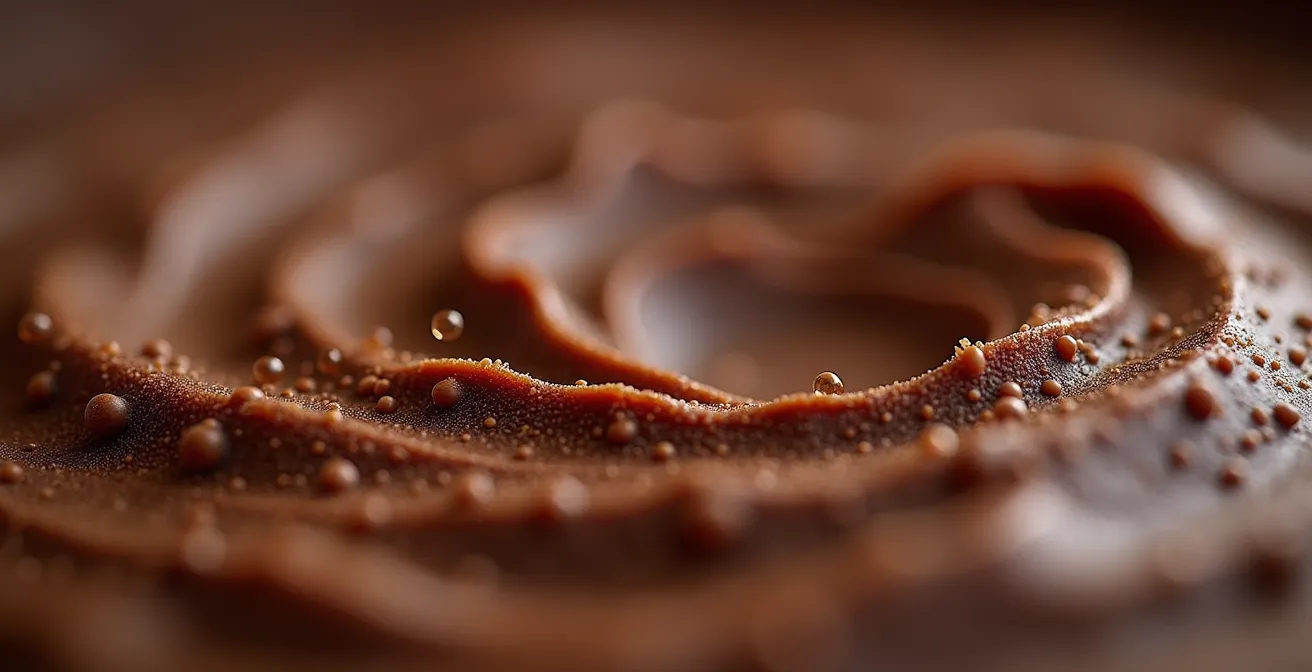
As seen in the textural transformation, this phase is dynamic. Controlling the key parameters is essential for success. The goal is to maintain a high enough temperature to encourage evaporation without initiating excessive caramelization or burning the mass. Continuous, but not overly aggressive, airflow is the vehicle for removing the evaporated acids. This phase ends when the desired level of acidity has been reached and enough moisture has been removed, preparing the chocolate for the “wet” or plastic phase where lecithin and additional cocoa butter are added to finalize its flow properties.
Action plan: Key parameters for an effective dry phase
- Temperature Control: Maintain a temperature between 40-65°C, adjusting for the specific needs of milk or dark chocolate to optimize evaporation without damaging flavour.
- Continuous Airflow: Ensure a steady stream of air is passed through the conche to effectively carry away the evaporated volatile compounds.
- Shear and Aeration: Use the conche’s mixing action to continuously expose new surface area, facilitating the release of trapped acids and moisture.
- Moisture Monitoring: Track the reduction in moisture content as a key indicator that the dry phase is progressing effectively and off-notes are being removed.
- Shear Intensity: Adjust the shearing force based on the initial particle size, ensuring aggregates are broken down while managing heat generation.
Wheel mixer or longitudinal conche: which one to choose for a production of 50 kg/week?
For a small-scale bean-to-bar chocolatier producing around 50 kg per week, the choice of equipment is a critical decision that balances functionality, space, and cost. The two primary contenders are the combination grinder/refiner, often called a wheel mixer or melangeur, and the dedicated longitudinal conche. While both can perform the task, their approach to rheology and efficiency differs significantly, making the choice dependent on your specific production philosophy and goals.
The wheel mixer or melangeur is often the entry point for craft chocolatiers due to its multi-functionality and smaller footprint. It can take cocoa nibs and sugar and refine them down to the desired particle size, and then continue to run to perform a conching action. It excels at particle size reduction but is less efficient at aeration and intensive shearing compared to a dedicated conche. A longitudinal conche, on the other hand, is built for one purpose: to apply intense shear and aeration to a refined chocolate mass. It works by forcing the chocolate back and forth against a bedplate, creating immense friction and surface exposure.
This table summarizes the key trade-offs for a small-scale producer. While a longitudinal conche offers superior conching performance, a high-quality melangeur offers a pragmatic, all-in-one solution that is often a better fit for the space and budget constraints of a 50 kg/week operation. It’s also worth noting that technology is evolving. Some studies show that modern equipment can perform flavor and texture development in under 2-3 hours, challenging traditional timelines.
| Feature | Wheel Mixer (Melangeur) | Longitudinal Conche |
|---|---|---|
| Processing Time | 24-72 hours | 12-96 hours |
| Batch Capacity | 15-75 kg | Variable, typically larger |
| Multi-functionality | Can grind and conche | Conching only |
| Energy Efficiency | Lower power consumption | Higher power requirements |
| Footprint | Compact | Requires more space |
The aeration error that kills the subtle notes of yellow fruits
There is a pervasive belief in chocolate making that “longer is better” when it comes to conching. To an extent, this is true for eliminating harshness. As Chef Michael Antonorsi of Chuao Chocolatier notes, “The longer you conch, the less acidic or tart the chocolate becomes.” This process effectively drives off the aggressive acetic acid. However, this advice becomes a dangerous oversimplification when working with fine flavour cacao that possesses delicate aromatic top notes, such as the esters responsible for hints of citrus, flowers, or yellow fruits.
The critical error is treating all volatile compounds as enemies. Aeration, the process of introducing air to carry away volatiles, is not selective. It will remove the heavy, unwanted acetic acid, but it will just as eagerly strip away the light, ethereal aromatic esters that define a Grand Cru’s personality. This is the conching paradox: the very tool used to clean the flavour profile can also sterilize it. Research confirms that a long conching time is a disadvantage for volatile aromatics due to these evaporation effects.
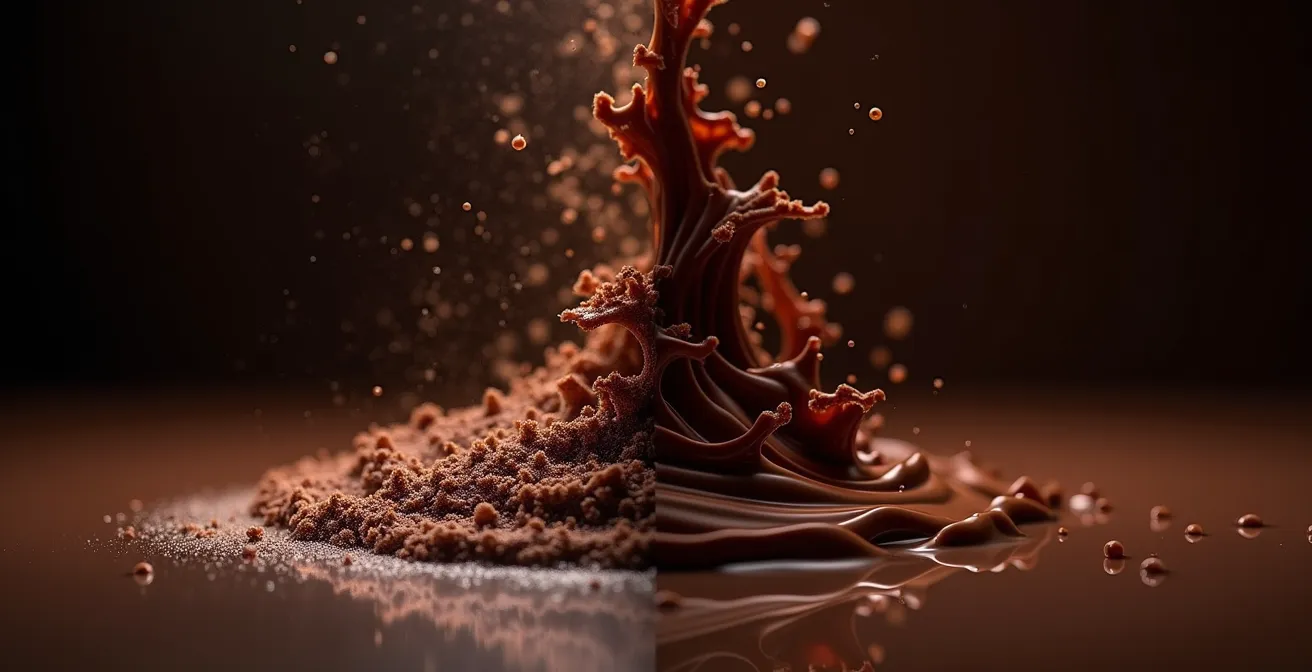
The solution lies in precision. Instead of simply conching for a long duration, an expert chocolatier manages aeration with intent. This might involve a vigorous dry conching phase with high airflow to quickly remove the bulk of the acetic acid, followed by a “closed” or low-aeration wet conching phase. During this latter stage, the primary goal shifts from flavour stripping to textural development—coating particles and reducing viscosity—while protecting the precious remaining aromatics. Over-aeration, especially late in the process, is the fastest way to turn a complex, fruity chocolate into a flat, one-dimensional, and boring one.
Fineness problem: how to rescue a poorly ground batch at the end of conching?
You’ve reached the final stages of conching, but a taste test reveals a dreaded sensation: grittiness. This indicates a problem not with the conching itself, but with the initial refining stage. The particles of sugar and cocoa are too large, creating a sandy texture on the palate. The threshold for human perception is remarkably fine; indeed, consumer research shows that once particles above 30µm are present, the mouthfeel deteriorates rapidly. So, is the entire batch lost? Not necessarily. While you cannot magically shrink the particles in a conche, you can use rheological principles to mitigate the problem.
The sensation of grittiness is a function of two things: the actual particle size and the friction between those particles and the tongue. Conching’s power lies in addressing the latter. By manipulating the formula, you can increase the lubrication within the chocolate mass, effectively masking the presence of oversized particles and improving the overall flow and sensation of smoothness. This is a rescue operation, not a perfect fix, but it can save a batch from being a total write-off.
The primary tools for this are emulsifiers and fat. Adding a small amount of lecithin (typically soy or sunflower) works wonders. Lecithin is a surfactant; one end of its molecule is attracted to fat (cocoa butter) and the other to non-fat particles (sugar, cocoa solids). It wraps around the solid particles, drastically reducing inter-particle friction and lowering the chocolate’s viscosity, making it feel smoother and flow better. A direct increase in cocoa butter content will also achieve a similar, though less potent, effect by simply increasing the volume of the liquid phase. Extended conching at a slightly higher temperature can also help, ensuring these additives are perfectly integrated and every particle is as well-coated as possible.
Checklist: Emergency remediation for a gritty batch
- Add Lecithin: Introduce 0.3-0.5% lecithin to the total batch weight to significantly reduce apparent viscosity and coat solid particles.
- Increase Cocoa Butter: Add an extra 1-3% of cocoa butter to improve the overall fluidity and lubrication of the chocolate mass.
- Extend Conching Time: Continue conching at a slightly elevated temperature (65-70°C) for an additional 4-6 hours to ensure full integration of additives.
- Verify Viscosity: Measure the viscosity to confirm that it has been standardized. The goal is to improve flow, which helps mask the textural imperfections.
- Re-evaluate Application: If the texture is still not premium, consider repurposing the batch for applications where a super-fine texture is less critical, such as inclusions or certain baked goods.
Why is a particle size below 20 microns crucial for the creamy sensation?
The pursuit of a creamy, luxurious mouthfeel in chocolate is fundamentally a battle of microns. While the general industry standard aims to ensure the human tongue cannot detect particles reduced to less than 30 micrometers (μm), achieving a truly “creamy” sensation requires pushing this boundary even further. The difference between a chocolate that is merely “smooth” and one that is perceived as “creamy” lies in this microscopic realm, specifically in the range below 20 microns.
The human tongue is an incredibly sensitive instrument. When chocolate melts in the mouth, the tongue’s receptors are not just tasting flavour; they are performing a complex textural analysis. Any particle large enough to be detected individually is registered as a point of friction, or “grit.” The 30-micron mark is the general threshold for detection, but this doesn’t account for the collective effect of millions of particles. Even if individual particles are below the detection limit, a high concentration of particles in the 25-30 micron range can still create a background “noise” that detracts from a perfectly fluid sensation.
To achieve a state of true creaminess, the goal is to reduce the vast majority of particles (often measured as the D90 value, meaning 90% of particles are below this size) to under 20 microns. At this level, the solid particles are so small that when coated with cocoa butter, they behave more like a continuous fluid than a suspension of solids. The sensory experience is one of uninterrupted smoothness. In fact, highly sensitive scientific analysis has shown the perception is even more acute. A study in *Nature* found that for trained tasters, the Just Noticeable Difference (JND) for particle size in melted chocolate was ~5 μm. This demonstrates that for the ultimate creamy texture, every micron counts.
Why does not chewing release the aromas encapsulated in cocoa butter?
The tasting of fine chocolate is a lesson in patience. The instinctive urge is to chew, to break it down and get to the flavour. However, this action bypasses the very mechanism that a well-made chocolate is designed to leverage: the slow, controlled release of flavour from its fat matrix. As noted by experts at Santa Barbara Chocolate, proper “conching produces the unique creamy mouthfeel, balances flavors, and smoothes out the chocolate,” creating a perfect vehicle for flavour delivery.
Chewing is a brute-force approach. It immediately fractures the cocoa butter crystals and exposes all the flavour compounds at once, overwhelming the palate. More importantly, it mixes the chocolate with a large amount of saliva and moves it to the back of the throat for swallowing too quickly. This prevents the primary mechanism of complex flavour perception: retronasal olfaction. This is the process where volatile aroma compounds, released by the warmth of the mouth, travel up the back of the throat to the olfactory receptors in the nasal cavity. It’s how we perceive the subtle notes of fruit, flowers, spice, or roasted nuts that are distinct from the basic tastes (sweet, bitter, sour) on the tongue.
To properly experience these encapsulated aromas, one must let the chocolate melt. Placing a piece on the tongue and allowing body heat to slowly liquefy the cocoa butter initiates a timed release. As the fat melts, it gently frees the volatile aromas. By breathing gently through your nose during this process, you create a gentle airflow that carries these compounds to your olfactory system. This slow, deliberate process allows you to perceive the “arc” of the chocolate’s flavour, from the initial top notes to the deeper base notes, exactly as the chocolatier intended. Chewing simply demolishes this carefully constructed experience.
Optimal chocolate tasting technique for full aroma release
- Place the chocolate on your tongue and let it rest for a few seconds to acclimate.
- Resist the urge to chew; allow your body heat to slowly and gently melt the cocoa butter.
- As it melts, the mass becomes a fluid, releasing volatile compounds.
- Breathe gently through your nose to facilitate retronasal perception, allowing the full spectrum of aromas to reach your olfactory sensors.
Key takeaways
- Mastering conching is about controlling rheology—viscosity, shear, and particle interaction—not just time.
- A critical balance must be struck: evaporate harsh acids (acetic) without stripping desirable aromatic esters (fruity notes).
- The ultimate sensation of creaminess depends on reducing particle size below 20 microns and ensuring complete particle coating with cocoa butter.
What couverture to choose for molded candies with an ultra-thin shell?
The final application of your chocolate is the ultimate test of its rheological properties. Creating molded candies with a delicate, ultra-thin, and glossy shell is one of the most demanding tasks for a couverture. Success is almost entirely dependent on the chocolate’s flow behaviour, specifically its viscosity and yield stress. A chocolate that is too thick will not flow into the fine details of a mold and will create a clumsy, overly thick shell. A chocolate that is too thin will pool at the bottom of the mold, leaving the walls transparent and fragile.
The perfect couverture for this application exists in a narrow rheological window. Casson viscosity is a measure of the chocolate’s resistance to flow under shear (i.e., when it’s moving). A low viscosity is needed for it to spread easily and coat the entire mold surface. Casson yield stress, on the other hand, is the initial amount of energy required to get the chocolate to start flowing. A moderate yield stress is crucial; it allows the chocolate to “set up” on the mold walls and resist the pull of gravity, ensuring an even shell thickness rather than all the chocolate running to the bottom. Both fat content and particle size are primary drivers of these properties.
For a chocolatier aiming to create these elegant, thin-shelled bonbons, selecting or creating a couverture that meets specific, measurable rheological targets is non-negotiable. The following table outlines the ideal property ranges for this highly specialized application. A chocolate with a higher fat content (around 35-38%) and an exceptionally fine particle size (D90 well below 20 μm) will naturally have the low viscosity required. The yield stress can then be fine-tuned through precise conching and emulsifier levels. This is where all the previous steps of refining and conching converge to produce a chocolate that is not only delicious but also perfectly functional for the most demanding artistic applications.
| Property | Ideal Range | Impact on Shell Formation |
|---|---|---|
| Casson Viscosity | 1.5-2.5 Pa·s | Controls flow into mold details |
| Casson Yield Stress | 1-5 Pa | Prevents pooling, maintains wall thickness |
| Fat Content | 35-38% | Ensures proper fluidity |
| Particle Size (D90) | <20 μm | Smooth texture, even coating |
By shifting your focus from the clock to the specific rheological transformations occurring within the conche, you can elevate your chocolate from simply good to truly exceptional. This control allows you to consistently produce a couverture with the exact texture, flavour, and flow properties your craft demands. To put these principles into practice, begin by evaluating the rheological properties of your current chocolate and identify which parameters—viscosity, particle size, or yield stress—need adjustment to meet your ideal product profile.