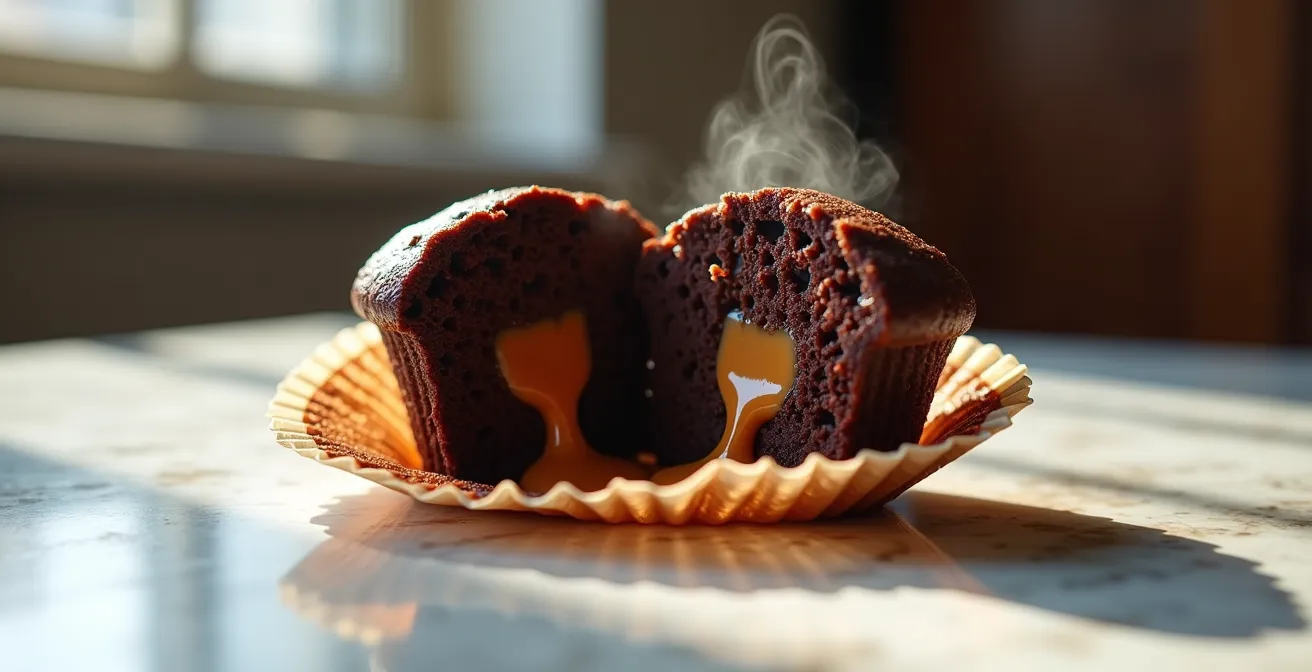
Achieving a stable, liquid-at-room-temperature center in a fully baked product is not a baking trick; it’s an application of thermal physics.
- The key lies in creating a high-fat ganache insert with high thermal inertia, which acts as a heat shield during baking.
- Success depends on precise control over material density to prevent sinking and a staged de-freezing process to avoid condensation.
Recommendation: Stop relying on under-baking. Instead, engineer the insert’s composition and thermal properties to withstand the baking process entirely.
The quest for the perfect “lava” effect—a molten, flowing core erupting from a warm muffin or cookie—is a holy grail for bakers and a viral moment for food enthusiasts. Common advice often suggests simply freezing a ball of ganache or under-baking the batter. While these methods can work for immediate consumption, they fail the test of a professional product: stability. A true “travel cake” or retail-ready item cannot rely on a raw center, and a simple frozen ganache often melts into the batter, gets absorbed, or causes a soggy bottom. This is where baking artistry meets material science.
The standard approaches are flawed because they ignore the fundamental physics at play inside the oven. Creating an insert that remains liquid and distinct *after* the surrounding cake is fully cooked and cooled requires a shift in thinking. It’s not about finding a magic recipe; it’s about engineering a system. This involves manipulating heat transfer, density, emulsion stability, and phase transitions. We must treat the ganache insert not as a simple filling, but as a technical component with specific thermal properties designed to survive a 200°C environment.
This guide moves beyond the kitchen hacks to provide an R&D framework for mastering the bake-stable liquid core. By understanding the ‘why’ behind the ‘how’, you gain the power to not only replicate the effect reliably but also to adapt it for different fillings, sizes, and products. We will deconstruct the process, from formulating the ganache for maximum thermal protection to mastering the precise baking and cooling parameters that guarantee a spectacular, stable, and delicious molten center every single time.
This article provides a complete technical breakdown, exploring the scientific principles and practical production methods for creating flawless molten inserts. The following sections will guide you through each critical stage of the process.
Summary: Mastering the Bake-Stable Molten Insert
- Why use a high-fat ganache delays its baking in the oven?
- How does the frozen ganache ball survive 200°C for 15 minutes?
- Seringue or inclusion solide : quelle méthode est la plus rentable pour 500 pièces ?
- The density error that causes your insert to sink to the bottom of the muffin
- Problème de fluidité : comment adapter la technique pour un cœur praliné pur ?
- How to create an elastic and shiny core using the friction technique?
- The freezing mistake that makes your chocolates sweat when coming out of the cold
- How to master baking to the degree for a liquid core and a firm crust?
Why use a high-fat ganache delays its baking in the oven?
The secret to a bake-stable insert begins with its composition. A standard ganache may be delicious, but for this application, we must think of it as a thermal shield. The key ingredient for this shield is fat, specifically cocoa butter. Fat has a lower thermal conductivity compared to water, which is abundant in cake batter. This means it transfers heat much more slowly. By formulating a ganache that is rich in fat (e.g., a 2:1 or even 3:1 ratio of chocolate to cream, supplemented with cocoa butter), you are essentially creating an insulating material. This concept is fundamental, as research on heat transfer properties shows that materials with lower conductivity require more time to heat up.
When this high-fat ganache is placed inside a water-based batter, it creates a thermal barrier. While the oven’s heat rapidly penetrates the batter, causing water to turn to steam and proteins to set, it struggles to breach the fatty core. The fat molecules in the ganache absorb thermal energy at a much slower rate. Furthermore, the addition of fat significantly alters the rheological and thermal parameters of the chocolate mixture. Detailed studies confirm this; as thermal modeling of chocolate melting dynamics shows, fat particles coat sugar and cocoa, reducing internal friction and lowering the overall rate of heat absorption.
This deliberate formulation is the first line of defense. It’s not just about flavor or texture; it’s a calculated engineering choice. You are creating a core with high thermal inertia, meaning it resists changes in temperature. While the surrounding cake bakes, sets, and browns, the high-fat core is only just beginning its slow journey towards melting temperature, giving it a crucial head start in the race against the oven’s clock.
How does the frozen ganache ball survive 200°C for 15 minutes?
If a high-fat composition is the first line of defense, freezing is the second, and it’s a powerful one. Placing a room-temperature ganache ball into batter is a recipe for failure; it will melt and bleed into the surrounding cake almost immediately. Freezing the insert transforms it from a simple filling into a block of thermal energy, leveraging the physics of phase transition. Before the ganache can even begin to melt, it must first absorb enough energy to raise its temperature from its frozen state (e.g., -18°C) to its melting point (e.g., 30-34°C). This process alone consumes a significant amount of thermal energy from the oven.
But the real magic happens at the melting point itself. The transition from a solid to a liquid is not instantaneous. It requires a massive amount of energy, known as the latent heat of fusion. The frozen core must absorb all this energy before it can fully liquefy. This creates a “thermal plateau” where the insert’s temperature remains stable at its melting point for a prolonged period, even as the oven continues to pump in heat. During this time, the surrounding muffin or cookie batter is cooking, setting its structure. The energy required is substantial, as thermal calculations demonstrate that a significant amount of energy is needed just to change a substance’s state.
The combination of a high-fat, insulating composition and the energy sink created by the phase transition is what allows the frozen core to survive. The outer layer of the ganache ball may liquefy, but it acts as an additional insulating layer for the still-frozen center.
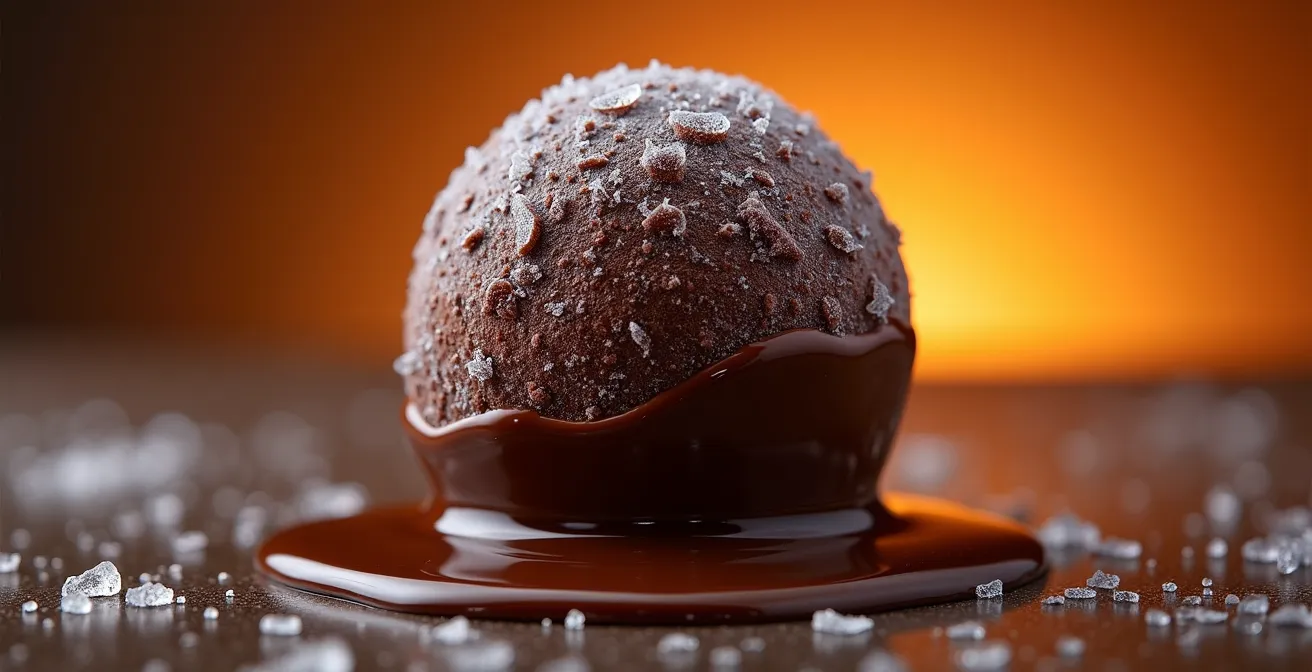
As visualized here, the process is a gradual phase transition from the outside in. By the time the surrounding cake is perfectly baked and firm (around 10-15 minutes), the ganache core has only just completed its melt. The established structure of the cake now contains the liquid insert, preventing it from leaking or being absorbed. This is how the insert survives the oven and remains liquid even when the product cools to room temperature.
Seringue or inclusion solide : quelle méthode est la plus rentable pour 500 pièces ?
Once the science is mastered, production efficiency becomes the next challenge, especially when scaling up. For a small batch, injecting a liquid core post-baking with a syringe might seem easy. However, for a production run of 500 units, the choice between post-bake injection and pre-bake solid inclusion has significant implications for cost, consistency, and labor. Post-baking injection is labor-intensive, prone to inconsistency in centering and fill volume, and often leads to higher waste from leaks or blowouts. It also pierces the product’s crumb structure, potentially affecting shelf life.
The solid inclusion method—embedding a pre-formed, frozen ganache sphere into the raw batter—is vastly superior for scaled production. While it requires an initial investment in silicone molds and freezer space, the returns in efficiency and quality are substantial. The labor time per unit drops dramatically, as depositing a solid sphere is much faster than carefully injecting a liquid. Most importantly, it guarantees perfect centering and a consistent fill volume every time, which is critical for a professional-grade product and a reliable “wow” factor for the customer.
For even larger industrial scales, co-extrusion technology exists, but for a semi-artisanal production of 500 pieces, the solid inclusion method hits the sweet spot between investment and return. A cost-benefit analysis makes the choice clear.
As this comparative analysis of insertion methods demonstrates, the initial equipment cost for solid inclusion is quickly offset by major savings in labor and waste.
| Method | Labor Time/Unit | Equipment Cost | Waste % | Consistency |
|---|---|---|---|---|
| Syringe Injection | 30 seconds | Low ($50) | 5-8% | Variable centering |
| Solid Inclusion | 15 seconds | Medium ($200 molds) | 1-2% | Perfect centering |
| Co-extrusion | 5 seconds | High ($2000+) | <1% | Excellent |
The data unequivocally favors the solid inclusion method for achieving consistent, high-quality results at scale. It transforms a finicky manual process into a repeatable, streamlined manufacturing step, which is essential for profitability.
The density error that causes your insert to sink to the bottom of the muffin
You’ve perfected your high-fat ganache and frozen it solid. You place it carefully into the center of your muffin batter, bake it, and cut it open, only to find the molten core pooled at the very bottom. This common failure isn’t a baking error; it’s a physics error. The problem lies in the density gradient between your insert and your batter. If the ganache core is significantly denser than the raw batter it displaces, it will inevitably sink during the initial, liquid stage of baking.
The principle at play is a classic from physics, as one research team eloquently states in their analysis:
Frame the problem using Archimedes’ principle: the insert sinks if its density is greater than the density of the raw batter it displaces.
– Food Science Research Team, Journal of Culinary Physics
To solve this, you must engineer the densities. Your muffin or cookie batter’s density is relatively fixed by its formula. Therefore, you must adjust the density of your ganache insert. A ganache made with very dense, low-cocoa-butter chocolate and heavy cream will be a prime candidate for sinking. To reduce the insert’s density, you can incorporate lighter ingredients. This could involve using a higher cocoa butter chocolate (which is less dense than cocoa solids), or carefully whipping the ganache before freezing to incorporate microscopic air bubbles. This process, known as aeration, can significantly lower the overall density without compromising the fat content required for thermal insulation.
The goal is to achieve near-neutral buoyancy, where the density of the frozen insert is as close as possible to the density of the raw batter. A simple test is to drop a frozen test-sphere into a cup of your batter. If it plummets to the bottom, your insert is too dense. It should sink slowly or hover. By mastering this variable, you ensure the core remains perfectly centered, delivering a flawless cross-section and the ideal eating experience.
Problème de fluidité : comment adapter la technique pour un cœur praliné pur ?
Once you’ve mastered the chocolate ganache insert, the next logical step is to experiment with other fillings, such as caramel, fruit purée, or praline. However, simply freezing a ball of pure praline paste and dropping it into batter will likely result in failure. Unlike a high-fat ganache, many of these fillings have a different composition, particularly a higher sugar and/or water content and a lower fat content. A pure praline, which is an emulsion of roasted nuts and sugar, is notoriously unstable under heat. The oil can separate from the solids, creating a greasy, broken texture that leaches into the surrounding cake.
The solution is to adapt the core principle: you must re-engineer the filling to improve its emulsion stability and thermal properties. For a praline core, this means turning it into a “praline ganache.” This is achieved by emulsifying the praline paste with a stabilizing fat, typically melted cocoa butter or a high-quality white chocolate. This serves two purposes. First, the added fat improves the thermal inertia, just as it does in a standard chocolate ganache. Second, the fat and the emulsifiers present in the chocolate (like lecithin) help to bind the nut oils, preventing them from separating under the stress of baking.
The ratio is critical. You might start with a 70:30 mix of praline to melted white chocolate, testing and adjusting until you find the perfect balance of flavor and stability. You may also need to incorporate a tiny amount of a structural agent, like a specialized starch or even a small percentage of flour, to help bind the emulsion. This principle is well-understood in baking; as one study notes, “You do not need a lot of flour for these lava cakes. The flour provides structure, but too much will compromise the molten centers.” This same logic applies to stabilizing a non-chocolate core. The goal is to add just enough structure to survive the bake without turning the liquid center into a solid paste.
How to create an elastic and shiny core using the friction technique?
Creating a stable core is the primary technical challenge, but for a truly premium product, the final quality of the ganache matters. You want a core that is not just liquid, but also glossy, smooth, and with an elastic “stretch” when pulled. This superior texture is the result of a perfect emulsion and precise chocolate crystal formation. While standard melting and mixing can work, a more advanced method to achieve this is the friction technique, often performed with a food processor or a high-power blender.
Instead of gently melting the chocolate, this technique uses the mechanical energy and friction of rapidly spinning blades to melt and emulsify the ingredients simultaneously. By processing solid chocolate callets with the liquid cream, the intense shear force creates an incredibly fine and stable emulsion. The fat and water particles are dispersed more uniformly than with traditional methods, resulting in a ganache with a uniquely smooth and elastic mouthfeel. This process also provides excellent control over temperature, which is vital for proper crystallization of the cocoa butter.
The shine of a chocolate product is directly related to its crystal structure. The goal is to encourage the formation of Form V crystals, which are the most stable and provide the best snap and gloss. While full tempering isn’t necessary for an insert that will be melted, controlling the emulsion process through friction helps create a more organized and homogenous crystalline base. According to tempering science, these stable crystals are key to a professional finish. By creating a superior emulsion through friction, you set the stage for a ganache that not only flows beautifully but also has a luxurious, high-quality appearance and texture, elevating it from a simple filling to a gourmet component.
The freezing mistake that makes your chocolates sweat when coming out of the cold
You’ve navigated the complex physics of baking, and your molten core muffins come out of the oven perfectly. But a few hours later, you notice a fine layer of moisture on the surface, a phenomenon known as “sweating.” This is caused by condensation, and it’s a critical post-baking error that can ruin the product’s appearance and lead to sugar bloom. The mistake happens when a product with a still-cold core is exposed to warmer, more humid ambient air. The cold surface of the product cools the surrounding air below its dew point, causing water vapor to condense directly onto it.
This is especially problematic with frozen inserts. Even after baking, the core of the product can remain significantly cooler than the exterior for some time. Pulling them directly from the oven into a warm kitchen is the most common trigger. The solution is to manage the product’s temperature transition carefully, a process known as staged tempering. The goal is to allow the product’s internal and external temperatures to equalize gradually, preventing any surface from becoming cold enough to cause condensation.
Implementing a standard operating procedure is the best way to ensure consistency and avoid this pitfall. This involves moving the baked goods through progressively warmer environments. For example, instead of moving them from the oven to the countertop, you might move them to a cooler, low-humidity part of the kitchen first, or even use a series of holding cabinets set at different temperatures. For the inserts themselves, studies show that chocolate should be brought from freezer to room temperature gradually over 2-3 hours to prevent condensation. The same principle applies to the finished product.
Action Plan: Audit Your De-Freezing Process
- Move inserts from freezer (-18°C) to a sealed, airtight container. This prevents initial contact with humid air.
- Transfer the sealed container to a refrigerator (4°C) for a minimum of 2 hours. This is the crucial first stage of gradual warming.
- Move the still-sealed container to a cool room (18°C) for at least 30 minutes. This brings it closer to ambient temperature.
- Open the container only when you are certain the surface temperature of the inserts has reached the room’s temperature.
- Use the inserts immediately in your batter or store them in a controlled, low-humidity environment to prevent re-absorption of moisture.
Key Takeaways
- Success hinges on physics, not recipes: Use high-fat ganache for thermal insulation and freezing for energy absorption (phase transition).
- Density is non-negotiable: Your insert’s density must be close to your batter’s density to prevent it from sinking during the bake.
- Control the cool-down: Gradual, staged temperature reduction is essential to prevent condensation (“sweating”) and sugar bloom on the final product.
How to master baking to the degree for a liquid core and a firm crust?
The final variable in this complex equation is the baking environment itself. You can have a perfectly engineered insert, but if the baking time and temperature are wrong, the entire system fails. The goal is to apply enough heat to fully cook the surrounding cake while delivering just enough residual energy to melt the core without overheating it. This requires understanding the critical temperature points in baking. Your batter doesn’t cook instantly; it undergoes a series of transformations at specific temperatures.
For a typical cake batter, the process follows a predictable sequence. As thermal analysis research indicates that starch gelatinization starts at 65°C, which is when the batter begins to thicken and set. Shortly after, egg proteins begin to coagulate around 73°C, providing the final structure and crumb. Finally, the Maillard reaction and caramelization, which create the desirable brown crust and complex flavors, occur at much higher temperatures, typically above 140°C. Your baking strategy must be calibrated to these milestones.
Your objective is to keep the internal temperature of the ganache core below the setting temperature of the cake for as long as possible, but ensure the batter *around* the core surpasses the 73°C threshold needed for a firm structure. A high initial oven temperature (e.g., 200-210°C) can help set the outer crust quickly, providing structural integrity, followed by a potential reduction in temperature to allow the inside to cook more gently. Using a precise probe thermometer to measure the internal temperature of the cake portion (not the insert) is the ultimate tool for consistency. When the cake portion reaches approximately 90-95°C, it is fully cooked. At this point, your engineered insert should be perfectly molten, held securely within the set crumb.
By combining a scientifically formulated insert with a precisely controlled baking process, you move from hoping for a liquid center to engineering one with certainty. This R&D mindset is the ultimate tool for creating innovative, reliable, and spectacular baked goods that stand out in a crowded market.
Frequently Asked Questions on Creating Molten Cores
What speed should I use for friction mixing?
For the friction technique, a medium-high speed (equivalent to setting 6-7 on most stand mixers) for about 3-4 minutes is optimal. This generates enough shear force and gentle heat to create a perfect, fine emulsion without breaking it.
How do I know when the friction is complete?
You can identify the completion of the friction process by visual cues. The ganache mixture will transform, becoming noticeably glossy and often slightly lighter in color. The key indicator is when it becomes thick enough to leave defined “ribbons” on the surface when the whisk or paddle is lifted.
Can I over-mix using the friction technique?
Yes, over-mixing is a risk. If you continue to mix at high speed after the emulsion is formed, you can generate too much heat and shear, which can cause the emulsion to break. The fat (cocoa butter) will separate from the other ingredients, resulting in a greasy, grainy texture. It is crucial to stop mixing as soon as the ganache becomes glossy and forms ribbons.