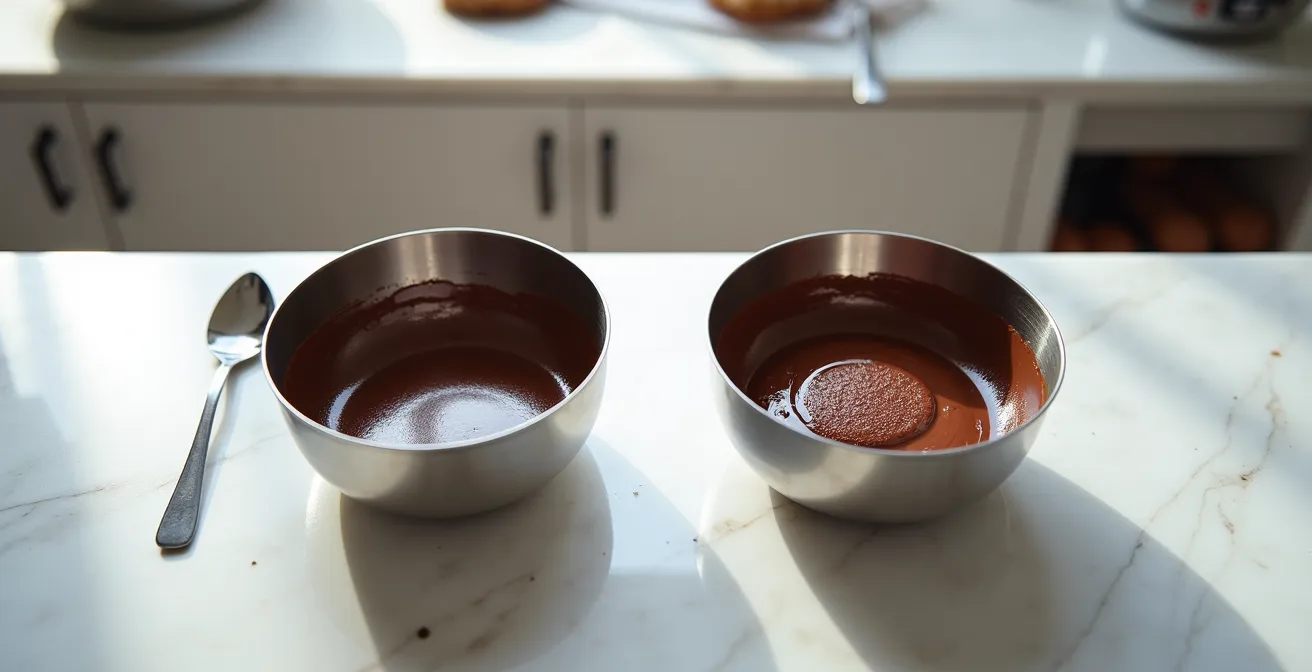
The choice between maltitol and erythritol is not about which is “better,” but about mastering their distinct molecular mechanics to control the final texture and sensory profile of your chocolate creations.
- Erythritol’s cooling effect and poor solubility require strategic masking and blending, while its zero-calorie, non-glycemic profile is ideal for keto and diabetic recipes.
- Maltitol’s sucrose-like behavior provides superior texture and gloss but comes with a higher glycemic index and a significantly lower digestive tolerance.
Recommendation: Formulate with a calculated blend of polyols, fibers, and flavor agents rather than relying on a single substitute. This is the key to achieving both structural integrity and a balanced palate in professional sugar-free patisserie.
For any pâtissier venturing into sugar-free or low-carb formulations, the battlefield is littered with grainy ganaches, weeping mousses, and chocolate that refuses to snap. The primary culprits are often the sugar substitutes themselves, with maltitol and erythritol as the leading contenders. The common advice simply pits one against the other based on glycemic index or a vague mention of a “cooling” aftertaste. This superficial approach fails the professional who understands that texture and mouthfeel are paramount.
The debate isn’t about which one tastes sweeter. It’s a question of physical chemistry and molecular interaction within a complex matrix of cocoa solids, fat, and emulsifiers. A successful sugar-free dessert doesn’t come from a one-to-one swap, but from a deep understanding of how each polyol behaves under heat, during crystallization, and in the presence of water. The true challenge lies in compensating for the structural and functional roles that sucrose plays so effortlessly.
But what if the key wasn’t choosing a “winner” but learning to command an arsenal? This guide moves beyond the simplistic “versus” debate. We will dissect the molecular mechanics of these sweeteners, providing you, the formulator, with the technical knowledge to control their behavior. We will explore how to mask undesirable sensory effects, leverage fibers for texture, understand the critical thresholds for digestive tolerance, and master the art of tempering chocolate when sucrose is off the table. This is your manual for building structurally-perfect, sugar-free patisserie from the molecule up.
Summary: A Formulator’s Guide to Polyols in Chocolate Pastry
- Why does your chocolate cake have a minty taste and how can you mask it?
- How do chicory fibers replace fat and sugar in a mousse?
- Dates or applesauce: which fruit puree pairs best with strong cocoa?
- The polyol overdose mistake that turns your dessert into a laxative
- Stevia or monk fruit: which sweetener doesn’t alter the tempering of chocolate?
- Gluten or gluten-free: which powder ensures the finest structure?
- The dosing error that turns fine cocoa into a bland candy
- Why does choosing an 85% cocoa chocolate optimize your antioxidant intake?
Why Does Your Chocolate Cake Have a Minty Taste and How Can You Mask It?
That notorious “minty” or “cool” sensation from erythritol is not a flavor, but a physical phenomenon. It’s an endothermic reaction; as erythritol dissolves in saliva on the tongue, it absorbs heat from its surroundings, creating a cooling feeling. This effect is more pronounced in applications with low water content or high concentrations of the sweetener, such as in a rich chocolate cake or a dense brownie. For a pâtissier, this sensory interference can completely derail the intended flavor profile of a deep, warm chocolate dessert.
Masking this effect is a game of chemical and sensory strategy. The goal is to either overwhelm the cooling sensation with competing flavors or alter the dissolution rate of the erythritol itself. Simply increasing the amount of cocoa or vanilla is rarely sufficient. A more effective approach involves a multi-pronged attack on the formulation.
The key is to think like a formulator, not just a baker. Blending erythritol with other sweeteners that have different dissolution properties is a primary technique. Allulose, for example, can disrupt erythritol’s crystalline structure, leading to a smoother mouthfeel and reduced cooling. Incorporating warm spices or ingredients with specific chemical compounds can also create a sensory counter-balance. Effective methods include:
- Blending with other polyols: A 40/60 mix of erythritol and maltitol can significantly reduce the cooling effect while improving texture.
- Using warm spices: Compounds like cinnamaldehyde in cinnamon directly counter the cooling sensation on a sensory level.
- Incorporating high-fat ingredients: Fats like cocoa butter or heavy cream can coat the erythritol crystals, slowing their dissolution in the mouth.
- Leveraging context: Use erythritol in recipes where cooling is a natural fit, such as mint-chocolate desserts or fruit sorbets.
Action Plan: Auditing Your Recipe for Erythritol’s Cooling Effect
- Quantification: Measure the current erythritol-to-total-solids ratio in your formula. Is it the dominant bulking agent causing the pronounced cooling?
- Synergy Analysis: Identify existing ingredients that can mask the effect. Do you have warm spices, high-fat components (cocoa butter, cream), or other polyols that can be leveraged?
- Blending Tests: Formulate three small test batches, replacing 10%, 20%, and 40% of the erythritol with allulose or maltitol. Evaluate the sensory changes in a blind tasting.
- Flavor Adjuncts: In a separate test, add 0.5% cinnamon or 1% vanilla extract to the original formula. Assess if the cooling perception is diminished without overpowering the chocolate.
- Final Formulation: Based on test results, create a final revised formula integrating the most effective combination of blending and flavor masking. Document the new ratios for future consistency.
How Do Chicory Fibers Replace Fat and Sugar in a Mousse?
In a classic chocolate mousse, sugar provides bulk and structure, while fat (from egg yolks and cream) delivers a rich, creamy mouthfeel. Removing both leaves a significant structural and sensory void. This is where hydrocolloids like inulin, a fiber derived from chicory root, become essential tools for the modern pâtissier. Inulin doesn’t just add fiber; it fundamentally alters the physics of the mousse.
Inulin’s power lies in its ability to form a particle gel in water. When hydrated, its long-chain molecules create a fine, creamy network that mimics the mouthfeel of fat. This network traps air bubbles, providing the stability and body that sugar would typically contribute. This allows you to create a mousse that is both light in texture and rich in perception, without the caloric load of sugar or excess fat. Unlike other hydrocolloids such as xanthan gum, which can create a slimy or elastic texture, inulin results in a “short,” clean break on the palate, very similar to traditional mousse.
The successful use of chicory fiber depends on understanding its dosage and synergy with other ingredients. It works best in high-moisture applications like mousse, panna cotta, or custards. However, it’s crucial to note that inulin is a high-FODMAP ingredient, which can be a concern for some customers with digestive sensitivities. Therefore, it’s a powerful tool but one that requires careful consideration of the final consumer profile.
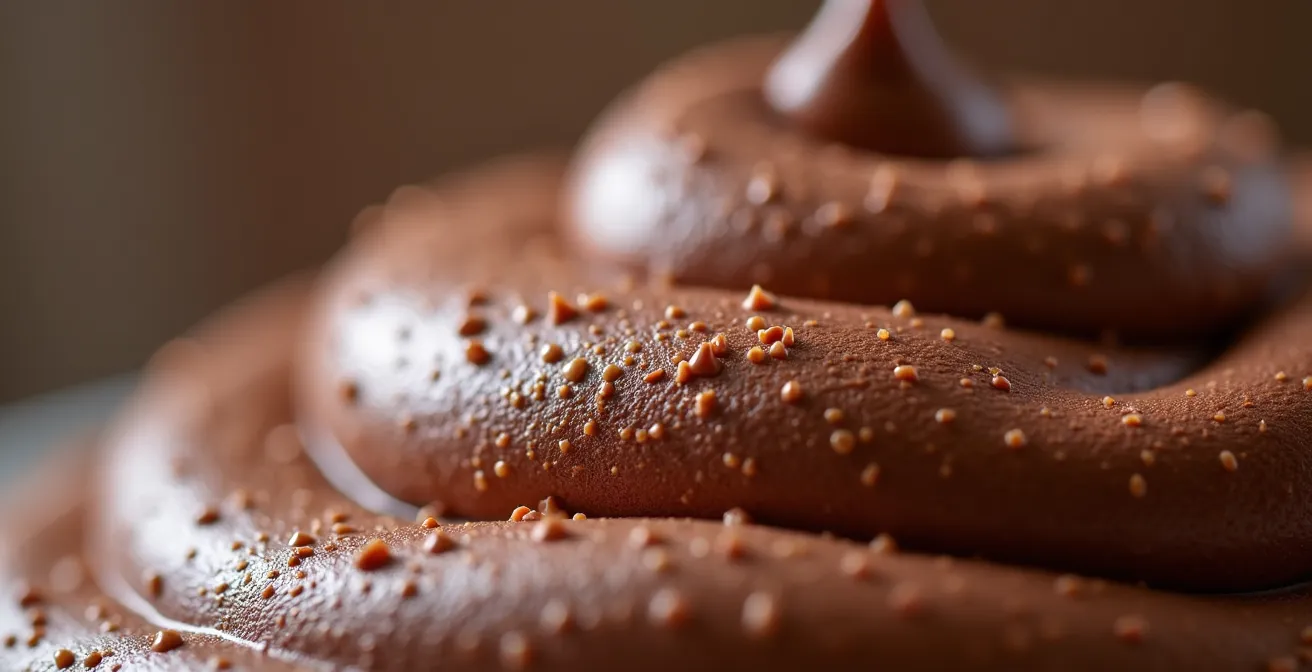
As you can see in the microscopic view, the successful incorporation of air is what defines a mousse. Chicory fiber helps to create and stabilize this delicate, bubble-filled matrix. The result is a product that feels indulgent and full-bodied, demonstrating that texture can be engineered through a scientific understanding of ingredients, going far beyond simple substitution.
Dates or Applesauce: Which Fruit Puree Pairs Best with Strong Cocoa?
When replacing refined sugar with fruit purees, a pâtissier must consider more than just sweetness. The two most critical factors are water content and flavor chemistry, especially when working with assertive, high-cacao chocolate. While applesauce is a common household substitute, its high water content makes it a challenging ingredient in professional patisserie.
A revealing nutritional analysis shows that applesauce contains approximately 88% water, while date paste contains only around 23%. This massive difference in hydration has profound implications for a chocolate recipe. The excess water in applesauce can dilute the cocoa flavor, disrupt the emulsion in a ganache, and lead to a gummy, overly moist crumb in cakes. It forces the formulator to rebalance the entire recipe, often by adding more flour or dry ingredients, which can compromise the final texture.
Date paste, on the other hand, offers a concentrated source of sweetness with low water activity. Its true advantage, however, lies in its flavor synergy with dark cocoa. The production of date paste involves heating, which initiates the Maillard reaction. This creates complex flavor compounds like furaneol (caramel notes) and sotolon (maple/nutty notes). These roasted, deep flavors don’t just sweeten the chocolate; they complement and enhance its inherent bitterness and roasted character, creating a sophisticated and layered flavor profile. Professional chocolatiers have found that brownies made with date paste not only have a fudgier texture but also exhibit 30% better moisture retention after 72 hours compared to those made with applesauce, thanks to the binding properties of the dates’ fiber and sugar profile.
The Polyol Overdose Mistake That Turns Your Dessert Into a Laxative
For the sugar-free formulator, the most significant non-culinary consideration is the digestive tolerance of polyols. Sugar alcohols are not fully absorbed in the small intestine, and excessive consumption draws water into the colon, leading to a well-known laxative effect. This is not a minor side effect; it’s a critical formulation constraint that directly impacts customer safety and satisfaction. The mistake is assuming all polyols are created equal in this regard.
Maltitol, prized for its sucrose-like texture, has a much lower digestive tolerance than erythritol. The laxative threshold for maltitol is around 0.4 grams per kilogram of body weight, whereas for erythritol it’s as high as 1g/kg. This means a 70kg person might experience issues after consuming just 28g of maltitol—an amount easily found in a couple of sugar-free chocolate bars or a single generous dessert portion. In contrast, they could consume up to 70g of erythritol. Further complicating matters, sorbitol, often used in commercial sugar-free products, has an even lower threshold, with clinical studies demonstrating that 60-70% of healthy adults experience digestive issues with a dose as small as 10g.
A responsible pâtissier must track the cumulative polyol load in a recipe. This includes not just the primary sweetener but also those hidden in other sugar-free ingredients. A single dessert might contain a blend of maltitol, erythritol, and sorbitol from various components, and their effects are additive. Transparency with customers, especially those new to keto or diabetic diets, is paramount. Labeling a product as “sugar-free” without a warning about potential digestive effects can lead to a negative experience that undermines trust in your brand.
The following table, based on data from analyses of common polyols, is an essential reference for any formulator.
| Polyol | Laxative Threshold | Glycemic Index | Sweetness vs Sugar |
|---|---|---|---|
| Erythritol | ~1g/kg body weight | 0 | 70% |
| Maltitol | ~0.4g/kg body weight | 35-52 | 75-90% |
| Sorbitol | ~0.2g/kg body weight | 9 | 60% |
| Xylitol | ~0.3g/kg body weight | 13 | 100% |
Stevia or Monk Fruit: Which Sweetener Doesn’t Alter the Tempering of Chocolate?
Tempering chocolate is a precise science of temperature control to encourage the formation of stable Form V crystals in cocoa butter. These crystals are responsible for the desirable high gloss, firm texture, and satisfying “snap” of well-tempered chocolate. When sucrose is replaced, the entire crystalline structure is at risk. While high-intensity sweeteners like stevia and monk fruit are excellent for their zero-calorie profile, their use in chocolate making is fraught with challenges related to their physical form.
Most commercially available stevia and monk fruit powders are not pure. They are blended with bulking agents to make them measurable for consumers. The most common bulking agent is, ironically, erythritol. As we’ve established, erythritol does not fully dissolve in the fat phase (cocoa butter) of chocolate. It remains as microscopic, suspended solid crystals. These rogue crystals interfere with the cocoa butter’s ability to align into the proper Form V structure, acting as “seed” points for incorrect crystal formation. The result is a chocolate that fails to temper properly, leading to a dull, streaky appearance, a soft or crumbly texture, and fat bloom over time.
Maltitol, by contrast, behaves much more like sucrose on a molecular level. Its chemical similarity allows it to integrate seamlessly into the chocolate mass during conching. In fact, chocolate manufacturing data reveals that maltitol integrates 85% better into the chocolate mass than erythritol, which is why it’s the preferred bulking sweetener for many large-scale commercial sugar-free chocolates.
Luker Chocolate’s 8-Year Sweetener Development
The critical factor is avoiding bulking agents. In an extensive eight-year development process, specialty manufacturer Luker Chocolate confirmed this principle. Their research found that the only way to use high-intensity sweeteners without compromising temper was to use them in their pure, liquid form. Pure liquid stevia or monk fruit drops, which contain no solid bulking agents, can be added to the chocolate without introducing foreign crystals. This allows the cocoa butter to form the stable Form V crystals uninhibited, preserving the chocolate’s gloss and snap.
Gluten or Gluten-Free: Which Powder Ensures the Finest Structure?
When engineering the structure of a sugar-free chocolate cake, the choice of flour is just as critical as the choice of sweetener. Sugar is not just a sweetener; it’s a tenderizer and a moisture-retaining agent. When it’s removed and replaced with a drier polyol like erythritol, the flour’s properties are magnified. The gluten network in traditional wheat flour provides a strong, elastic structure that can tolerate these changes to some degree, resulting in a familiar tight, uniform crumb.
Venturing into gluten-free territory dramatically complicates the formulation. Gluten-free flours like almond or coconut have entirely different relationships with moisture and fat. Almond flour, high in protein and fat, creates a dense, moist crumb but can become heavy. Coconut flour is exceptionally absorbent—it requires up to 25% more liquid than wheat flour—and can easily result in a dry, crumbly texture if the recipe isn’t properly rehydrated. This high absorbency can be an advantage when paired with sweeteners that don’t bind water well, but it demands a complete rebalancing of the formula’s liquids.
Gluten-free blends that rely on starches and a gum-like xanthan to mimic gluten’s structure are the most sensitive of all. The delicate network they create can be easily disrupted by the crystalline nature of certain sugar substitutes. The choice of sweetener directly impacts the viability of a gluten-free flour blend. A successful gluten-free, sugar-free chocolate cake is therefore a masterclass in balancing the competing needs of a substitute structure (the GF flour blend) and a substitute sweetener.
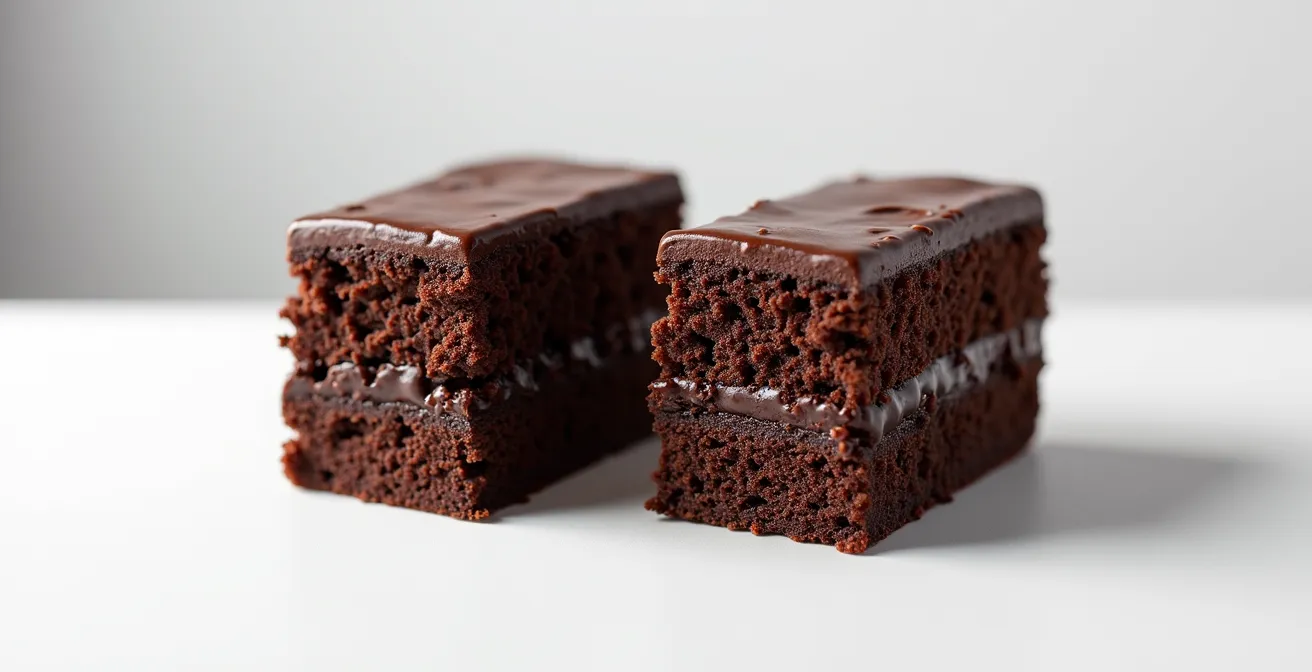
This side-by-side comparison highlights the structural challenge. The gluten-based cake maintains its integrity, while the gluten-free version’s structure is entirely dependent on the precise balance of its flour blend, hydration level, and its interaction with the chosen polyol. There is no single “best” powder; there is only the right powder for a specific, fully-balanced formulation.
The Dosing Error That Turns Fine Cocoa Into a Bland Candy
One of the most common mistakes in sugar-free formulation is treating sweeteners as a simple, one-dimensional substitute for sucrose’s sweetness. This ignores a crucial secondary role of sugar: flavor suppression. In traditional chocolate making, the high concentration of sucrose actually mellows and rounds out the sharp, bitter, and sometimes harsh flavor notes inherent in raw cocoa beans. It acts as a buffer, making the final product more palatable.
When you replace sucrose with a high-intensity sweetener like stevia or even a less-sweet polyol like erythritol, you are unmasking the cocoa. Suddenly, all of its raw, complex, and sometimes aggressive flavors come to the forefront. If the cocoa powder or chocolate liquor used is of average quality, this can result in an unpleasantly bitter, acidic, or earthy taste. The dessert no longer tastes like a rich chocolate treat, but like a piece of bland, unsophisticated health food. The dosing error is not just about making something “too sweet” or “not sweet enough”; it’s about failing to account for sugar’s role as a flavor modulator.
As one expert guide for chocolatiers notes, this is a fundamental principle of advanced formulation:
Sugar’s role is not just sweetness, but also flavor suppression. High-intensity sweeteners unmask the raw, sometimes harsh flavor of cocoa that sucrose would normally mellow.
– Professional Chocolatier Network, Advanced Chocolate Formulation Guide 2024
To counteract this, the formulator must think in layers. This involves using a blend of sweeteners to create a more rounded “sugar-like” sweetness profile, and incorporating “bridge” flavors like vanilla or a pinch of salt. Salt, in particular, is a powerful tool as it can suppress bitterness without adding any sweetness. This technique of flavor layering allows you to control the final flavor profile, turning the unmasked cocoa from a liability into an asset by showcasing its complex notes in a balanced way.
Key Takeaways
- Mastering sugar-free patisserie is about understanding the molecular mechanics and physical properties of polyols, not just their sweetness.
- Erythritol’s cooling effect can be masked by blending with other sweeteners and using fats or specific spices to alter its dissolution.
- The choice between maltitol and erythritol is a trade-off: maltitol offers superior texture at the cost of lower digestive tolerance and a higher glycemic impact.
Why Does Choosing an 85% Cocoa Chocolate Optimize Your Antioxidant Intake?
For the health-conscious consumer driving the sugar-free trend, the appeal of dark chocolate goes beyond flavor; it’s about the perceived health benefits, particularly its high antioxidant content. The primary antioxidants in cocoa are a class of polyphenols called flavanols. As a general rule, the higher the percentage of cocoa solids in a chocolate, the higher the concentration of these beneficial compounds. This makes an 85% or even 99% cocoa chocolate an attractive base for a “healthy” dessert.
However, the percentage on the label is not the only factor. The processing of the cocoa itself plays a critical role. “Dutch-processing” or alkalization is a common method used to neutralize cocoa’s natural acidity, resulting in a darker color and milder flavor. Unfortunately, this process can significantly degrade the flavanol content. A startling antioxidant analysis reveals that a natural (non-alkalized) 75% chocolate can contain more bioavailable flavanols than a Dutch-processed 85% chocolate. Therefore, for a formulator looking to maximize the health benefits, selecting a high-cacao chocolate that is also labeled “natural” or “non-alkalized” is essential.
The choice of a higher cacao percentage also directly correlates with a lower sugar (and net carb) content, which aligns perfectly with the goals of diabetic and keto formulations. The dramatic reduction in sugar from a 70% to an 85% bar is a key formulation advantage.
| Cacao % | Fat (g/100g) | Sugar (g/100g) | Flavanols (mg/100g) | Net Carbs |
|---|---|---|---|---|
| 70% | 42 | 24 | 500-600 | 27g |
| 85% | 49 | 14 | 700-900 | 19g |
| 99% | 54 | 1 | 900-1200 | 8g |
By selecting a high-percentage, natural cocoa chocolate, you are not only creating a more intensely flavored product but also delivering a verifiably higher dose of beneficial flavanols and a lower carbohydrate load. This transforms the dessert from a simple indulgence into a functional food, a powerful selling point for your target audience.
Now that you understand the molecular behavior of these ingredients, the next step is to apply this knowledge systematically. Begin by auditing your current recipes not just for taste, but for structural integrity, sensory artifacts, and digestive impact, using these principles as your guide.