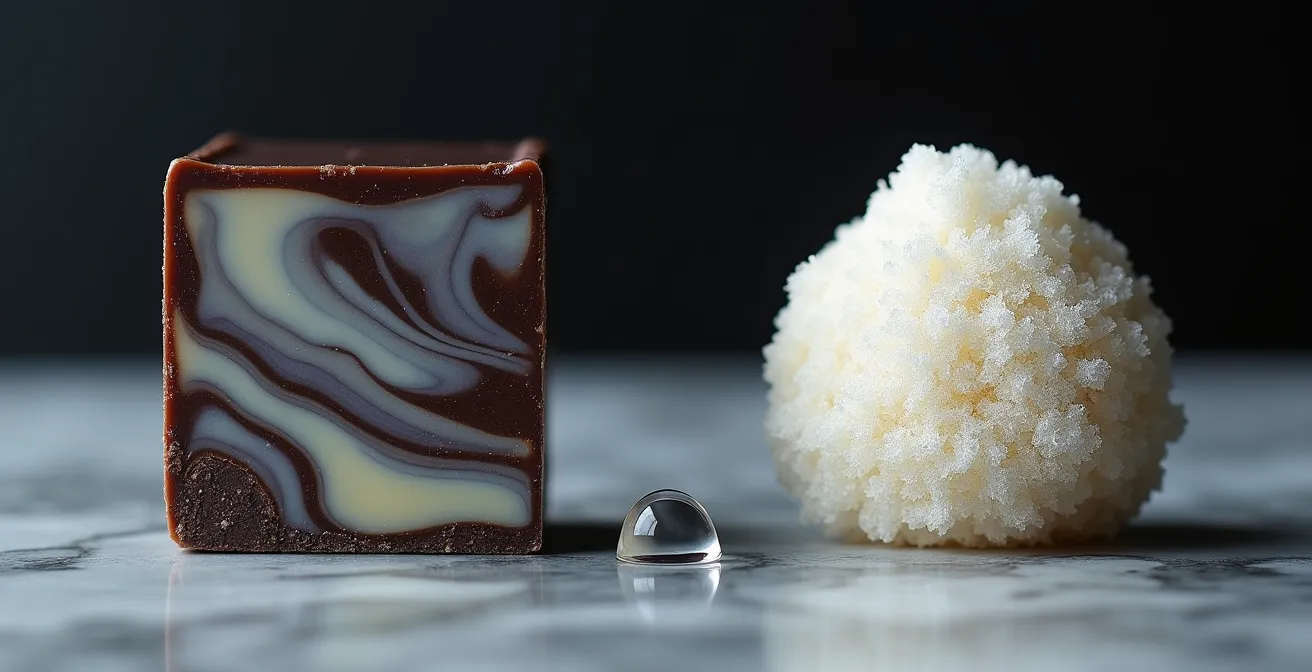
The white film on your chocolate isn’t spoilage; it’s a manageable physical reaction related to cocoa butter crystal stability.
- Fat bloom is caused by temperature fluctuations forcing fat to the surface, while sugar bloom results from moisture dissolving and recrystallizing surface sugar.
- Both are safe to eat, but they alter the texture. Bloomed chocolate can often be salvaged for baking or even re-tempered.
Recommendation: Master temperature and humidity control in your storage environment. This is not just about keeping chocolate cool, but about preventing the micro-fluctuations that trigger bloom.
Discovering a whitish, dusty film on a previously glossy bar of chocolate can be alarming for any reseller or connoisseur. The immediate fear is spoilage, waste, and a potential loss of investment. Many assume the product is old or has gone bad, leading to perfectly good chocolate being discarded. This reaction, while understandable, is based on a common misunderstanding of chocolate’s delicate nature. The issue is rarely about the chocolate being “off,” but rather about its physical response to its environment.
The conventional wisdom simply labels this phenomenon “bloom” and advises storing chocolate in a “cool, dry place.” But for a professional or a serious enthusiast, this advice is insufficient. It doesn’t explain why a premium bar stored in a pantry can still bloom, or how to confidently reassure a customer returning a product. The truth lies deeper, within the science of crystallography. The key is not just to avoid heat, but to understand and master the stability of cocoa butter’s crystal structure.
Instead of viewing bloom as a sign of decay, this guide will reframe it as a predictable, and therefore preventable, outcome of improper crystal management. We will explore the precise triggers behind both fat and sugar bloom, moving beyond generic advice to provide actionable strategies. By understanding the physics of fat migration and the impact of minuscule environmental shifts, you can protect your inventory, salvage affected stock, and turn a potential problem into a demonstration of your expertise.
This article provides a comprehensive roadmap for diagnosing, preventing, and managing chocolate bloom. By following the structured advice within each section, you will gain the confidence to handle your chocolate inventory like a seasoned expert.
Summary: A Professional’s Guide to Chocolate Bloom
- Why a 5°C Fluctuation in Your Shop is Enough to Spoil Your Stock?
- Toss or Melt: Can You Reuse Bloomed Chocolate for Baking?
- How Does Hazelnut Fat Migrate to the Surface and Create White Spots?
- Cupboard or Wine Cellar: Where to Store Your Bars to Avoid Thermal Shock?
- Visual Flaw or Health Hazard: How to Reassure a Customer Who Returns a Bloomed Product?
- The Freezing Mistake That Makes Your Chocolates Sweat When They Thaw
- The Handling Error That Shatters Your Bars into Unusable Pieces
- How to Guarantee a Ganache That Stays Shiny and Smooth for 3 Weeks?
Why a 5°C Fluctuation in Your Shop is Enough to Spoil Your Stock?
The glossy snap of a perfect chocolate bar is thanks to a specific crystal structure in its cocoa butter, known as Form V. This is the most stable and desirable form, achieved through a precise heating and cooling process called tempering. However, this stability is fragile. Even a seemingly minor temperature change can initiate a process of recrystallization, causing the bloom that ruins the chocolate’s appearance and texture. This is not a slow degradation; it’s a rapid physical transformation.
Scientific research shows that the critical threshold is surprisingly low. When the temperature rises, even briefly, the cocoa butter begins to melt. As it cools back down, it doesn’t necessarily return to the stable Form V. Instead, it can recrystallize into a different, larger, and more unstable form, often Form VI. These larger crystals scatter light differently, creating the dull, whitish appearance of fat bloom. According to scientific research on chocolate polymorphism, a temperature that exceeds 20°C (68°F) can trigger the transformation from the desirable Form V to the bloom-inducing Form VI crystals.
In a retail environment, a 5°C swing is common. A sunny spot near a window, the heat from display lights, or the daily cycle of air conditioning can all push the chocolate past this critical point. This is why consistent temperature control is more important than just keeping the storage area “cool.” A stable 18°C is far superior to a temperature that fluctuates between 15°C and 20°C. Monitoring microclimates within your shop or storage area is essential to prevent this chain reaction and protect your stock from the dreaded fat bloom.
Toss or Melt: Can You Reuse Bloomed Chocolate for Baking?
Seeing a batch of chocolate affected by bloom can be disheartening, but it doesn’t mean your inventory is a total loss. While the texture and appearance are compromised for eating out of hand, bloomed chocolate is perfectly safe and can be effectively repurposed, especially in applications where it will be melted. The key is to understand its limitations and choose the right recovery method.
Melting bloomed chocolate essentially resets its crystal structure. The fats that have migrated to the surface are re-incorporated, and the gritty texture of sugar bloom dissolves. For mild fat bloom, it’s even possible to re-temper the chocolate to bring it back to its original glossy state, though this requires time and skill. For more severe bloom, the chocolate is an excellent candidate for baking, sauces, or hot chocolate. Its flavor profile remains largely intact. Professional pastry chef Fran Costigan demonstrated this by successfully salvaging bloomed chocolate, melting it to create garnishing shards and to mix with raisins, proving its viability in baking where appearance is secondary.

The type of bloom dictates the best course of action. Fat bloom is generally easier to recover from than sugar bloom, which permanently alters the texture due to the recrystallized sugar. The following table provides a clear guide on how to assess the potential of your bloomed stock.
| Bloom Type | Recovery Potential | Best Applications | Limitations |
|---|---|---|---|
| Fat Bloom (mild) | High – can re-temper | All applications after re-tempering | Time-consuming process |
| Fat Bloom (severe) | Medium | Baking, sauces, hot chocolate | Cannot restore original texture |
| Sugar Bloom (mild) | Low-Medium | Brownies, cakes, melted applications | Texture permanently altered |
| Sugar Bloom (severe) | Very Low | Baking only where melted | Grainy texture, flavor impact |
Ultimately, tossing bloomed chocolate should be the last resort. By understanding its recovery potential, you can significantly reduce waste and salvage the value of your product. It becomes a matter of smart kitchen management rather than a financial loss.
How Does Hazelnut Fat Migrate to the Surface and Create White Spots?
Chocolates with fillings, especially those containing nuts like hazelnuts, are particularly susceptible to a specific type of fat bloom. This occurs not just from external temperature changes, but from an internal process called fat migration. The liquid fat (oil) from the nut filling slowly seeps through the porous structure of the chocolate shell and recrystallizes on the surface, creating those tell-tale white spots or a hazy finish.
This phenomenon is driven by basic physics. The nut oil is in a liquid state at room temperature, while the cocoa butter in the chocolate shell is solid. Nature seeks equilibrium, so the liquid fat migrates from the area of high concentration (the filling) to the area of low concentration (the shell). This process is accelerated by warmer temperatures, which lower the viscosity of the nut oil and make the cocoa butter structure more permeable. The result is a bloom that is often mistaken for old age but is actually an inherent challenge of filled confections.
While temperature is a catalyst, humidity plays a compounding role, especially in triggering sugar bloom. When moisture is present, it dissolves sugar on the chocolate’s surface. As the moisture evaporates, the sugar recrystallizes into larger, coarser grains, creating a gritty, sandy texture. To prevent this, industry standards recommend maintaining a storage environment with a relative humidity below 55%. As the CocoaSupply Technical Team notes, when cocoa butter’s structure is compromised, “The cocoa butter will form layers between the other ingredients in the chocolate, creating an uneven texture that can be gritty or sandy”. This highlights how both fat migration and humidity can work together to degrade the product’s quality.
Cupboard or Wine Cellar: Where to Store Your Bars to Avoid Thermal Shock?
Choosing the right storage location is the single most effective way to prevent chocolate bloom. The common advice to use a “cool, dry place” is a good start, but for a professional, precision is key. The ideal environment must protect the chocolate from its three main enemies: heat, temperature fluctuations (thermal shock), and humidity. This rules out many common storage spots.
A standard kitchen cupboard can be problematic. Its temperature can fluctuate significantly depending on its proximity to ovens, dishwashers, or even direct sunlight. A refrigerator is even worse; while it’s cool, it’s a high-humidity environment that is the primary cause of sugar bloom. The drastic temperature change when removing chocolate from the fridge also causes condensation to form on the surface, leading to a sweaty, sticky mess.
The optimal solution is a location that mimics the conditions of a professional chocolatier’s cellar. This means a stable temperature and controlled humidity. As a general rule, chocolate experts recommend storing at a consistent temperature between 15°C and 20°C (59-68°F). A wine cellar or a dedicated cool room is ideal. If that’s not available, choose the coolest, darkest, and most stable part of a building, far from heat sources and windows. Using airtight containers is also crucial, as they provide a buffer against both humidity and ambient odors, which chocolate easily absorbs.
Action Plan: Setting Up Your Professional Storage Zone
- Identify the coolest, most stable location in your premises, away from direct sunlight, heat sources (lights, vents), and external doors.
- Install a digital thermometer and hygrometer with data logging to monitor temperature and humidity, aiming for a stable 15-20°C and under 55% RH.
- Use airtight, opaque containers to store chocolate. This protects against humidity, light, and foreign odors that can be absorbed by the cocoa butter.
- Ensure gentle air circulation in the storage area to prevent microclimates and pockets of stagnant, humid air, but avoid direct drafts on the product.
- Wrap bars tightly in their original packaging before placing them in a secondary container to create an additional protective barrier against environmental changes.
Visual Flaw or Health Hazard: How to Reassure a Customer Who Returns a Bloomed Product?
When a customer returns a chocolate bar with a white film, their primary concern is safety. Your first and most important job is to reassure them with confidence and expertise. Handling this situation well can turn a potential complaint into an opportunity to build trust and educate your customer. The key is to be prepared with a clear, concise, and accurate explanation.
Start by validating their concern and immediately confirming that the product is completely safe to eat. Explain that the white layer is not mold, but a natural phenomenon called “chocolate bloom.” You can then briefly differentiate: if it feels waxy, it’s likely fat bloom (cocoa butter that has separated); if it feels gritty, it’s sugar bloom (sugar that has recrystallized due to moisture). Emphasize that this is a physical change, not a chemical or bacterial one, and it primarily affects texture, not flavor or safety.
This is where your expertise shines. You can explain that it’s often caused by slight temperature or humidity changes during transport or storage, even after it leaves your shop. This shifts the context from a “defective product” to an “unfortunate but harmless reaction.” As the experts at Whitakers Chocolates UK state, this is a powerful piece of information to share directly with a customer:
While it may not look as appetising — and its texture may be a bit different, with sugar bloom making chocolate feel gritty and fat bloom giving it a slightly crumbly texture — there are no health risks associated with eating bloomed chocolate.
– Whitakers Chocolates UK, What is Bloomed Chocolate?
Offer a replacement or a refund as a gesture of good customer service, but use the moment to share a pro-tip: “If you encounter this at home, the chocolate is still perfect for melting into a hot chocolate or for baking!” This helpful advice positions you as a knowledgeable and trustworthy expert, leaving the customer with a positive impression despite the initial issue.
The Freezing Mistake That Makes Your Chocolates Sweat When They Thaw
In a desperate attempt to keep chocolate cool, many people turn to the refrigerator or even the freezer. This is one of the most common and damaging mistakes you can make, as it almost guarantees sugar bloom. The issue isn’t the cold itself, but the drastic temperature differential and high humidity of these environments. When you take cold chocolate out into a warmer, ambient room, condensation immediately forms on its surface—just like a cold can of soda on a hot day.
This moisture is the trigger for sugar bloom. The water droplets on the surface dissolve the sugar in the chocolate. As the water evaporates, the sugar doesn’t just dry; it recrystallizes into larger, irregular formations. This leaves the chocolate with a dusty, white appearance and, more importantly, a perceptibly grainy and unpleasant texture on the tongue. The smooth mouthfeel, a hallmark of quality chocolate, is permanently lost.
Case Study: The Michigan State University Extension Warning
Research from the Michigan State University Extension provides a clear warning against refrigerating chocolate. Their studies confirm that sugar bloom is a direct result of storing chocolate in damp environments like a refrigerator, which is far too humid. They found that taking chocolate from a cold, humid space to a warmer room creates condensation, leading to sugar recrystallization. Their strong advisory is to never put chocolate in the refrigerator, recommending instead an airtight container in a cool part of the house where the temperature is more stable.
Furthermore, the extreme cold can make the cocoa butter more brittle and affect the flavor, as cold temperatures can dull the complex aromatic compounds. If you absolutely must store chocolate for a very long period, freezing is a last resort. To do it correctly, you must first wrap the chocolate tightly, then place it in the refrigerator for a few hours, and only then move it to the freezer. The thawing process must be reversed: freezer to fridge, fridge to room temperature, allowing it to acclimatize gradually to prevent condensation.
The Handling Error That Shatters Your Bars into Unusable Pieces
The satisfying “snap” of a high-quality chocolate bar is a direct indicator of good tempering and a stable crystal structure. Professional chocolatiers work hard to achieve the ideal Form V cocoa butter crystals, which provide not only a glossy appearance but also that characteristic clean break. However, this structure also makes the chocolate brittle, especially when it’s cold. A common handling error is trying to cut or break chocolate straight from a cool storage environment, which often results in it shattering into small, unusable shards instead of clean pieces.
When chocolate is too cold, its cocoa butter is rigid and inflexible. Applying sudden, forceful pressure—like chopping with a cold knife—exceeds its structural tolerance, causing it to fracture unpredictably. This is frustrating for portion control in a professional kitchen and disappointing for a consumer who wants a neat square from their bar. The solution is to allow the chocolate to acclimate to a slightly warmer temperature before handling.
To avoid shattering, let the chocolate sit at room temperature for a short while, ideally reaching around 18-20°C (64-68°F). At this temperature, the cocoa butter has a tiny bit more flexibility without being soft. For very clean cuts, professionals use the warm knife technique: dip the blade of a large knife in hot water, dry it completely, and then press down firmly and steadily on the chocolate. The gentle heat from the blade melts a microscopic path, allowing for a perfect cut without stressing the crystal structure. Gentle, steady pressure is always superior to a forceful chop.
Key Takeaways
- Chocolate bloom is a physical change in cocoa butter crystals, not a sign of spoilage, and the chocolate remains safe to eat.
- The primary triggers are temperature fluctuations (fat bloom) and moisture (sugar bloom), making stable storage conditions paramount.
- While bloom affects texture, the chocolate can almost always be salvaged for baking applications by melting it down.
How to Guarantee a Ganache That Stays Shiny and Smooth for 3 Weeks?
Achieving a ganache that remains perfectly shiny, smooth, and stable for weeks is one of the pinnacles of chocolate work. Its longevity is a delicate balance of recipe formulation and perfect storage, both of which are designed to combat the forces that lead to bloom and spoilage. A broken or bloomed ganache is often a sign that either its internal water activity was too high or it was subjected to thermal shock.
The key to a stable ganache is controlling water activity (aw), which is a measure of the “free” water available for microbial growth. By using a proper ratio of chocolate to cream and sometimes adding an invert sugar like glucose or sorbitol, you can bind the water, making it unavailable to bacteria and reducing the risk of spoilage. However, even a perfectly formulated ganache can be ruined by improper storage. Like a solid bar, it is highly susceptible to bloom.
The process of tempering the chocolate before making the ganache is a critical step for longevity. As noted by the technical team at Heavenly Chocolates UK, ” Tempering stabilizes the cocoa butter crystals, preventing them from migrating to the surface.” An untempered chocolate will inevitably lead to a dull or bloomed ganache over time. Once made, the ganache must be stored in the same ideal conditions as solid chocolate: a stable, cool, and dry environment. The professional standard is a consistent temperature between 15-18°C (59-64°F) with a relative humidity below 50%. This prevents both fat bloom from the cocoa butter and sugar bloom from any potential condensation, ensuring the ganache maintains its luscious texture and shine.
Start implementing these crystal management strategies today to protect your inventory and ensure every bar you sell is a perfect representation of its quality.
Frequently Asked Questions About Chocolate Bloom
Is bloomed chocolate safe to eat?
Yes, bloomed chocolate is completely safe. The bloom is purely cosmetic and not a sign of spoilage, though texture may be altered.
Can I still use bloomed chocolate for baking?
Absolutely. Melting the chocolate will typically resolve the bloom, though severe bloom may affect the texture of finished goods.
How can I tell if it’s mold or bloom?
Bloom appears as white/gray streaks or a dusty film and does not have an unusual smell. Mold would typically have a fuzzy, three-dimensional growth and an off, musty odor.