Achieving the perfect nutty or biscuit profile in cocoa is a delicate balance. A few degrees too high or a few minutes too long, and you’re left with acrid, burnt, and unsalvageable beans. This guide reveals that the key to success isn’t a rigid recipe of time and temperature, but rather a deep, sensory understanding of the roast. By learning to read the bean’s aromatic, auditory, and tactile signals, you can confidently guide the Maillard reaction to its peak flavour development and stop it just before it tips into carbonization.
Every roaster knows the feeling. The air, once filled with the promising scent of warm brownie and baking bread, suddenly carries a sharp, acrid warning. It’s the smell of failure, of a batch pushed seconds too far, where the magic of the Maillard reaction has collapsed into the disaster of carbonization. Many beginners cling to the apparent safety of recipes found online—roasting in a home oven, setting a timer, and hoping for the best. While this can be a starting point, it ignores the most crucial variable in the entire process: the bean itself.
The truth is, a fixed formula cannot account for the unique character of each origin, the variations in moisture content, or the density of the bean. To truly master the craft, you must move beyond being a machine operator and become a sensory conductor. This is not about simply avoiding burnt flavors; it’s about actively sculpting them. The transition from raw, acidic precursors to a complex symphony of biscuit, nutty, and chocolatey notes is a chemical journey you can learn to navigate by ear, nose, and touch.
This approach transforms roasting from a high-stakes guessing game into a controlled, repeatable art form. Instead of fearing the tipping point, you will learn to approach it with confidence, knowing exactly which signals to look for. This guide will walk you through the critical stages of this sensory journey. We will decode the chemical reactions, identify the make-or-break temperature thresholds, and equip you with the infallible sensory tools needed to stop your roast at the precise moment of peak flavor.
To navigate this complex process, we will explore the key stages and decisions a master roaster makes. This article breaks down the science and sensory art of cocoa roasting into a clear, actionable roadmap.
Summary: The Art and Science of Developing Cocoa Flavours
- Why a Roast That Is Too Fast Destroys Floral Aroma Precursors?
- How to Adapt Your Heating Curve for Beans from Venezuela?
- Maillard or Carbonization: What Is the Limit Not to Be Crossed?
- The Temperature Mistake That Makes Your Chocolate Inedible for 50% of Customers
- When to Stop Roasting: The 3 Foolproof Sensory Signals
- Why Do Your Beans Develop Banana or Red Fruit Aromas?
- How to Identify Fruit or Spice Notes Once the Sugar Has Melted?
- Why Is Conching the Critical Step for Eliminating Volatile Acidity?
Why a Roast That Is Too Fast Destroys Floral Aroma Precursors?
In the rush to achieve that deep brown colour, many roasters make a fundamental error: they apply too much heat too quickly. A rapid roast is the enemy of complexity. The delicate, volatile compounds responsible for floral and nuanced fruit notes are fragile. When the temperature climbs aggressively, these precursors don’t have time to participate in the controlled Maillard reaction; they are simply incinerated and lost forever. Think of it as a chemical sprint versus a marathon. A sprint gets you to the finish line—a brown bean—but you miss all the scenery along the way.
A slower, more controlled Rate of Rise (RoR) is essential. By starting with a lower temperature drying phase, you allow for crucial enzymatic activity to continue, setting the stage for deeper flavor development. A gradual increase in heat then gently coaxes the beans through the Maillard reaction, giving those precious aroma precursors the time they need to transform into desirable esters and aldehydes. The impact of a rapid roast is not trivial; research on roasting dynamics shows that a staggering 70% of volatile esters are lost in roasts that exceed a 10°C per minute RoR.
This loss is irreversible. Once those floral notes are gone, no amount of conching or aging can bring them back. The goal is to build a foundation of flavour, not just to apply colour. A successful roast preserves the bean’s inherent potential, and that begins with respecting the time it takes to unlock it. Controlling the Rate of Rise (RoR), ideally keeping it between 3-5°C per minute during the critical browning phase, is the first principle of preserving complexity.
How to Adapt Your Heating Curve for Beans from Venezuela?
The “one-size-fits-all” approach to roasting fails spectacularly when you consider the vast diversity of cocoa beans. A roasting profile that works wonders for a dense Forastero from Ghana will likely ruin a delicate, high-fat Trinitario from Venezuela. Venezuelan beans, particularly those prized for their nutty and creamy profiles, demand a unique approach. They are often higher in fat content, which affects their density and how they absorb and conduct heat.
A common mistake is to underload the roaster. For example, high-fat Venezuelan beans are less dense, meaning you might need to double the standard machine load by weight to achieve the proper bean mass for even heat distribution. A roaster designed for one pound of coffee might need two pounds of these specific cacao beans to function optimally. This increased bean mass acts as a thermal buffer, slowing heat transfer and allowing for a more gentle and controlled roast.
The heating curve itself must be adapted. A gentler hand is required from the start. Where a standard bean might handle a starting temperature of 150-170°C, a Venezuelan bean benefits from a lower entry point to avoid scorching the exterior before the interior is properly roasted. The entire profile is stretched over a longer period, with a slower Rate of Rise, allowing the rich, nutty flavours to develop without introducing bitterness.
This table illustrates the key differences in approach:
| Parameter | Standard Beans | Venezuelan Beans |
|---|---|---|
| Initial Temperature | 150-170°C | 120-140°C |
| Rate of Rise | 5-7°C/min | 3-4°C/min |
| Total Roast Time | 30-45 minutes | 45-60 minutes |
| Bean Mass Temperature | 135-145°C | 125-135°C |
Ultimately, you must let the bean dictate the profile. Understanding the unique properties of your origin is not an optional step; it is the very essence of craft roasting.
Maillard or Carbonization: What Is the Limit Not to Be Crossed?
The roaster’s primary task is to harness the power of the Maillard reaction while steering clear of its destructive twin, carbonization. These are not two separate events; they are a continuum. The Maillard reaction is the beautiful, complex dance between amino acids and reducing sugars that creates hundreds of new aroma and colour compounds. Carbonization is what happens when that dance gets out of control and everything burns. The line between them is fine and unforgiving.
As the esteemed pastry chef and chocolate expert Michael Laiskonis explains, this is the moment of creation:
All of the complex chemical reactions (Maillard reactions and Strecker degradation) take place during roasting, transforming the flavor precursors created during fermentation into hundreds of individual compounds that give chocolate its alluring color and taste.
– Michael Laiskonis, ICE Chocolate Lab
The sweet spot for the Maillard reaction produces the notes we seek: biscuit, toast, coffee, caramel, and nuts. It’s a browning process. Carbonization, on the other hand, is a burning process. It occurs at higher temperatures when the organic material itself begins to break down into elemental carbon. The resulting flavours are uniformly bitter, acrid, and ashen. All nuance is lost, replaced by the one-dimensional taste of char.
Visually, the difference is stark. A perfectly roasted bean has a rich, even brown colour with a subtle sheen. A carbonized bean is dull, black, and often looks dry or blistered. Understanding this visual cue is your first line of defense.

The key takeaway is that you are not simply aiming for a dark colour. You are aiming for a specific type of browning. The transition from Maillard to carbonization can happen in a matter of seconds, driven by the roaster’s thermal momentum. This is why constant sensory monitoring, not just a timer, is the only reliable way to know when you’ve reached the peak of flavour and must stop the roast immediately.
The Temperature Mistake That Makes Your Chocolate Inedible for 50% of Customers
There’s a specific temperature threshold that, once crossed for too long, guarantees a poor-quality chocolate. It’s not just about the obvious burnt taste; it’s about the irreversible destruction of key chemical compounds that define the chocolate experience. Specifically, we’re talking about the breakdown of alkaloids like theobromine. These compounds are responsible for some of chocolate’s bitterness and its stimulating effects, but when they degrade, they create harsh, unpleasant, and often metallic off-flavours.
The critical danger zone is clear. Extensive chocolate chemistry research indicates that temperatures above 150°C (302°F) for more than 10 minutes cause this irreversible alkaloid breakdown. While the bean’s internal temperature needs to reach a certain point to develop Maillard flavours (typically 120-135°C), letting it linger at or above 150°C is catastrophic. The resulting chocolate may not even taste overtly burnt, but it will have a “hollow” or “harsh” character that lacks the satisfying depth of a well-crafted bar.
This isn’t a theoretical problem. The internet is filled with cautionary tales from roasters who learned this lesson the hard way. One home roaster, following a standard profile for Ecuadorian beans, described a sudden disaster: with just a minute left on the timer, heavy smoke filled the chamber, followed by what looked like flames. Despite hitting the ‘cool’ button immediately, the batch was a total loss, tasting only of char and regret. This experience highlights how quickly a roast can go from perfect to ruined, especially when relying solely on a pre-set program rather than real-time sensory feedback.
This is the mistake that can make a batch of chocolate unpalatable to a significant portion of your audience, even those who can’t articulate exactly what’s wrong. They’ll simply perceive it as “bad chocolate.” Avoiding this error is about respecting the bean’s chemical limits and understanding that your roaster’s temperature reading is only part of the story; the bean mass temperature and roast duration are the true arbiters of quality.
When to Stop Roasting: The 3 Foolproof Sensory Signals
A timer can tell you how long the beans have been in the roaster, but only your senses can tell you when the roast is truly finished. The perfect moment to stop is a fleeting window where the desirable Maillard flavours are at their peak and the negative notes of carbonization have not yet begun. To hit this target, you must rely on a trinity of sensory signals: aroma, sound, and touch.
1. Aroma (The Olfactory Checkpoint): Your nose is your most important tool. Throughout the roast, the aroma will evolve dramatically. Initially, it will smell grassy or acidic, sometimes like vinegar, as volatile acids from fermentation burn off. As the Maillard reaction takes hold, this will transition to the much more pleasant smells of baking bread or brownies. This is your sign that you are in the right zone. Pay close attention; when this rich chocolatey aroma reaches its peak intensity, you are very close to the end of the roast. Any hint of a sharp, smoky, or acrid smell is a red-alert that you’re tipping into carbonization.
2. Sound (The Audible Cue): As moisture inside the bean turns to steam and escapes, you will hear an audible “crack” or “pop,” similar to popcorn but much quieter. This is a critical indicator that the internal structure of the bean is changing and the roast is entering its final, rapid phase. For many beans, this first crack is the signal that the roast is nearly complete. Some profiles may extend slightly beyond this point, but it should put you on high alert to begin sampling frequently.
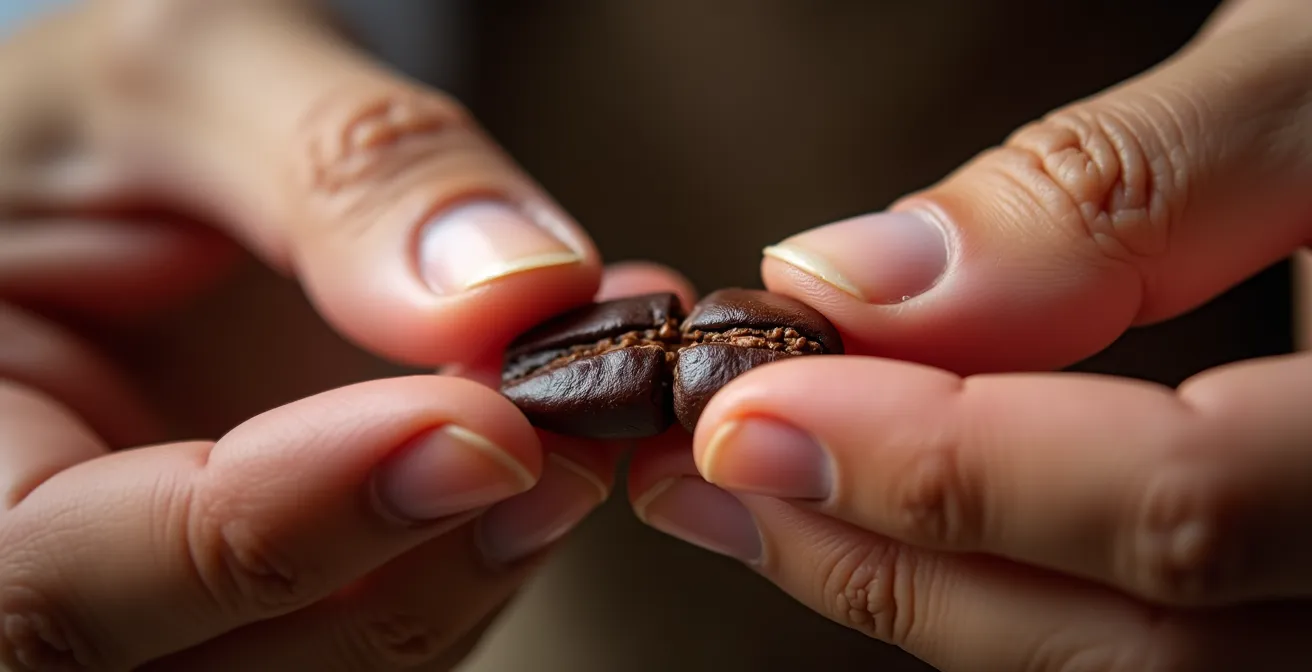
3. Touch (The Tactile Test): The final and most definitive test is the “snap test.” Once the crack is heard and the aroma is peaking, begin pulling a single bean every 30-60 seconds and cooling it rapidly. A properly roasted bean, once cooled, should have a brittle, clean snap when broken between your fingers. If it’s soft or bends, the roast is not yet complete. If it shatters into dust, you’ve likely gone too far. This tactile feedback, combined with tasting the sample, gives you the most accurate assessment of the roast’s development.
By triangulating these three signals, you can move beyond hope and into the realm of precision. You are no longer a passenger on the roast; you are the pilot, making the final call based on direct, undeniable evidence from the beans themselves.
Why Do Your Beans Develop Banana or Red Fruit Aromas?
The fruity notes in chocolate—like banana, red berries, or citrus—are not created during the roast. Rather, they are born during fermentation and the roast is the process that reveals them. During fermentation on the farm, yeasts and bacteria break down the pulp surrounding the beans, creating a complex cocktail of organic acids and esters. These esters are the direct chemical precursors to many of the fruity aromas we prize in fine chocolate.
However, fermentation also produces less desirable compounds, most notably acetic acid—the same acid found in vinegar. In a raw, unroasted bean, this sharp, vinegary note can easily overpower the more delicate fruity esters. The first job of the roaster, therefore, is not to create flavour, but to clean the slate. As one expert guide from Sweet Maria’s notes, the initial phase of roasting is about removal: “Volatile and vinegary acetic acid from fermentation is driven off during the roast. The roasted cacao will have more of a ‘classic’ chocolate aroma.”
Once this overpowering acetic acid is evaporated, the stage is set for the subtler aromas to shine. The heat of the roast then transforms the remaining precursors. For example, a slow and gentle roast can preserve these delicate fruit esters, allowing them to express themselves fully in the final chocolate. A flavour profile analysis of a carefully roasted bean might reveal “toasty fruited flavors with winey notes” or “very sweet, fruity notes including coconut.” These flavours were always there, latent within the bean; the roaster’s skill was in creating the conditions for them to emerge, unmasked by harsh acidity.
How to Identify Fruit or Spice Notes Once the Sugar Has Melted?
As the roast progresses and sugars begin to caramelize, the roaster’s chamber becomes a fog of heat and powerful aromas of brownie and toast. In this environment, detecting the subtle, high-note aromas of fruit or spice can feel impossible. Your nose becomes overwhelmed. To accurately assess the development of these delicate flavours, you must decouple the aroma from the ambient heat of the roaster. This requires a professional technique using a “tryer.”
The tryer is a small scoop that allows you to pull a few beans from the roaster without significantly altering the roasting environment. By analyzing these samples away from the machine, you get a clear, unadulterated snapshot of the bean’s aromatic profile at that exact moment. This is how you find the hidden notes. Different flavour compounds become dominant at different temperatures; for instance, aroma chemistry studies demonstrate that a 110-130°C roasting range significantly increases phenolic content, which is often associated with spice notes like clove or cinnamon.
To perform this analysis effectively, you need a methodical approach. It’s not enough to just pull a bean and smell it. You must create a concentrated environment to capture the fleeting volatile compounds.
Action Plan: Detecting Subtle Aromas with the Tryer Method
- Isolate the Sample: Use the tryer to pull 3-4 beans and immediately place them into a pre-heated glass container.
- Concentrate the Aromas: Cover the container and shake it vigorously for 5 seconds. This releases volatiles from the hot beans and traps them in the air inside the glass.
- Perform the First Olfactory Test: Uncover and smell immediately. This gives you the purest sense of the aromas, separate from the roaster’s heat.
- Cool for the Second Test: Quickly pour the beans onto a metal plate to cool them for about 60 seconds. This stops the internal cooking process.
- Release the Full Profile: Crush the cooled beans with a small mortar and pestle. This final act breaks down the cell walls, releasing the maximum aroma burst for a complete evaluation.
This systematic process allows you to track the evolution of flavour with precision, identifying the exact moment when those desired fruit or spice notes reach their peak before being overshadowed by heavier roast flavours.
Key Takeaways
- Roasting is a sensory art, not a timed event. Your nose, ears, and hands are more reliable than any clock for achieving the perfect flavour profile.
- The line between a perfect Maillard reaction (biscuit, nutty notes) and destructive carbonization (burnt, acrid notes) is razor-thin and can be crossed in seconds.
- Every bean origin is different. Adapting your heating curve, Rate of Rise (RoR), and even your batch size is essential for unlocking the unique potential of each bean.
Why Is Conching the Critical Step for Eliminating Volatile Acidity?
The roaster’s job does not end when the beans are cooled. Even in a perfectly executed roast, some residual volatile acidity, primarily acetic acid from fermentation, remains trapped within the cocoa mass. While roasting removes a significant portion—studies show an additional 70% of these acids escape during roasting on top of what is lost during drying—the final traces can still impart a harsh, sour edge to the finished chocolate. This is where conching becomes the final, critical act of flavour refinement.
Conching is a process of continuous mixing, agitating, and aerating liquid chocolate over a long period, often at a controlled temperature. This constant movement does two things. First, it smooths the chocolate, reducing particle size for a silky mouthfeel. More importantly for our purpose, it provides a massive surface area and gentle heat, encouraging the last remnants of unwanted volatile compounds like acetic acid to evaporate and escape.
The duration and temperature of conching are powerful tools for shaping the final flavour. As the experts at Land Chocolate, a bean-to-bar maker, explain, it’s a long but necessary process:
Conching for 72 hours at controlled temperature allows trapped acetic acid to escape while preserving desirable Maillard flavors.
– Land Chocolate, Bean-to-Bar Process Guide
Without this final step, the bright, fruity notes you worked so hard to preserve and the deep, nutty notes you carefully developed during the roast can be muted or soured by lingering acidity. Conching is the step that polishes the final product, ensuring the flavour profile is clean, balanced, and a true expression of both the bean’s origin and the roaster’s skill.
By shifting your focus from a rigid set of instructions to a dynamic, sensory-driven process, you can consistently guide your cocoa beans to their highest flavour potential. Start applying these principles today, and listen to what your beans are telling you. Your palate—and your customers—will thank you.