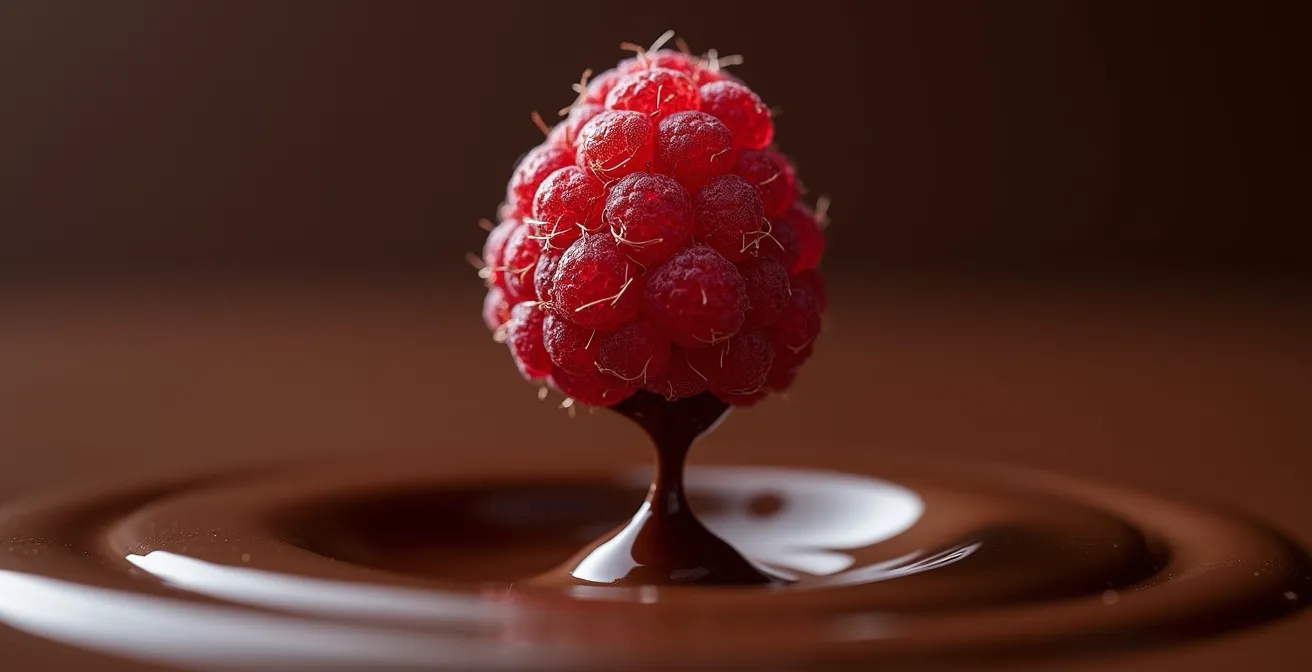
The secret to perfectly crisp freeze-dried fruit in chocolate lies not in the recipe, but in controlling the physics of moisture migration.
- Sogginess is caused by the fruit’s high “Water Activity” (aW) drawing moisture from its surroundings, a process that must be managed through temperature and handling.
- Balancing intense fruit acidity requires strategic pairing with chocolates that have complementary fat and sugar profiles, turning a potential flaw into a sensory highlight.
Recommendation: Treat freeze-dried fruit as a highly unstable, hygroscopic ingredient. Incorporate it at the coolest possible working temperature and package immediately to preserve its essential crunch and vibrancy.
As a confectioner, you chase a specific kind of magic: the perfect snap of tempered chocolate followed by a surprising burst of flavour and texture. You reach for freeze-dried raspberries, dreaming of that intense, acidic crunch. You scatter the vibrant jewels onto your beautiful mendiant tablets. They look stunning. But two days later, a customer—or worse, you—bites into one, and the magic is gone. The once-crisp fruit is disappointingly soft, even chewy. The vibrant acidity has dulled. It’s a common frustration that leaves many creators confused, blaming the fruit or the chocolate.
The typical advice is often too simple: “work quickly” or “store in a dry place.” But this ignores the fundamental science at play. The issue isn’t just ambient humidity; it’s a microscopic battle for moisture happening within your finished product. To truly master these inclusions, you must think less like a chef following a recipe and more like a food scientist controlling an environment. The key isn’t just what you add, but understanding the invisible force of “Water Activity” that dictates texture and shelf life.
This guide will deconstruct that science. We won’t just tell you *what* to do; we’ll explain *why* it works. We’ll move beyond the platitudes to explore the principles of moisture migration, sensory balance, and crystalline structure. By understanding these concepts, you can stop fighting against soggy fruit and start creating confections with a consistently perfect, explosive crunch that lasts.
To guide you on this journey from frustration to mastery, this article breaks down the core challenges and their scientific solutions. We will explore everything from the fundamental reason your fruit loses its crunch to the advanced techniques for tempering and creating seasonal marketing appeal.
Summary: A Confectioner’s Guide to Mastering Freeze-Dried Inclusions
- Why do your freeze-dried raspberries turn soft after 2 days in chocolate?
- How to balance the concentrated acidity of the freeze-dried fruit with a sweet chocolate?
- Sugar or pure fruit: which to choose for a modern ‘healthy’ tablet?
- The handling mistake that turns your beautiful fruits into red dust on the tablet
- Strawberry in summer or orange in winter: how to adapt your inclusions to the marketing calendar?
- Why your chocolate stings the throat instead of recalling citrus?
- How to make a fluid couverture thick enough for piping?
- How Mycryo powder directly provides Beta crystals without tabling?
Why do your freeze-dried raspberries turn soft after 2 days in chocolate?
The culprit behind your once-crisp raspberries turning soft is an invisible force called Water Activity (aW). It’s not about how much water an ingredient contains, but how much of that water is “free” and available to move. Freeze-dried fruit is intensely hygroscopic, meaning it’s desperate to absorb moisture from its surroundings. Even in a seemingly dry environment like chocolate, a moisture gradient exists. The fruit acts like a sponge, pulling free water molecules from the air and, to a lesser extent, from other components in the chocolate.
Think of it as a law of physics. Moisture always moves from an area of high water activity to an area of low water activity until equilibrium is reached. While high-quality chocolate has a very low aW, the surrounding air does not. Dried fruits, in general, are known to have relatively high water activity. For instance, dried fruits typically maintain water activity levels between 0.60-0.70 aW, a range that makes them prone to absorbing moisture. Once the fruit’s crisp, porous structure becomes saturated, it collapses, turning from crunchy to chewy.
The solution, therefore, is two-fold. First, you must create a barrier. A complete and flawless coating of well-tempered chocolate can significantly slow this process. Second, you must control the environment from the moment of creation to the moment of consumption. According to experts in moisture migration, the most effective strategy is to limit exposure time. This means packaging your confections in an airtight, low-humidity container as quickly as possible after the chocolate has set. You aren’t just protecting it from dust; you are protecting it from the invisible moisture in the air that is its greatest enemy.
How to balance the concentrated acidity of the freeze-dried fruit with a sweet chocolate?
Freeze dried fruits maintain a fresh flavor and bright color.
– Chaucer Foods, Confectionery News
The intense, “fresh flavor” of freeze-dried fruit is its greatest asset and its biggest challenge. The lyophilization process removes water but leaves behind a super-concentrated dose of the fruit’s natural acids, primarily citric and malic acid. This can create a flavor that is thrillingly tart or unpleasantly sharp, depending on what it’s paired with. The key to success is not to mute this acidity but to achieve sensory balance through strategic pairing.
Think of it as a culinary equation. The high acidity of the fruit needs to be balanced by the fat and sugar content of the chocolate. Here’s a practical guide:
- For highly acidic fruits (passion fruit, raspberry, lemon): Pair them with sweeter, creamier chocolates. A high-quality white chocolate, with its high cocoa butter and sugar content, provides a rich, fatty canvas that mellows the sharp acid, creating a classic “cheesecake” effect. A milk chocolate with caramel notes can also work beautifully, with the sweetness directly counteracting the tartness.
- For moderately acidic fruits (strawberry, blueberry): These are more versatile. They can stand up to the complexity of a mild dark chocolate (55-65% cacao), where the fruit’s acidity can cut through the richness and highlight the chocolate’s own fruity notes.
- For low-acidity, sweeter fruits (banana, mango): These risk being overpowered by a very sweet chocolate. They shine when paired with a more intense dark chocolate (70%+). The bitterness and complexity of the chocolate provide the contrast needed to make the fruit’s subtle sweetness pop.
To truly master this, experiment with different origins and brands of couverture. A Madagascan dark chocolate with its natural red fruit notes will interact with a freeze-dried raspberry very differently than an earthy Ecuadorian one. The goal is a finished product where the chocolate and fruit elevate each other, creating a dynamic flavor journey in a single bite.
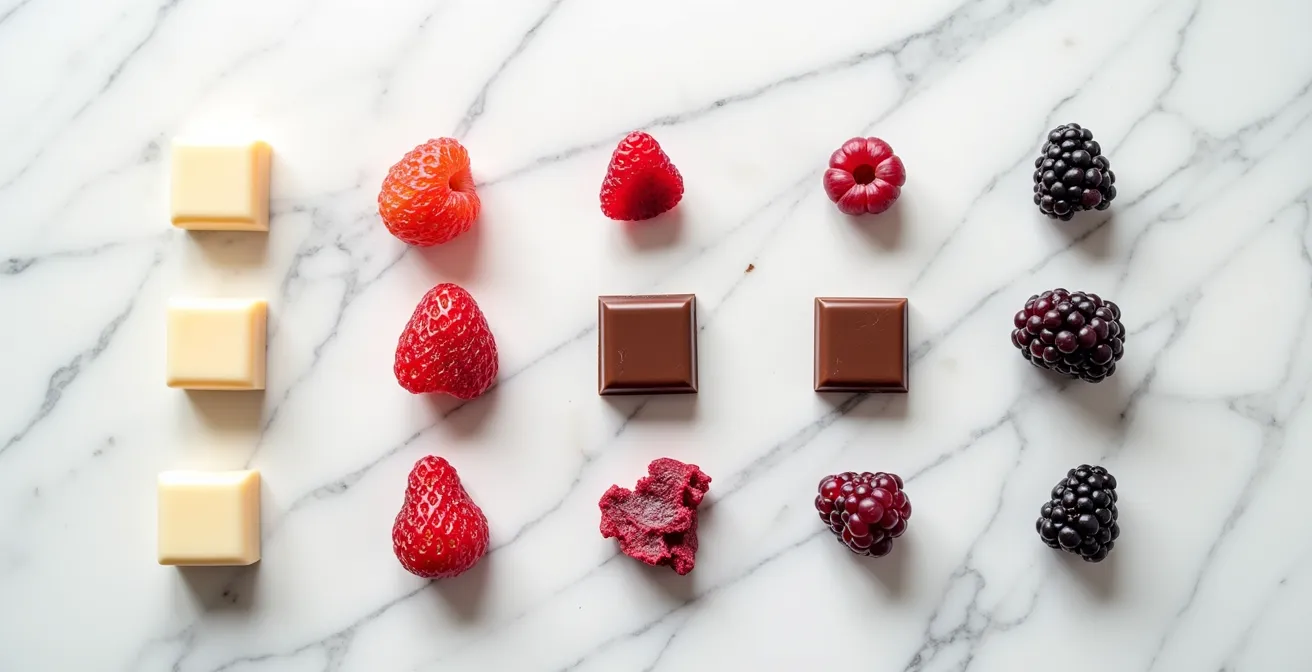
As you can see, the visual harmony between the chocolate and the fruit often hints at the flavor compatibility. The color gradient from light to dark serves as a roadmap for pairing, guiding the creator towards a balanced and beautiful final product.
Sugar or pure fruit: which to choose for a modern ‘healthy’ tablet?
The modern consumer is increasingly label-conscious, seeking out “clean” ingredients and reduced sugar. This presents a choice for the confectioner: should you use pure, unsweetened freeze-dried fruit, or versions that have been infused with sugar? While “pure fruit” sounds better from a marketing perspective, the answer depends on both your brand positioning and technical needs. Pure freeze-dried fruit offers the most potent flavor and an attractive nutritional profile. In fact, research suggests that freeze-dried strawberries contain more nutrients than fresh strawberries, as the process preserves the nutritional value exceptionally well.
However, sugar-infused freeze-dried fruits have a technical advantage: the sugar can slightly lower the fruit’s hygroscopicity, making it a bit more stable and less prone to becoming soggy. It also pre-balances some of the intense acidity, which can simplify your chocolate pairing decisions. The choice is a trade-off between the “clean label” appeal of pure fruit and the enhanced stability and pre-balanced flavor of a sugared version. For a brand focused on premium, health-conscious offerings, mastering the use of pure fruit is a powerful differentiator.
To make an informed decision, it’s essential to understand the fundamental differences between freeze-dried and traditionally dehydrated fruits, as outlined by a recent comparative analysis. Freeze-drying’s superiority in moisture removal and texture retention is what makes it so unique for creating crunch.
| Characteristic | Freeze-Dried Fruit | Traditional Dried Fruit |
|---|---|---|
| Moisture Removal | Up to 99% | 80-90% |
| Shelf Life | Much longer in proper packaging | Shorter than freeze-dried |
| Texture | Crispy, light | Chewy, dense |
| Size Retention | Near original size | Half original size |
Ultimately, for a modern “healthy” tablet, pure freeze-dried fruit is the winning choice, provided you have mastered the handling techniques to protect its delicate, crunchy texture. The marketing story of “just fruit and chocolate” is powerful, and the explosive, unadulterated flavor is a hallmark of a high-end product.
The handling mistake that turns your beautiful fruits into red dust on the tablet
You’ve selected the perfect fruit and chocolate pairing. You’re ready to create. But the moment you stir the delicate fruit pieces into your warm, tempered chocolate, they shatter, creating a smear of colored dust instead of distinct, beautiful inclusions. This is the most common handling mistake, and it stems from a misunderstanding of the fruit’s fragile crystalline structure and its interaction with temperature.
Freeze-dried fruit is essentially a delicate, porous lattice. It’s incredibly light and brittle. Stirring it too vigorously or adding it to chocolate that is too warm will cause this structure to collapse instantly. The key is to be gentle and, most importantly, to work at the coolest possible end of your chocolate’s working temperature range. For dark chocolate, which is typically workable between 31-32°C (88-90°F), you should aim to add your inclusions when the chocolate has cooled to 31°C. This slightly thicker viscosity helps cushion the fruit pieces, and the lower temperature reduces thermal shock.
The goal is to fold, not stir. Use a soft spatula and gently fold the fruit pieces into the chocolate with minimal movement, just enough to coat them. If you are sprinkling them on top of a tablet, drop them from a low height to prevent them from breaking on impact. Speed is also essential, but for a different reason than you might think: the fruit’s lightness means it will try to float to the surface. Working quickly ensures it remains evenly distributed throughout the bar as it sets.
Action Plan: Preserving Fruit Integrity During Incorporation
- Gently melt chocolate on the lowest possible heat, stirring regularly and removing from heat as needed to avoid overheating.
- Allow the tempered chocolate to cool to its lowest working temperature, ideally around 30-31°C for dark chocolate.
- Gently fold in the freeze-dried pieces at this coolest temperature, using minimal agitation to avoid breakage.
- Work quickly to pour or spread the chocolate, as the light fruit pieces will tend to float if left to sit.
- Package the finished product immediately after setting to protect it from ambient humidity, which can soften the fruit within a day or two.
Strawberry in summer or orange in winter: how to adapt your inclusions to the marketing calendar?
Once you’ve mastered the technique of using freeze-dried fruits, you unlock a powerful marketing tool: seasonality. While freeze-dried products are available year-round, consumers’ cravings are deeply tied to the seasons. Aligning your creations with this natural calendar tells a compelling story and creates a sense of timeliness and novelty that drives sales. This strategy transforms your chocolate tablets from a simple product into a limited-time experience.
Think of your display case as a reflection of the seasons. This approach has been used successfully by brands like TruFru, whose chocolate-covered fruit products are often seen as the perfect seasonal treat. You can create a calendar of rotating “mendiant” tablets that capture the essence of each time of year:
- Spring: Feature light, floral, and bright flavors. Think freeze-dried strawberry with crushed pistachio and rose petals on a white or ruby chocolate base.
- Summer: Embrace bold, tropical, and zesty notes. Pair freeze-dried passion fruit or mango with toasted coconut on a milk chocolate tablet for a taste of sunshine.
- Autumn: Move towards warmer, spicier, and comforting profiles. Combine freeze-dried cranberry or apple with toasted pecans and a hint of cinnamon on a 65% dark chocolate.
- Winter: Offer rich, deep, and festive combinations. A classic pairing of freeze-dried orange or cherry with roasted almonds and star anise on a 70%+ dark chocolate evokes holiday warmth.
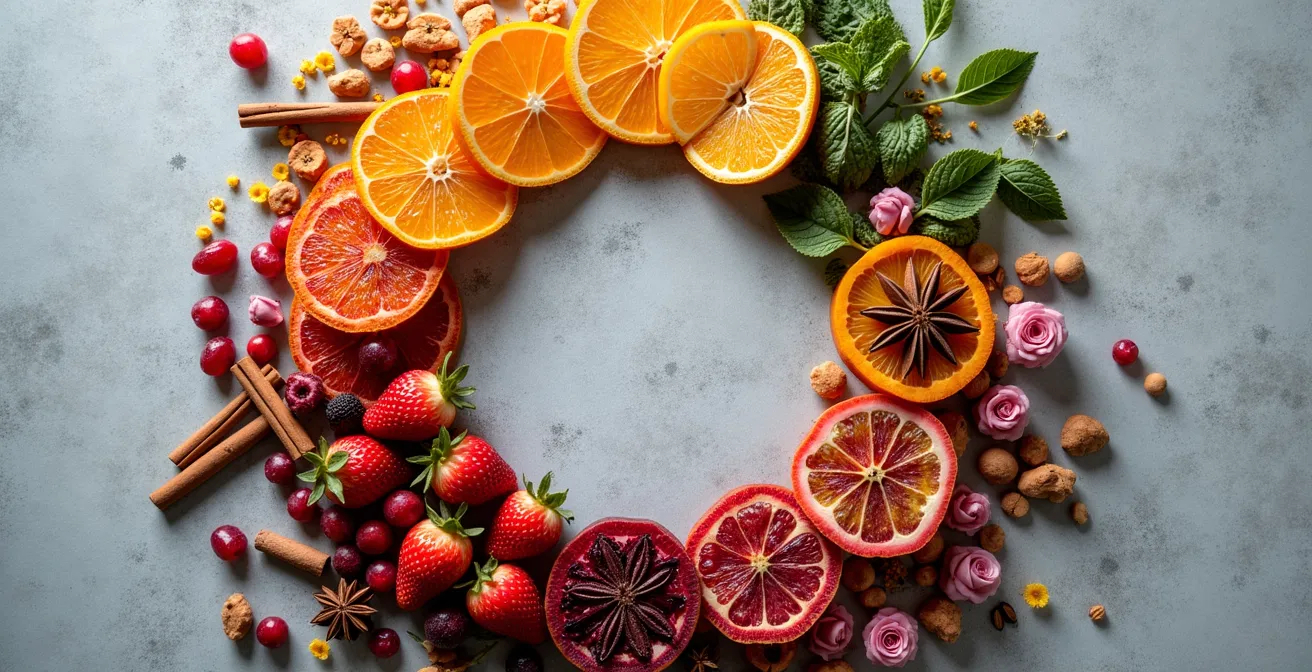
This seasonal rotation not only keeps your offerings fresh and exciting but also encourages repeat business as customers return to see what’s new. It allows you to tell a story about ingredients and flavors, connecting your craft to the natural world and creating a deeper appreciation for your work. You are no longer just selling chocolate; you are selling a taste of a specific moment in time.
Why your chocolate stings the throat instead of recalling citrus?
You’ve paired a freeze-dried orange with dark chocolate, expecting a bright, citrusy lift. Instead, the result is an aggressive, sharp sensation that almost “stings” the back of the throat. This unpleasant outcome is another manifestation of a problem related to Water Activity (aW) and acid concentration. The sharp, “stinging” sensation is often caused by undissolved acid crystals hitting the palate directly. For an acid to be perceived as a smooth, rounded flavor, it needs a small amount of moisture to be dissolved in saliva.
When you have a very dry system—like a perfectly crisp piece of freeze-dried fruit in low-moisture chocolate—the highly concentrated citric acid doesn’t have a chance to dissolve before it hits your taste buds. This creates a harsh, prickly sensation rather than a pleasant tartness. The problem is exacerbated in environments where slight moisture migration has occurred, but not enough to soften the fruit. This is a delicate balance; too little moisture leads to a sharp taste, and too much leads to a soggy texture.
According to food science principles, many chemical and textural changes occur in a specific range of water activity. Research shows that between water activities of 0.40 to 0.70, chemical instability and texture changes are the most likely modes of failure. The stinging sensation is a form of this instability. One way to mitigate this is by ensuring your fruit pieces are smaller. A fine powder or very small granules will have a larger surface area, allowing them to dissolve more quickly in the mouth and integrate more smoothly with the chocolate’s flavor profile, reducing the “stinging” effect.
How to make a fluid couverture thick enough for piping?
Sometimes your creative vision extends beyond simple tablets. You might want to use a mixture of chocolate and crushed freeze-dried fruit powder for decorative piping, but you find the mixture is too fluid and won’t hold its shape. The addition of the fruit powder doesn’t significantly alter the chocolate’s viscosity. To achieve a pipeable consistency without compromising the temper, you need to adjust the chocolate’s rheology—its flow properties.
The simplest method is to let your tempered chocolate cool slightly. As it approaches the lower end of its working temperature, its viscosity will naturally increase, making it thicker and more suitable for piping. However, this gives you a very short working window before it begins to set completely. For more control, you can introduce a small amount of an ingredient that will thicken the mixture. Adding more of the same chocolate, but in a solid, finely grated (or “seed”) form, can increase the crystal count and thicken the mass. You could also add a small amount of cocoa powder, though this will alter the flavor and texture.
In industrial applications, confectioners use emulsifiers to precisely control viscosity. For example, lecithin is typically used to *decrease* plastic viscosity and make chocolate more fluid, while other emulsifiers like Polyglycerol polyricinoleate (PGPR) are used to reduce the yield stress. For a craft chocolatier, the most practical approach is temperature control and potentially the addition of a bit of extra cocoa butter that has been cooled, or more solid chocolate “seed.” This allows you to achieve the desired viscosity control for detailed decorative work, enabling you to pipe sharp, stable lines of fruit-infused chocolate.
Key Takeaways
- The primary cause of soggy freeze-dried fruit in chocolate is moisture migration, governed by the scientific principle of Water Activity (aW).
- Achieving sensory balance is crucial: pair high-acid fruits with sweeter, fattier chocolates (white, milk) and low-acid fruits with more complex dark chocolates.
- Proper handling is non-negotiable: incorporate fruit at the coolest possible working temperature with gentle folding to prevent the fragile structure from turning to dust.
How Mycryo powder directly provides Beta crystals without tabling?
Tempering is the foundation of all great chocolate work, and it’s essential for creating the snap and shine that protects your fragile fruit inclusions. The traditional process of tabling or seeding can be time-consuming. This is where a modern ingredient like Mycryo cocoa butter offers a revolutionary shortcut. Mycryo is 100% cocoa butter in a powdered form, but its magic lies in the fact that it consists purely of stable Beta V crystals—the exact crystal structure you are trying to create during tempering.
Instead of manually creating these crystals through a complex temperature curve, you are simply adding them directly to your melted chocolate. This “seeding” process is incredibly efficient and reliable. The process is straightforward and relies on precise temperature control:
- Melt your couverture chocolate to 40-45°C (104-113°F). This ensures all existing crystal structures are completely melted.
- Let the chocolate cool at room temperature to 34°C for dark chocolate or 33°C for milk/white chocolate. It must not be too warm, or it will melt the Mycryo crystals you are about to add.
- Add 1% Mycryo powder by weight to the chocolate. According to Callebaut, the manufacturer, merely 1% Mycryo is exactly the right amount of beta crystals to start a chain reaction that results in perfect crystallisation. For 1kg of chocolate, this is just 10g of Mycryo.
- Mix thoroughly to ensure the seed crystals are evenly distributed throughout the mixture.
- Once the Mycryo is mixed in, your chocolate is tempered and ready to use. Keep it at its ideal working temperature (around 31°C for dark, 29°C for milk/white) for application.
Using Mycryo is not cheating; it’s a smart, scientific method that guarantees a perfect temper every time with minimal effort. This reliability is invaluable when working with delicate and expensive ingredients like freeze-dried fruit, as it ensures your chocolate will set with the hard, protective shell needed to ward off moisture migration and preserve that all-important crunch.
By understanding and applying these scientific principles—from Water Activity to crystallization—you can elevate your craft, ensuring every tablet you create delivers the intended experience of vibrant flavor and a truly satisfying crunch. Begin applying these techniques today to transform your fruit inclusions from a point of frustration into a signature of your mastery.