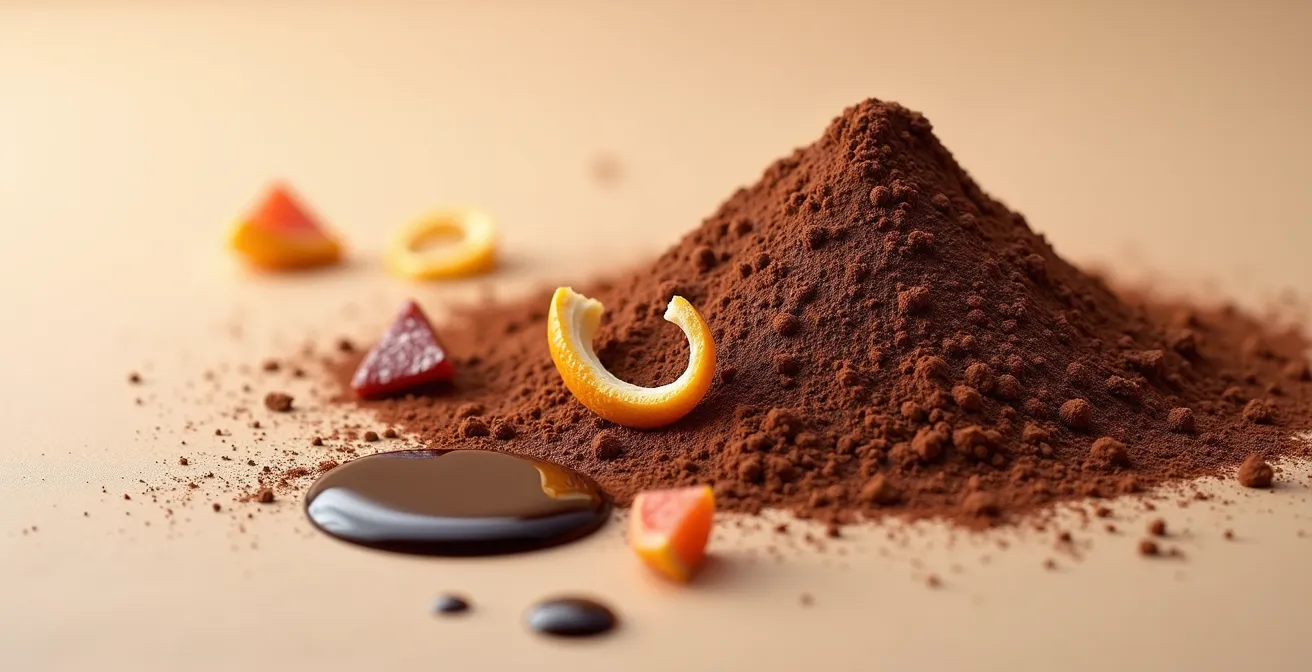
Cocoa’s acidity is not a flavor to be masked, but a functional tool to master.
- It acts as a palatal cleanser, using organic acids to cut through fat and sugar, bringing lightness and preventing palate fatigue.
- The right acidity (citric, malic) creates complexity and freshness, while the wrong one (acetic) is a defect resulting from poor fermentation control.
Recommendation: Instead of defaulting to alkalized powders, learn to leverage the terroir-specific acidity of natural cocoa as an architectural element to engineer sophisticated, dynamic tasting experiences.
There is a shared, almost universal memory among connoisseurs of fine pastry: the encounter with a chocolate dessert so overwhelmingly rich, so dense with butter and sugar, that the initial moment of pleasure quickly gives way to a cloying, monotonous heaviness. A single bite is decadent; a third is a commitment. The common response to this challenge has often been to either double down on sweetness or to retreat entirely, opting for milder, less characterful chocolates.
For decades, the prevailing wisdom has treated acidity in cocoa as an antagonist—a sharp, undesirable note to be tamed or, more often, chemically neutralized through alkalization (the “Dutch process”). This approach, however, is a profound misunderstanding. It sacrifices complexity for the sake of a flat, one-dimensional profile. It is akin to a winemaker stripping a Sauvignon Blanc of its vibrant citrus notes, leaving only a bland, sugary liquid.
But what if this perceived flaw—this bright, sometimes sharp, acidity—is not the problem, but the very solution? What if acidity, when understood and controlled, is the most sophisticated tool a pastry chef possesses to bring balance, lightness, and an evolving narrative to a rich creation? This is the central thesis we will explore. We will treat acidity not as a mere flavor note, but as an agent of sapidity and a structural component, a functional tool that can actively cleanse the palate and transform the perception of fat and sugar.
This guide will deconstruct the origins of cocoa’s acidity, from fermentation to roasting, and demonstrate how to harness it. We will explore how to distinguish desirable organic acids from fermentation defects, how to pair acidic chocolates with other ingredients to create harmony rather than discord, and ultimately, how to use it to engineer desserts that are not just rich, but truly dynamic and memorable.
Summary: Mastering Cacao’s Acidity as a Structural Element in Pastry
- Why does your chocolate sting your throat instead of evoking citrus?
- How to control the temperature of your fermentation boxes to avoid acetic acidity?
- Brazil or Ghana: which terroir offers the most vibrant acidity for your sorbets?
- The dosage error that turns fine cocoa into a common candy bar
- How to pair the acidity of a Peruvian cocoa with exotic fruits without a clash?
- How to pair an acidic Madagascan chocolate with a sweet white wine?
- Vinegar and cocoa: how to achieve the sweet and sour balance of a simmered dish?
- Heaviness problem: how an acidic ganache awakens a praline entremets?
Why does your chocolate sting your throat instead of evoking citrus?
The first step in mastering acidity is to recognize that not all acidity is created equal. There is a vast sensory chasm between the bright, pleasant tartness of a raspberry and the harsh, vinegary sting of a defect. When your chocolate possesses an aggressive, throat-burning quality, you are not tasting the noble acidity of the terroir; you are tasting the ghost of a flawed fermentation. This is primarily due to acetic acid, the same compound found in vinegar.
Desirable acidity, in contrast, comes from a family of organic acids—citric, malic, tartaric, and lactic—that evoke notes of citrus, red fruits, or green apples. These are the hallmarks of a well-fermented, high-quality cacao. The unpleasant sharpness is a sign of excessive acetic acid production, often caused by uncontrolled exposure to air and high temperatures during the fermentation process. Quality analysis data confirms this distinction, showing that high-quality cocoa, such as that from Ghana, often has a pH between 5.3 and 5.5, while beans with fermentation defects can drop to a much more acidic pH of 4.4 to 4.7, like some Malaysian cocoa.
Some industrial producers attempt to mask these off-flavors through aggressive roasting. As expert analysis on roasting practices reveals, vinegar-like acidity from acetic acid can be driven off at high temperatures, but this is a corrective measure, not a sign of quality. Roasting to hide defects often means destroying the delicate, desirable aromatic compounds in the process. The goal for a connoisseur is to source beans with a clean, vibrant organic acidity from the start, not to settle for a product that has been “fixed” and stripped of its character.
How to control the temperature of your fermentation boxes to avoid acetic acidity?
To prevent the formation of harsh acetic acid, one must go to the source: the fermentation process. This crucial post-harvest stage is where the precursors to chocolate’s complex flavor profile are developed. It is a delicate microbiological dance, and temperature is the choreographer. Uncontrolled temperature is the primary culprit behind the overproduction of acetic acid, turning potentially fine cacao into a vinegary disappointment.
The process occurs in two main phases. Initially, in an anaerobic (oxygen-free) environment, yeasts convert sugars in the pulp into ethanol. In the second, aerobic phase, bacteria take over. Lactic acid bacteria are followed by acetic acid bacteria, which convert the ethanol into acetic acid. This is a necessary step, but it must be controlled. If the temperature rises too high or there is too much oxygen, these bacteria proliferate wildly. Indeed, fermentation studies indicate that a 45-50°C peak temperature is when acetic acid bacteria become most active. Exceeding this for too long or with excessive aeration is the recipe for a sharp, unpleasant final product.
Effective control requires meticulous monitoring and intervention. It is not a passive process but an active management of heat and oxygen. The design of the fermentation boxes themselves plays a role, as does the schedule for turning the bean mass to release heat and ensure even fermentation. For producers and bean-to-bar makers, mastering this is non-negotiable for achieving a clean, complex acidity.
Fermentation Quality Control Checklist: Avoiding Acetic Defects
- Phase 1 (0-36 hours): Maintain anaerobic conditions. Ensure boxes are well-covered to encourage yeast dominance, which produces the necessary ethanol without premature acetic acid formation.
- Phase 2 (36-72 hours): Monitor the temperature rise as lactic acid bacteria become active. Use a probe to ensure the core temperature of the mass stays below the 45°C threshold.
- Phase 3 (72-120 hours): Begin turning the bean mass every 24 hours. This action releases built-up heat and controls oxygen exposure, preventing the overgrowth of acetic acid bacteria.
- Sensory Cue: Perform regular sensory checks. A distinct shift in aroma from fruity and alcoholic to a sharp, vinegary smell is a clear indicator that acetic production is becoming excessive and intervention is needed.
- Box Design: Utilize shallow, wide fermentation boxes rather than deep, narrow ones. This design promotes better natural heat dissipation and allows for more controlled and even aeration during turning.
Brazil or Ghana: which terroir offers the most vibrant acidity for your sorbets?
Once you are confident in sourcing cacao with a clean, well-managed acidity, the next layer of mastery involves understanding terroir. Just as with wine, the origin of the cacao bean—its genetics, soil, and climate—imparts a unique acidic and aromatic signature. For a creation like sorbet, where the goal is often pure, unadulterated refreshment, selecting the right terroir is paramount. Here, acidity is not just for balance; it is the very engine of vibrancy.
Different origins are known for distinct acidic profiles. For instance, cacao from Madagascar is famous for its powerful red fruit and citrus notes, a high-impact citric acidity that can make a sorbet sing. Cacao from Peru often delivers a similar bright, fruity character. In contrast, cacao from Ghana, a benchmark for classic chocolate flavor, typically presents a more moderate, balanced acidity, less sharp and more foundational. Brazilian cacao can be a wildcard, with certain varieties like Forastero from Bahia offering a more robust, earthy profile, while others can have surprising fruity undertones.
For a sorbet, the choice depends on the desired effect. If you seek a bold, zesty, and intensely refreshing experience, a high-acidity Madagascan or Peruvian natural cocoa is an excellent choice. Its inherent brightness will cut through the sweetness and amplify the sensation of cold. This is because natural cocoa powders, which have not been alkalized, retain their full acidic potential. In fact, research from antioxidant studies shows that natural cocoa’s pH of 5.3-5.8 is directly correlated with a high flavanol content (around 34.6 mg/g), linking this vibrant acidity to a richer, more complex, and potentially healthier product.
The dosage error that turns fine cocoa into a common candy bar
The antithesis of leveraging natural acidity is the widespread practice of alkalization, or the “Dutch process.” This chemical treatment uses an alkaline solution to raise the pH of the cocoa powder, resulting in a darker color and a milder, less acidic flavor. While this process has its applications, its overuse in the pursuit of a “smoother” taste is often the single error that strips a fine chocolate of its soul, reducing its potential complexity to that of a common candy bar.
The trade-off is devastatingly clear. As highlighted by researchers, the process of alkalization decimates the very compounds that contribute to chocolate’s complexity and health benefits. In a key study published in the Journal of Agricultural and Food Chemistry, Miller et al. found that natural, non-alkalized powders are the richest in polyphenols and flavanols:
Natural, nonalkalized powders had the highest total polyphenols and flavanols, showing a linear decrease as pH increased. Average total flavanol contents were 34.6 mg/g for natural cocoas versus only 3.9 mg/g for heavily processed powders.
– Miller et al., Journal of Agricultural and Food Chemistry
This is not just a nutritional loss; it is a gastronomic one. Acidity plays a crucial structural role in baking. By neutralizing it, you alter the chemistry of your recipe, often with disastrous results. Without its natural acidity to react with leavening agents or to help set proteins, baked goods can fail spectacularly.
Case Study: The Collapsing Cakes of High Altitude
The structural importance of cocoa’s natural acidity is starkly illustrated in high-altitude baking. Cookbook author Susan Purdy famously discovered that while most of her recipes worked at 9,000 feet, her chocolate cakes consistently failed. The reason? She was using Dutch-process cocoa. Its lack of acidity meant it couldn’t provide the necessary chemical reaction to help the egg proteins set quickly in the lower atmospheric pressure, leading to collapse. Similarly, a Los Angeles chef watched in horror as his chocolate biscotti melted into a puddle in the oven, a failure he later traced to the high alkalinity of the Dutch-process cocoa he was using.
How to pair the acidity of a Peruvian cocoa with exotic fruits without a clash?
Pairing a high-acidity chocolate with fruit is an exercise in chemical diplomacy. A clumsy combination can result in a discordant, “clashing” acidity that is unpleasant and overwhelming. However, a thoughtful pairing can create a symphony of flavors where each element enhances the other. The key is to move beyond generic “fruit” notes and map the specific dominant acids in both the cocoa and the fruit.
Peruvian cacao, for example, is often high in citric acid, giving it bright notes of grapefruit or lemon. Pairing this with a fruit that is also high in citric acid, like passion fruit, can be risky. While it might work, it can also create an excessively sharp, one-dimensional acidity. A more sophisticated approach is to pair it with a fruit dominated by a different but complementary acid. Mango, for instance, is rich in malic acid (also found in apples and pears), which provides a softer, more rounded tartness that can beautifully balance the sharpness of the citric acid in the cocoa.
Furthermore, sensory science shows that the perception of “chocolate flavor” itself is tied to an optimal pH. According to research by Jinap et al. in the *Food Quality and Preference Journal*, both very low and very high pH levels can diminish the core chocolatey notes. Their work revealed that beans with a medium pH of 5.20-5.49 were rated as having the strongest chocolate flavor, while low-pH beans were associated with more off-flavors. This implies that a well-balanced acidity not only tastes good on its own but is essential for the full expression of the chocolate itself.
- Identify Dominant Acids: First, taste the cocoa and identify its primary acid profile. Is it sharp and citric (lemon, grapefruit), or softer and malic (green apple, pear)?
- Select Complementary Fruits: Pair a citric-dominant cocoa with a malic-dominant fruit (e.g., Peruvian cocoa with mango) or vice-versa to create complexity.
- Factor in Ripeness: An under-ripe fruit will have a higher acid content, creating a more vibrant, high-contrast pairing. A very ripe fruit will be sweeter and can mellow the acidity of the chocolate.
- Bridge with Aromas: Look for shared secondary aromas. If your cocoa has subtle floral notes of jasmine, pairing it with lychee, which shares a similar aromatic profile, can create a seamless bridge between the two.
- Use a Neutral Buffer: If you must pair two highly acidic elements, introduce a neutral, fatty buffer like coconut cream or avocado to absorb and soften the acidic impact.
How to pair an acidic Madagascan chocolate with a sweet white wine?
Pairing chocolate with wine is notoriously challenging; pairing a high-acidity chocolate with a sweet wine is an endeavor for the true connoisseur. The risk is a battle on the palate, where the acidity of the chocolate clashes with the sugar of the wine, annihilating the subtleties of both. Yet, when executed with precision, it can be a sublime experience. The secret lies in managing temperature and creating aromatic bridges.
A high-acidity Madagascan chocolate, with its characteristic notes of red berries and citrus, needs to be handled with care. Serving a dessert made with this chocolate too warm will accentuate its sharpness. The solution is strategic chilling. Bringing the dessert to a cool 10-12°C will temper the peaks of acidity, making them more approachable. Conversely, a fine sweet white wine, like a German Riesling Beerenauslese or a French Sauternes, should be served slightly warmer, around 12-14°C. This subtle temperature difference prevents the wine’s sweetness from being muted by excessive cold and allows its complex aromatics to unfurl.
The choice of wine is critical. You can opt for a complementary pairing, selecting a high-acid sweet wine like a Riesling, where the wine’s acidity will resonate with and enhance the chocolate’s brightness. Alternatively, a contrast pairing with a botrytis-rich Sauternes can work beautifully, with the wine’s honeyed, decadent richness providing a luxurious counterpoint to the cocoa’s sharp edge. To ensure a seamless transition, a “bridge ingredient”—a component sharing aromatic compounds with both the wine and the chocolate, like apricot or passion fruit—is indispensable.
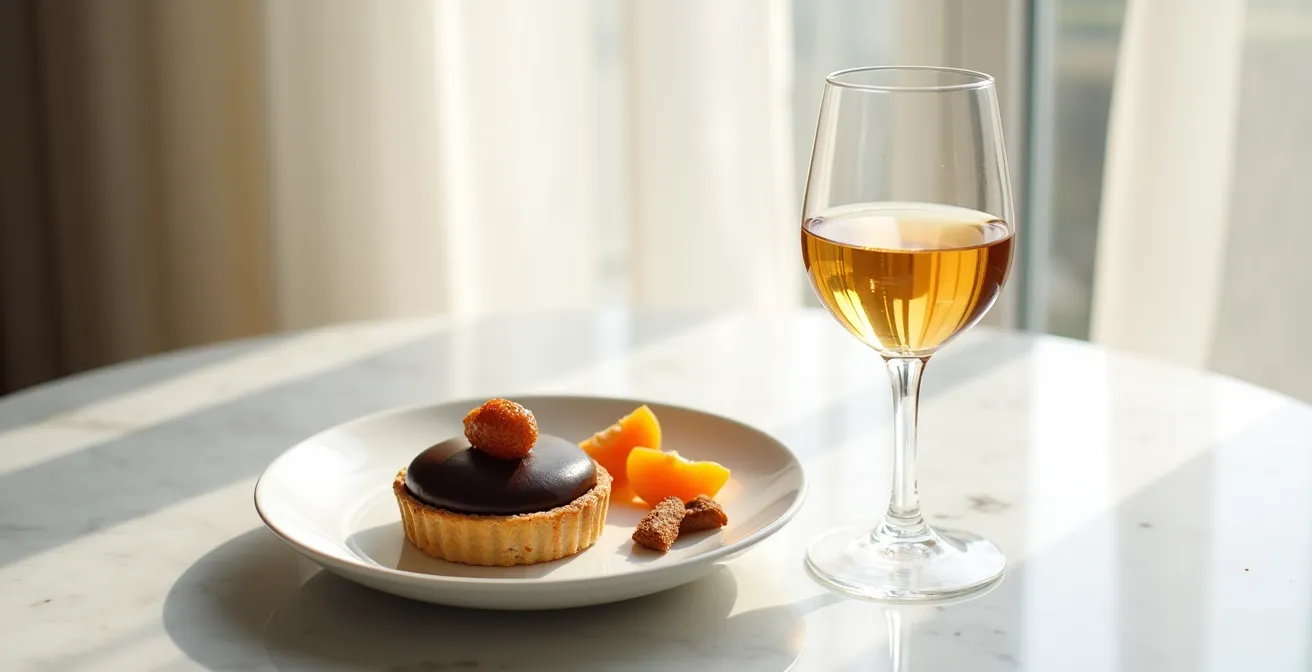
As seen in this composed setting, the elements are not merely placed together but are orchestrated. The gloss of the dark chocolate tart hints at the intensity within, while the golden hue of the wine promises luscious sweetness. The artfully arranged apricot slices are not just garnish; they are the diplomatic link, the aromatic handshake that ensures the pairing is a harmonious dialogue rather than a shouting match. This level of control transforms a simple dessert into a curated sensory journey.
Vinegar and cocoa: how to achieve the sweet and sour balance of a simmered dish?
The functional power of cocoa’s acidity extends far beyond the realm of pastry. In savory cooking, particularly in long-simmered dishes, stews, and sauces like Mexican mole, unsweetened, high-acidity cocoa is an ingredient of profound complexity. Here, its role is not to make the dish “chocolatey,” but to provide depth, bitterness, and a foundational acidic structure that can balance richness and tie other flavors together.
When combining cocoa with other acidic elements like vinegar or tomatoes in a savory sauce, the goal is to create a layered, “sweet and sour” profile where no single note dominates. The raw, often harsh acidity of the uncooked cacao bean is tamed and transformed through cooking. The Maillard reaction and caramelization that occur during prolonged simmering play a similar role to roasting, mellowing sharp notes and developing new, complex flavor compounds. The raw acidity vaporizes, while the browning reactions create the deep, resonant flavors we associate with a well-made stew.
This process is essential; without it, the dish would be unbalanced and harsh. As food scientists explain, the Maillard reaction during heating is what generates the characteristic chocolate flavor and aroma. Without this thermal transformation, cacao beans would retain their raw, intensely bitter, and sharply acidic profile. In a simmered dish, this slow cooking process allows the cocoa’s acidity to meld with the fats from the meat and the sweetness of other ingredients (like onions or dried fruit), creating a final product that is dark, mysterious, and impeccably balanced.
The cocoa acts as a low-level, resonant bass note, a foundation of earthy bitterness and acid upon which the brighter notes of vinegar, chiles, and spices can be built. It is the secret to the profound, lingering complexity that defines many of the world’s greatest slow-cooked dishes.
Key Takeaways
- Acidity isn’t a single flavor; it’s a spectrum from the desirable organic acids (citric, malic) of fine terroir to the defective acetic acid from poor fermentation.
- Mastered acidity acts as a functional tool: it cleanses the palate of fats, enhances fruit notes, and provides structural balance to rich desserts, preventing palate fatigue.
- Alkalization (Dutch processing) destroys not only acidity but also a significant portion of flavanols, sacrificing complexity for a flatter, one-dimensional flavor.
Heaviness problem: how an acidic ganache awakens a praline entremets?
We return to our original problem: the overwhelmingly rich dessert. Consider a classic praliné entremets—a construction of hazelnut, sugar, and butter. It is delicious but can quickly become dense and heavy on the palate. The solution, guided by our new understanding, is not to add more sugar or a blandly “smooth” chocolate. The solution is a counter-intuitive strike: the introduction of a deliberately acidic ganache.
This is where acidity performs its most magical function: palatal cleansing. The sensation of “heaviness” or “richness” is largely due to fats coating the tongue and mouth, dulling the taste buds. The organic acids present in a high-quality natural cocoa trigger a physiological response: they stimulate salivation. This saliva physically washes away the fatty coating, resetting the palate with each bite. The dessert feels instantly lighter, more dynamic, and less cloying. The acidic ganache doesn’t just add a new flavor; it fundamentally changes the physical experience of eating the dessert.
The visual contrast itself can signal this sensory experience. A layer of dark, glossy, fluid ganache atop a dense, matte praline base suggests a textural and flavorful dialogue. This contrast prevents monotony and keeps the palate engaged. The bright, sharp notes of the ganache cut through the deep, roasted sweetness of the praline, creating a complete and evolving flavor profile in a single mouthful. It moves the dessert from being static and monolithic to being a narrative that unfolds on the tongue.
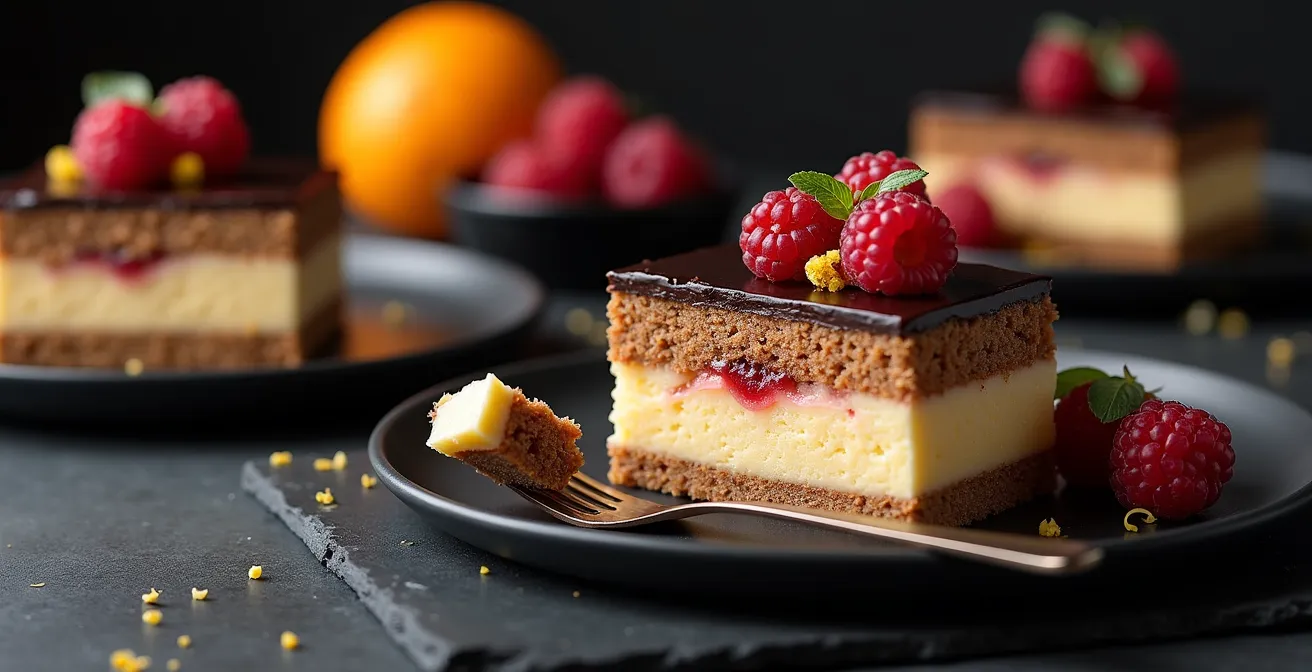
This is the pinnacle of mastering acidity. It is not about masking or merely balancing; it is about using acidity as an active, architectural tool to engineer a specific sensory effect. By understanding its function, you transform a potential flaw into your most powerful ally in the pursuit of a truly sophisticated and memorable dessert.
Frequently Asked Questions About Cocoa Acidity
What type of acid works best for cutting through praline sweetness?
Citric acidity (with its characteristic citrus notes) provides the maximum cleansing effect for an overly sweet praline, offering a sharp, refreshing contrast. Malic acidity (evoking apple or pear notes) is generally better suited for balancing excessive fattiness, providing a softer, more rounded counterpoint.
How does ganache acidity physically affect the palate?
The organic acids present in natural cocoa stimulate the salivary glands. This increased saliva production acts as a natural solvent, physically washing away the fatty, oily coating left on the tongue by ingredients like praline and butter. This process effectively “resets” your taste perception, making each bite feel fresh and preventing palate fatigue.
Can texture contrast enhance the perception of lightness?
Absolutely. A smooth, fluid, and slightly cool acidic ganache provides a stark textural contrast to a dense, crunchy, or crumbly praline layer. This sensory variation makes the overall dessert feel more dynamic and less monolithic in the mouth, which the brain interprets as being less heavy and more interesting.