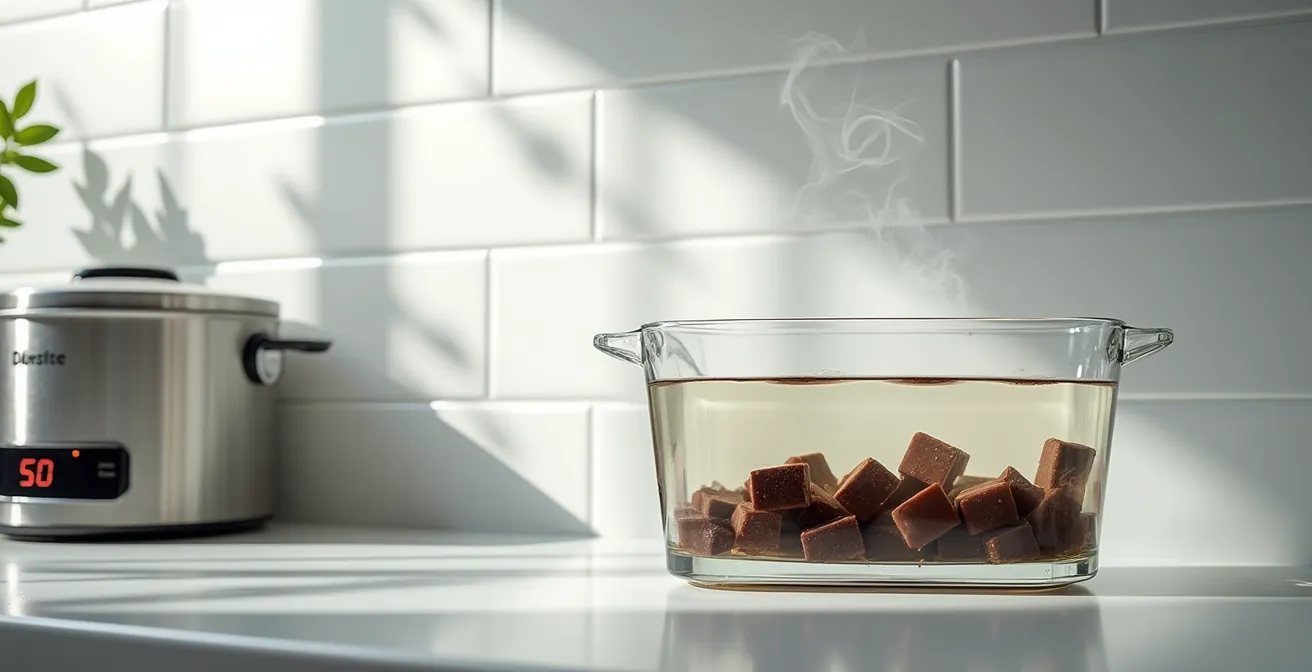
The greatest risk in advanced chocolate work—seizing from moisture—can be completely neutralized by using sous-vide as a precision laboratory tool.
- Sous-vide provides absolute temperature control, allowing for targeted flavor extraction and emulsion stability.
- By manipulating the chocolate’s environment in a sealed bag, you can introduce aromas like smoke or age it without direct contact.
Recommendation: Master the concept of Water Activity (Aw) first; it’s the fundamental principle that unlocks all advanced, moisture-safe chocolate techniques.
For any culinary experimenter, chocolate represents both a universe of possibility and a precipice of failure. We’ve all been there: a single, errant drop of water transforms a glossy, fluid pool of potential into a gritty, seized disaster. This fear has traditionally walled off some of the most exciting flavor frontiers, like infusing delicate aromas or creating ultra-light emulsions. Conventional wisdom tells us to simply keep water away at all costs, a sound but limiting piece of advice.
But what if the solution wasn’t avoidance, but absolute control? What if you could harness the very properties of heat and water to your advantage, without the risk? This is where we move beyond the kitchen and into the laboratory. The key isn’t a new ingredient, but a new methodology: sous-vide. Used not just for gentle heating but as a high-precision environmental chamber, sous-vide allows us to manipulate chocolate on a molecular level. It’s the tool that lets us hack chocolate’s fundamental properties to achieve textures and infusions previously deemed impossible or too risky for even a seasoned chef.
This guide will deconstruct the science behind these advanced techniques. We will explore how to cold-smoke chocolate without melting it, stabilize dairy-free sauces, create impossible textures like molecular chantilly, and even use sous-vide to rapidly mature chocolate, transforming its flavor profile in hours instead of months. It’s time to stop fearing moisture and start controlling it with scientific precision.
Summary: Beyond Tempering: How to Use Sous-Vide to Infuse Chocolate Without the Risk of Seizing
- Beechwood or Hay: How to Add Smoky Notes Without Melting the Bar?
- How to Stabilize a Light Chocolate Sauce Without Butter or Cream?
- Chocolate and Water Only: How to Succeed with Molecular “Chantilly Chocolate”?
- The pH Mistake with Fruit Juices That Makes Experimental Ganache Curdle
- Jar or Cigar Humidor: How to Mature Chocolate to Round Out Its Tannins?
- Why Is Measuring Free Water Vital to Prevent Mold in Your Confections?
- Floral vs. Earthy: Why Do Some Aromas Evaporate Faster Than Others?
- Why Dark Chocolate Is the Secret Ingredient in Authentic Italian Agrodolce?
Beechwood or Hay: How to Add Smoky Notes Without Melting the Bar?
Infusing smoke into chocolate seems like a paradox; the heat required for traditional smoking would destroy its delicate temper and texture. The solution lies in separating the smoke generation from the infusion environment, a process known as cold smoking. Here, the chocolate never comes into contact with the heat source. Instead, you use the sous-vide bag as a sealed vessel to trap cool smoke in close contact with the chocolate.
The choice of wood is critical. A robust wood like mesquite would overwhelm the chocolate’s profile. Instead, look to traditions that value subtlety. Premium Black Forest ham producers, for example, use beechwood exclusively for its mild, sweet, and nutty profile that complements, rather than overpowers, delicate flavors. Hay is another excellent option for imparting sweet, grassy notes. The process requires patience, as true flavor penetration happens over time, not with intense heat.
To execute this, place your chocolate in a large vacuum-sealable bag. Using a smoking gun, fill the bag with cool smoke from beechwood chips or hay, leaving enough space so the chocolate isn’t crowded. Seal the bag immediately, trapping the smoke inside. Let it infuse at a cool room temperature (or even in the refrigerator) for 24 to 48 hours. The sealed environment ensures a deep, consistent infusion without any risk of melting or textural damage, allowing you to create a truly unique confection with deep, aromatic complexity.
How to Stabilize a Light Chocolate Sauce Without Butter or Cream?
A classic chocolate sauce owes its rich, glossy texture to an emulsion of fat (from butter or cream) and water. Removing these dairy components for a lighter or vegan sauce presents a significant challenge: how do you create that same stable, luxurious mouthfeel? The answer lies in the world of molecular gastronomy, specifically with hydrocolloids.
Hydrocolloids are long-chain molecules, like xanthan gum or agar-agar, that have an incredible ability to trap and organize water. When whisked into a simple chocolate and water mixture, they form a microscopic web or matrix. This matrix prevents the water and cocoa solids from separating, effectively mimicking the emulsifying properties of fat. The result is a sauce that is surprisingly rich and viscous, yet contains no dairy at all. A tiny amount—often less than 1% of the total weight—is enough to achieve a perfectly stable and glossy texture.
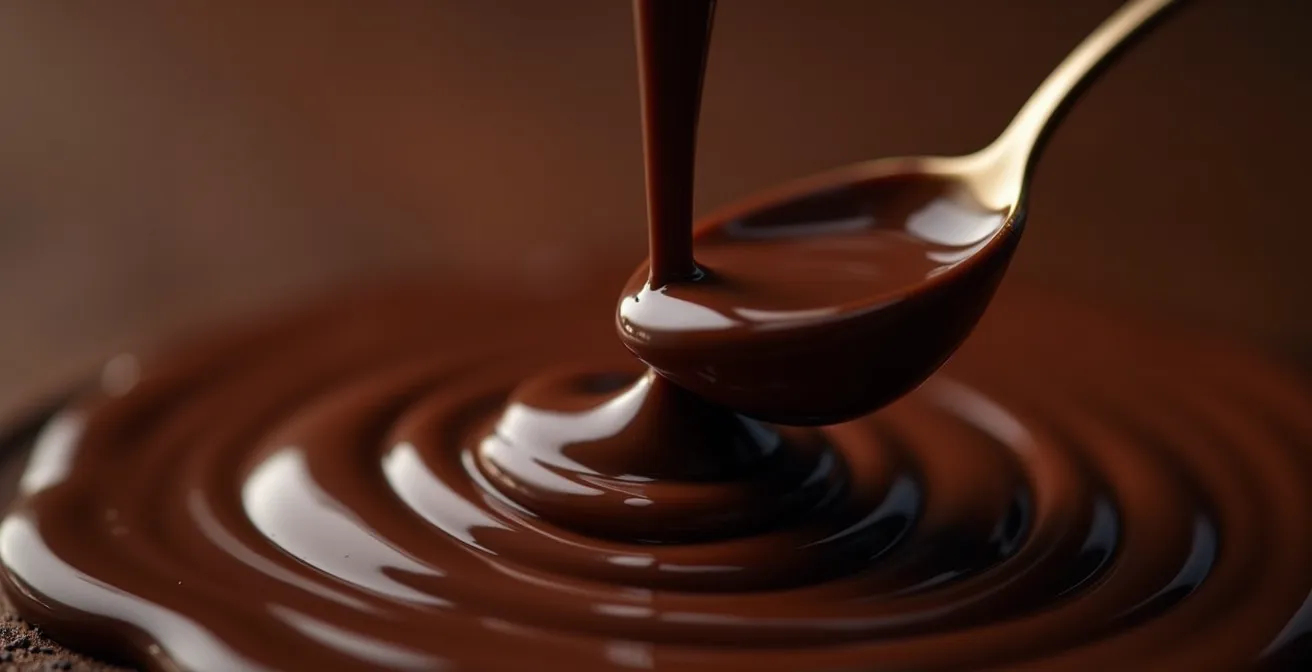
As the image above demonstrates, the result is a perfectly smooth and flowing sauce with an elegant sheen, indistinguishable from its dairy-based counterpart. Experimenting with different hydrocolloids can also fine-tune the final texture, from the fluid consistency of xanthan gum to the more gel-like structure provided by agar-agar. This technique fundamentally decouples texture from fat content, opening up a new world of light yet decadent chocolate creations.
Chocolate and Water Only: How to Succeed with Molecular “Chantilly Chocolate”?
The idea of whipping chocolate and water into a light, airy mousse—with no cream, eggs, or stabilizers—was pioneered by French physical chemist Hervé This. It sounds impossible, but it works by creating a perfect emulsion and then incorporating air. Success hinges on one factor: precise temperature control, which is where sous-vide becomes an indispensable tool. The goal is to melt the chocolate just enough to form an emulsion with water, without overheating it, which would cause the final texture to be grainy.
The process starts by combining high-quality dark chocolate (at least 70% cacao) and water in a bowl. Using a sous-vide circulator, a pre-melting temperature of 50°C (122°F) ensures a homogenous base, fully melting the cocoa butter’s crystals to facilitate a stable emulsion. Once the mixture is uniform, it’s placed over an ice bath and whisked vigorously. As the mixture cools, the cocoa butter begins to recrystallize around the water droplets, trapping them and creating a stable emulsion. Continued whisking incorporates air, and just like whipping cream, the mixture thickens and forms soft peaks. The result is a “chantilly” with an intensely pure chocolate flavor and an ethereal, melt-in-your-mouth texture.
Action Plan: Achieving Perfect Molecular Chantilly
- Ingredient Ratio: Start with a precise 2:1 ratio by weight of high-quality dark chocolate (70%+) to water. This is non-negotiable for the emulsion to form correctly.
- Controlled Melting: Combine chocolate and water in a sous-vide bag or a bowl set over a water bath controlled by an immersion circulator at exactly 50°C (122°F). Hold until completely melted and homogenous.
- The Shock & Emulsify: Prepare a large bowl filled with ice and a little water. Place the warm chocolate bowl inside it and begin whisking immediately and vigorously with a balloon whisk.
- Monitor for Transformation: Continue whisking as the mixture cools. You will feel the moment it begins to thicken—this is the emulsion forming. Keep whisking to incorporate air.
- The Final Whip: Once it reaches the consistency of softly whipped cream, stop. Over-whipping will make it grainy as the cocoa butter crystallizes too much. Serve immediately.
The pH Mistake with Fruit Juices That Makes Experimental Ganache Curdle
Adding a vibrant fruit flavor to a ganache is a common goal, but it often ends in a separated, grainy mess. This failure is typically not due to the water content of the juice, but its acidity. A traditional ganache is a delicate emulsion of fat (from cocoa butter and cream) and water. The proteins in the dairy act as stabilizers. However, these proteins are highly sensitive to pH levels. When you introduce a highly acidic liquid like passion fruit or lemon juice, the low pH denatures the proteins, causing them to clump together and lose their ability to hold the emulsion. The ganache “breaks” or curdles.
To create a successful fruit ganache, you must manage the acidity. One method is to use a less acidic fruit puree or to buffer the acidity of the juice by adding a small amount of sodium citrate before incorporating it into your cream. Another approach is to create a “water ganache” (using water instead of cream), which is less prone to curdling as it contains fewer proteins. In all cases, adding the acidic element slowly and at a controlled temperature can help maintain the stability of the emulsion.
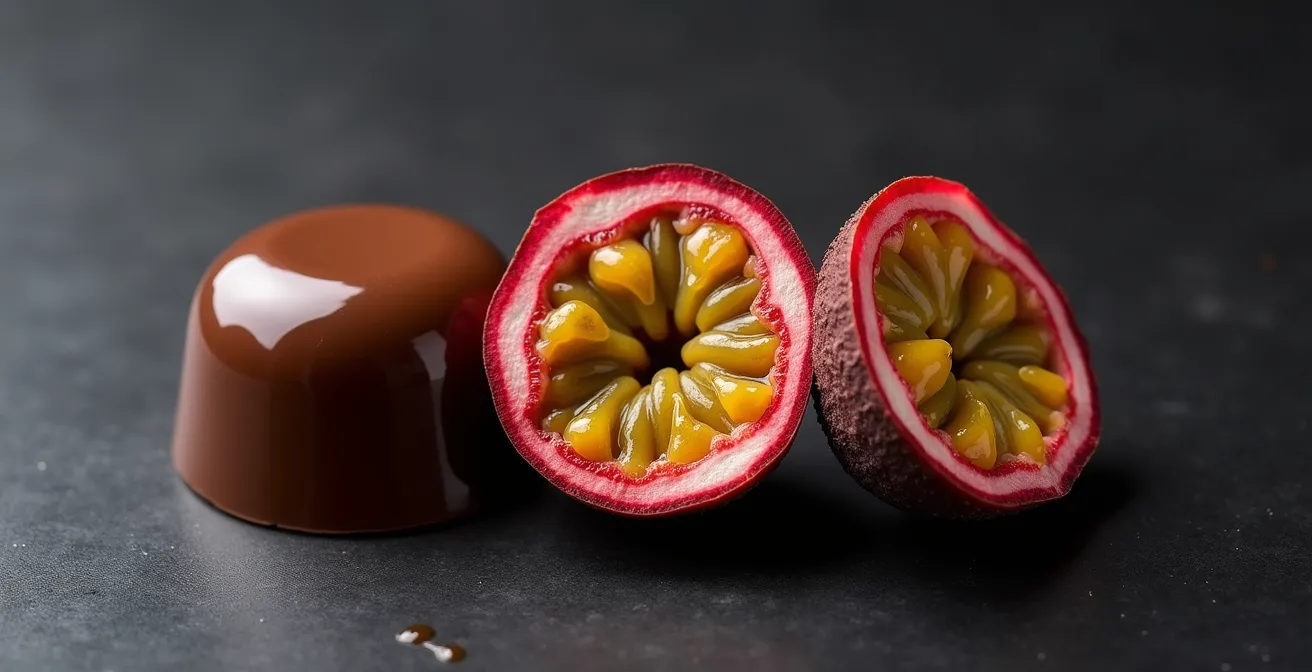
Furthermore, adding any water-based ingredient increases the overall “water activity” of the confection, which has implications for shelf life. As Barry Callebaut research confirms, below a water activity of 0.6 Aw, all microbial growth is completely inhibited. Introducing fruit juice raises this value, making it a critical factor to consider not just for texture, but for food safety.
Jar or Cigar Humidor: How to Mature Chocolate to Round Out Its Tannins?
Like fine wine or whiskey, high-quality chocolate possesses tannins (a type of polyphenol) that contribute to its astringency and complexity. Over time, these compounds can mellow, leading to a rounder, more harmonious flavor profile. Traditional aging involves storing chocolate for months in a cool, dark, stable environment like a wine cellar or cigar humidor (around 16-18°C and 60-70% humidity). This slow process allows for subtle enzymatic and oxidative changes. But what if you could achieve a similar effect in a fraction of the time?
This is another area where sous-vide shines, offering a method for accelerated aging. By vacuum-sealing a chocolate bar and placing it in a precisely controlled low-temperature water bath, you can speed up these chemical reactions. While not identical to slow aging, this technique transforms the flavor profile in fascinating ways. For instance, controlled sous-vide maturation at 40°C (104°F) for 24-72 hours mimics months of traditional aging, softening sharp notes and integrating flavors.
It’s important to understand that this is a transformative, not just a mellowing, process. As culinary author Jacob Grier notes on the topic of sous-vide infusions:
The heating can affect both the flavoring agents and the liquids being infused – a raw apple tastes different than a baked apple. The temperature used in the infusion will affect different foods at different levels.
– Jacob Grier, Amazing Food Made Easy – Sous Vide Infusion Guide
This “cooking” effect at low temperatures creates new, complex flavor compounds, offering a different but equally valid path to a more developed chocolate. It’s a powerful tool for the impatient experimenter looking to quickly evolve a chocolate’s character.
Why Is Measuring Free Water Vital to Prevent Mold in Your Confections?
Shelf stability is a primary concern for any chocolatier. While we often focus on ingredients and temperature, the single most critical factor for preventing microbial growth (like mold and yeast) is an invisible force: Water Activity (Aw). This isn’t a measure of the total amount of water in a product, but rather the amount of “free” or “available” water that microbes can use to grow. A completely dry cracker and a sugary jam might have very different water contents, but both can be shelf-stable if their water activity is low.
In chocolate confections, ingredients like fruit purees, caramels, and cream fillings all introduce water. The sugar and fats in these fillings bind some of that water, lowering the Aw. However, if there is enough free water, the confection becomes a breeding ground for spoilage. Pure chocolate itself has a very low Aw (around 0.3-0.5), making it inherently stable. The danger comes from the fillings. Measuring and controlling the Aw of your ganaches and creams is therefore not just a quality control step—it’s the fundamental basis of food safety and achieving a viable shelf life.
This is especially critical when developing new recipes with unconventional ingredients. As a comparative analysis of confectionery safety shows, crossing certain Aw thresholds directly correlates to specific microbial risks. The following table breaks down these critical levels.
| Water Activity (Aw) | Microbial Status | Product Examples |
|---|---|---|
| 0.30-0.50 | No microbial growth possible | Pure chocolate, cocoa powder |
| 0.60-0.83 | Only osmophilic yeasts/xerophilic molds | Caramels, cream fillings |
| 0.85+ | Pathogenic bacteria can grow | Fresh fruit inclusions |
| Below 0.60 | 12+ months shelf life achievable | Most chocolate confections |
Floral vs. Earthy: Why Do Some Aromas Evaporate Faster Than Others?
When infusing flavors into chocolate, not all aromas are created equal. You may find that a delicate floral note from rose petals vanishes quickly, while the earthy scent of a vanilla bean lingers. This phenomenon is due to the varying volatility of aromatic compounds. Volatility refers to a substance’s tendency to vaporize. Aromas are simply volatile molecules that we perceive through smell.
These compounds can be broadly categorized:
- Top Notes: These are highly volatile, small molecules that evaporate quickly. They are responsible for the initial burst of scent and are often described as floral, citrusy, or herbaceous (e.g., linalool in lavender, limonene in lemon). They are very sensitive to heat.
- Base Notes: These are larger, heavier, less volatile molecules. They evaporate slowly and provide the lasting foundation of a flavor profile. They are often earthy, woody, or resinous (e.g., vanillin in vanilla, geosmin which gives beets their earthy smell). Many are also fat-soluble, meaning they bind well to the cocoa butter in chocolate.
Sous-vide gives us the precision to target these different compounds. For delicate top notes, a very low and short infusion is required. As precision temperature control reveals, an infusion at 45-50°C (113-122°F) for just 1-2 hours captures delicate florals before they degrade or evaporate. Conversely, for robust base notes, a higher temperature and longer time can be used to achieve a deep, rich extraction, as the compounds are stable enough to withstand it. This is why a sous-vide bourbon infusion with chocolate and pecans at a higher temperature results in a complex spirit that retains its nutty and chocolatey depth.
Key Takeaways
- Water Activity (Aw) is the single most important metric for controlling the shelf life and safety of chocolate confections.
- Precision temperature control via sous-vide allows you to selectively extract flavor compounds based on their volatility—low temps for delicate florals, higher temps for robust earthy notes.
- Sous-vide transforms the chocolatier’s work from cooking into a form of materials science, enabling the creation of stable emulsions and unique textures impossible with traditional methods.
Why Dark Chocolate Is the Secret Ingredient in Authentic Italian Agrodolce?
The inclusion of dark chocolate in a savory sauce like the Italian Agrodolce (sweet and sour) often perplexes those unfamiliar with its classic formulation. The secret is that the chocolate is not there for sweetness, but for depth, complexity, and texture. In this context, chocolate acts as a powerful finishing ingredient, much like a knob of butter (monter au beurre) in French cuisine.
A high-quality dark chocolate (70% cacao or higher) contributes several key elements:
- Bitterness: It adds a pleasant, bitter counterpoint that balances the sweetness of sugar or honey and the sharpness of the vinegar.
- Umami & Depth: Fermented cacao beans contain compounds that contribute a savory, umami-rich background note, adding immense complexity to the sauce.
- Emulsifier: The cocoa butter in the chocolate helps to emulsify the sauce, giving it a glossy sheen and a velvety, more viscous texture that coats food beautifully.
This principle of using cocoa butter as a vehicle for savory flavor is being pushed to new limits in modern cuisine, often with the help of sous-vide.
Case Study: Chef Martin Lippo’s Coffee-Infused Cocoa Butter
In his advanced culinary courses, Chef Martin Lippo demonstrates a technique for creating coffee-infused cocoa butter using sous-vide. By infusing coffee beans into pure cocoa butter at a precisely controlled low temperature, he extracts the complex, aromatic, and bitter notes of the coffee without any of the acrid flavors that would result from high heat. This resulting fat becomes a powerful building block for savory dishes, demonstrating how cocoa butter can act as a sophisticated carrier for non-sweet flavors—a principle directly applicable to the role of chocolate in Agrodolce.
This sophisticated use shows that chocolate, when stripped of its sugary connotations, is one of the most versatile ingredients in the savory pantry.
Your culinary lab awaits. These techniques are not just recipes; they are a new set of rules for manipulating flavor and texture. Start by choosing one concept from this guide—perhaps the molecular chantilly or a simple cold-smoke infusion—and begin your own chocolate experiments. The path from kitchen geek to R&D chef starts with that first, fearless step into the science of confection.